Xi's US Visit Is a Pressure Test for Every Asian Ally
Xi Jinping's first US state visit in 11 years aims to freeze tensions, but de-escalation between Washington and Beijing sends shock waves through Asian capitals and remaps the global chip supply chain.
A Truce With Strings
Xi Jinping boarded a special flight from Beijing Capital International Airport on September 23, heading to Washington for what amounts to the most consequential US-China summit in more than a decade. His last state visit was in 2015, during the Obama administration. The May 2025 meeting in Beijing with Donald Trump was only the second top-level encounter since then, and now the roles are reversed: Xi arrives as the guest, carrying a corporate delegation that reads like a roster of China’s technological ambitions — BYD, CATL, Xiaomi, and others.
The shorthand from Beijing is “constructive strategic stability.” It is a phrase Chinese officials have been deploying with growing frequency since the May summit, and state media produced a explainer video on the concept just days before Xi’s departure. The idea is simple on paper: manage competition within bounds, prevent disagreements from spiraling into conflict, and buy time for both sides. What the phrase conceals is the asymmetry of need. China is the one that needs the breathing room more.
Beijing is wrestling with a prolonged property downturn, weakening domestic demand, and the political calculus of the 20th Party Congress next autumn, where Xi’s fourth term will be formalized. John Chen, who directed China affairs at the National Security Council, told Reuters that Xi is not seeking dramatic concessions but rather an extension of a gentleman’s agreement with Trump. The message from the Chinese side is clear: stabilize the relationship, contain the damage, and focus on what matters domestically.
But stabilization is never neutral. When the two largest economies pause their fight, everyone else recalibrates.
The Tariff Clock
The most concrete deadline hanging over this trip is November 10, when the current tariff truce expires. Both sides want an extension. Jamieson Greer, the US Trade Representative’s deputy representative, acknowledged the desire but warned that a deal this week is unlikely. The gap is real. On one side, American manufacturers and retailers want certainty on duties that have reshored some supply chains while inflating costs on others. On the other, China wants to lock in access to American agricultural purchases and keep the broader framework from unraveling.
What will likely emerge is a messy extension — perhaps six months, perhaps a year — with vague language that both sides can sell domestically. That is the point of “strategic stability” in practice: agreement on the shape of the disagreement, not on its resolution.
The Rare Earths Lever
Rare earths are the quiet center of gravity in these negotiations. The United States has complained openly that Chinese rare earth supplies have not been flowing smoothly since the truce began. China’s grip on the processing of these critical minerals — roughly 60 percent of global mining and nearly 90 percent of processing — gives Beijing a potent bargaining chip. It is also the very chokepoint the United States has been trying to reduce for years.
China is unlikely to loosen that grip. The more probable play is the reverse: use rare earth supply as leverage to extract concessions on US restrictions targeting Chinese advanced semiconductor and AI industries. The logic is straightforward. If Washington wants stable supply of minerals that underpin everything from F-35 components to EV batteries, Beijing can price that stability accordingly. The question for the rest of the world is whether other suppliers — Australia, Vietnam, Canada — can fill the gap fast enough to make Chinese leverage matter less.
The answer so far is no. CATL and BYD traveling to Washington is not coincidental. These companies sit at the center of the battery and EV supply chain that depends on rare earths and Chinese processing. Their presence signals that Beijing intends to anchor its diplomatic arguments in industrial reality, not just rhetoric.
Taiwan: Not a Bargaining Chip, but a Boundary
Taiwan remains the line Beijing refuses to let be crossed. Xi warned Trump in May that mishandling the issue could push relations to “a very dangerous point.” The question now is whether Trump will go further than the long-standing US position of not supporting Taiwanese independence — a phrase that has served as diplomatic friction buffer for decades — toward explicitly opposing independence.
Chinese experts are split on whether Taiwan can be traded. Dawei of Tsinghua’s Center for Strategic and Security Studies drew a hard line, saying Beijing did not put Taiwan on the table in May and will not do so now. Wu Xinbo of Fudan University pushed back, arguing that US-China relations have become increasingly transactional and that reciprocity could apply to Taiwan as well.
The more useful way to read this is through what both sides actually want. China wants the United States to constrain its military cooperation with Taipei and slow the sale of advanced weapons. The US wants China to stop coercing Taiwan economically and militarily. These are not easily swapped. But they can be quietly managed — which is exactly what “strategic stability” implies. An understanding that Taiwan will not be discussed openly, even as its status remains the unspoken floor beneath every other conversation.
The Ally Calculus
For Japan, South Korea, the Philippines, and Australia, the Xi-Trump reset is a problem wrapped in an opportunity. The opportunity is simpler: reduced immediate tension between Washington and Beijing means less risk of a sudden crisis that could draw them into a conflict they did not choose. The problem is harder to name.
Asian allies have built their security architectures around the assumption that the United States would treat China as a strategic competitor. Japan’s rearmament, South Korea’s THAAD deployment, the Philippines’ expansion of military bases, Australia’s AUKUS participation — these were all moves made in a climate where rivalry was assumed and escalation was a real possibility. A Trump-Xi détente complicates that logic. If the two powers are settling into a managed competition, the burden of containing China shifts more heavily onto regional partners. That could mean more pressure on Tokyo and Seoul to increase defense spending without the same level of US reassurance. Or it could mean Washington expects allies to shoulder more of the Taiwan burden while it focuses on the Middle East and Europe.
The corporate delegation accompanying Xi also carries implications. BYD’s presence signals China’s intent to dominate the next generation of automotive supply chains, not just through manufacturing scale but through direct investment in markets that have historically resisted Chinese EVs. CATL’s inclusion underscores the battery supply chain as the new theater of competition — one where the US has been pushing allies to diversify away from Chinese dependence and is now asking them to live with a truce that leaves Chinese firms in place.
What Comes Next
Nothing announced in Washington this week will resolve the underlying tensions. The tariff truce will be extended in some form. Rare earth supplies will remain a point of friction rather than a solved problem. Taiwan will stay on the shelf, carefully covered. The corporate delegation will return home with handshake agreements that are harder to translate into contracts.
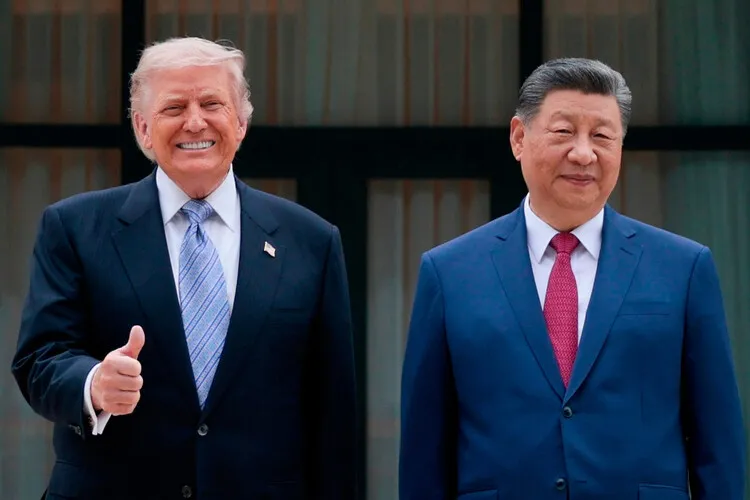
What changes is the atmosphere. Eleven years after the last state visit, the visual of Xi and Trump standing together carries weight beyond whatever agreements are signed. It signals that the default assumption in global economics — that US-China relations are on a collision course — has been replaced, however provisionally, by the assumption that the collision can be delayed.
For Asian allies, delay is neither comfort nor threat. It is a condition they must learn to live with. The structures built for confrontation will not simply disappear, but they will be tested by a period of managed uncertainty that could last months or years. The real question is whether those structures were designed for competition — and whether they can flex without breaking when the competition is paused rather than won.