Xiaomi Is Betting Its Chip Ambitions on a New AI Frontier
Xiaomi unveiled three custom silicon chips aimed at smartphones, edge AI, and autonomous driving — a bold move into territory dominated by Nvidia and AMD. What it signals about China's chip ambitions, and why Western rivals should pay attention.
The Announcement Nobody Will Forget
On August 24, Xiaomi did something that should have sent shockwaves through the semiconductor industry. The Chinese smartphone maker unveiled three custom-designed chips — a flagship smartphone SoC called XRING O3, an edge AI accelerator named XRING O100, and an autonomous driving SoC designated XRING D100. But the real headline was the O100, a chip boasting 1.22 terabytes per second of memory bandwidth, built with a wafer-on-wafer stacking technique that represents a significant packaging innovation.
Why does this matter? Because it signals China’s push for semiconductor self-sufficiency is moving beyond smartphones and into the most strategically sensitive corner of the chip industry: artificial intelligence.
The Numbers Are Impressive — But the Timeline Isn’t
The XRING O3 is already in production. It scores 5.22 million on AnTuTu Benchmark V11, runs at 3 nanometers, packs 24 billion transistors onto a 133-square-millimeter die, and is scheduled to power Xiaomi’s upcoming 18 Fold smartphone and Pad 9 Pro Max tablet. Its NPU delivers 200 TOPS of AI performance, and its GPU is claimed to be 85 percent faster than the previous generation while using 64 percent less power at equivalent performance.
The O100 and D100 tell a different story. Both are still in development and not expected to reach commercial use until 2027. That two-year gap is critical. By the time these chips ship, Nvidia and AMD will likely have released next-generation AI accelerators that are significantly more capable. Xiaomi is betting that the cost advantage and performance-per-watt gains from its packaging approach will close the gap.
The O100’s bandwidth figure — 1.22 TB/s — is genuinely eye-catching. Traditional processors often hit a wall when running large AI models at the edge because data transfer speed becomes the bottleneck. Xiaomi solved this by stacking memory directly on top of the compute die using hybrid bonding, achieving a through-silicon via hole diameter of just 0.7 micrometers and a bonding pitch of 1.4 micrometers. This is the kind of advanced packaging that requires significant R&D investment and manufacturing expertise.
The Tablet Prototype Raises Questions
Xiaomi showed off a tablet prototype that supposedly combines the O3 and O100 for cooperative computing. It runs a 295 tokens-per-second inference speed using Xiaomi’s MiMo edge model. But there’s a problem: the tablet’s cooling system dissipates only 10 watts. An O100 chip that generates even modest heat would struggle to operate at full capacity in that thermal envelope.
This suggests the O100 inside the tablet may be operating at a fraction of its rated performance, or the system relies on offloading heavier inference work to other devices. Xiaomi didn’t clarify this, which is a notable omission. If the company is trying to sell these chips to other manufacturers, it needs to be transparent about real-world thermal constraints.
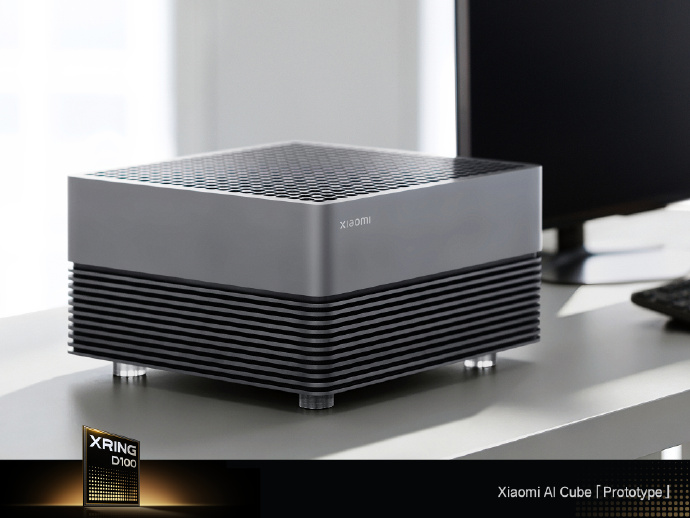
The AI Cube mini PC prototype, by contrast, features all three chips and claims 150 watts of thermal dissipation through an aluminum alloy chassis with over 33,000 CNC-machined ventilation ports. It can run both a 120-billion-parameter model and a 3-billion-parameter model simultaneously. That’s useful for developers, but it’s also a niche product that doesn’t scale to the enterprise AI market where margins are highest.
Why the OK Sign Matters
There’s a small detail that tells you everything about Xiaomi’s brand strategy. If you look at the XRING O3 die under a microscope, you can see a 60-micrometer “OK” hand gesture etched into the silicon. It’s a playful nod to the meme that emerged after Xiaomi CEO Lei Jun mistakenly said “Are you OK?” at an Indian product launch in 2015. What started as an embarrassing gaffe became a cultural phenomenon in China, and Xiaomi has now officially adopted it as part of its design language.
This isn’t trivial. Xiaomi is building a brand that feels human and culturally aware, not just technically competent. In an industry where companies like Intel and Qualcomm still present themselves as faceless engineering firms, this kind of personality could matter — especially if Xiaomi wants to compete in consumer-facing AI hardware where brand perception drives purchasing decisions.
The Geopolitical Subtext
The United States has maintained strict export controls on advanced AI chips to China since 2022, banning sales of its most powerful accelerators and restricting manufacturing equipment that could produce chips below certain performance thresholds. China’s response has been a massive state-backed push toward self-sufficiency, investing hundreds of billions in domestic semiconductor capabilities.
Xiaomi’s entry into AI accelerator design is part of that strategy. It’s not the first Chinese company to attempt this — Huawei has been making inroads with its Ascend series — but it’s significant because Xiaomi brings massive scale in consumer devices. If it can deploy its own chips across millions of smartphones, tablets, and eventually autonomous vehicles, it creates a demand pipeline that smaller rivals can’t match.
The risk is real. Xiaomi’s chips aren’t ready yet, and the 2027 commercial release date means they’ll face a landscape where Western competitors have already adapted to the export control environment. American companies have been working around restrictions by designing chips that are just powerful enough to meet the regulatory thresholds. By 2027, those adaptations will have matured.
But Xiaomi’s timing may also work in its favor. The company is entering the AI chip space when demand for edge inference is accelerating rapidly. Not every AI workload needs a data center — many can run on devices, and the O100’s bandwidth-focused design targets exactly that market. If Xiaomi can deliver competent performance at a competitive price point, it could carve out a meaningful position in the growing edge AI segment.
What Comes Next
The immediate test will be whether Xiaomi can actually manufacture these chips at volume. The O3 is reportedly in production, which means Xiaomi has at least some foundry relationship. But the O100 and D100 require more advanced packaging techniques that not many Chinese fabs can handle. Samsung and TSMC have the capability, but geopolitical tensions make it unlikely either would want to process chips designed for the Chinese market.
That leaves SMIC and other domestic foundries, which are still working to improve their yields on advanced processes. If Xiaomi can secure reliable manufacturing partnerships, the XRING chips could become a credible alternative to Western offerings in specific markets. If not, the announcement may look like a promising vision that couldn’t translate into production reality.
The world should watch closely. China’s semiconductor ambition isn’t new, but Xiaomi’s commitment to designing its own AI accelerators signals a shift from assembling components to owning the intellectual property. That’s a different kind of threat — and one that Western companies can’t afford to ignore.