America Is Training Space Warriors While South Korea Burns Its Military Academies
While Trump signs an executive order creating a U.S. Space Academy, South Korea's debate over closing its military service academies looks like strategic self-sabotage. The contrast reveals a nation losing its way on defense.
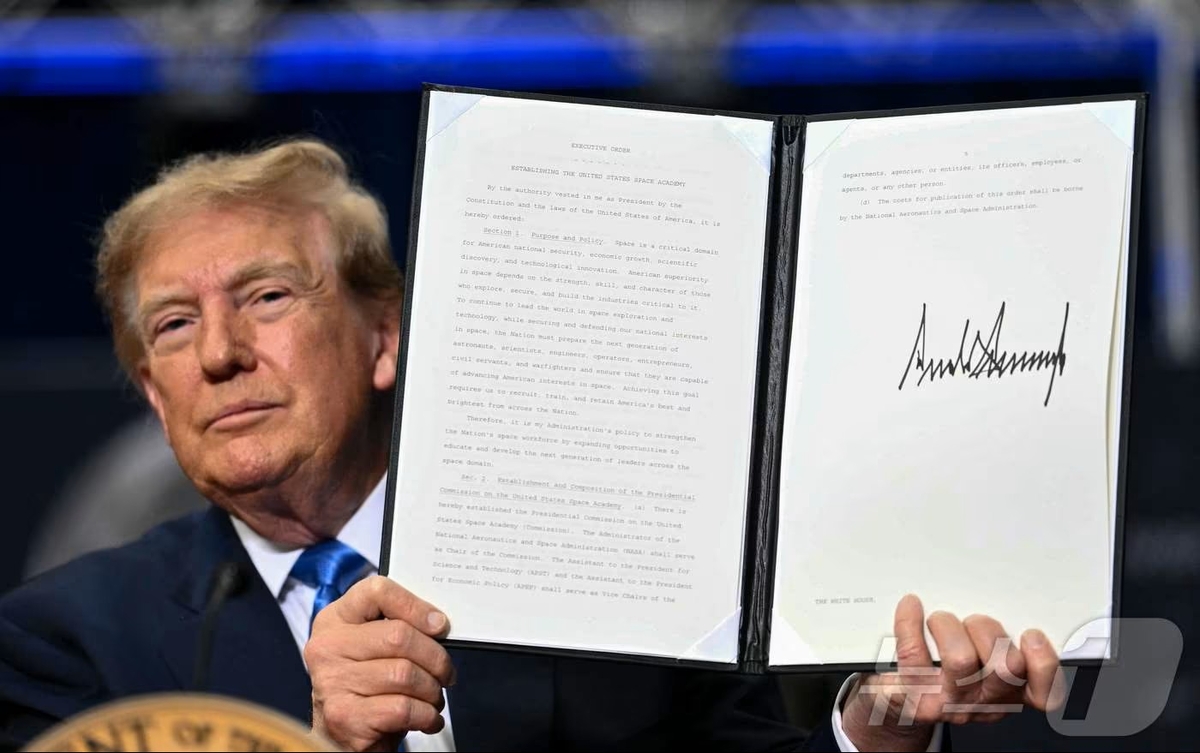
The World’s Most Powerful military just added a branch. Seoul’s government is busy deleting its oldest officer-producing institutions.
On November 28, Donald Trump signed an executive order at NASA’s Johnson Space Center in Houston, formally establishing the U.S. Space Academy. The ceremony — attended by the Artemis 2 crew receiving Congressional Space Medal of Honor awards — was the public face of what is, in practical terms, a serious institutional bet on space as the next operational domain of American military power.
Trump did not mince words. “You can’t be number 2 in space and be a number 1 country on Earth. It simply doesn’t work,” he said, according to Reuters. The line was not merely rhetorical. The United States now has a dedicated service — the Space Force, created in 2019 — and no formal academy to produce its own commissioned officers. That gap is now being filled.
The U.S. model is clear: specialization drives capability. The Army has West Point, the Navy Annapolis, the Air Force Academy at Colorado Springs. The Space Force gets its own. It is an incremental, institutional logic — build the domain, then build the人才培养 pipeline for it.
South Korea is moving in the opposite direction.
The Korean debate: integration as elimination
Kim Se-jin, secretary-general of the policy group Future Thinking, called the contrast stark in a pointed critique published by Munhwa Ilbo. The United States, he argued, is sharpening military specialization for future warfare. South Korea, meanwhile, is proposing to close its Army, Navy, and Air Force academies — and critics see no coherent plan for what replaces them.
“This is hasty, incoherent, and the closure of the service academies is an act of defense destruction,” Kim said.
Park Hwi-rak, a professor at Kookmin University’s graduate school of politics, agreed. The American move reflects a recognition that each service needs its own professional identity and training pathway. “Integrating Korea’s service academies is a mistake,” he said.
The proposed closures sit inside a broader defense restructuring debate that has been simmering for some time. Proponents argue that consolidation would reduce redundancy and modernize officer education for a more joint, technologically integrated force. The counter-argument — and it is a significant one — is that the ROK military is simultaneously facing a deteriorating strategic environment: North Korea’s accelerating missile and nuclear programs, China’s growing naval presence in the Yellow Sea, and the long-standing expectation that American forward deployment in the region may contract.
In that context, dismantling the institutional infrastructure that produces service-specific officers looks, to many defense analysts, like the wrong move at the wrong time.
What South Korea is actually debating
The source article does not specify the exact legislative or administrative mechanism behind the proposed closures, nor does it detail the government’s timeline. What is clear is that the debate is active and contested. The term used in the headline — a colloquial and somewhat mocking phrase roughly meaning “throwing a fit over closing the service academies” — signals that critics view the government’s push as rushed and ill-considered.
Kim’s comments suggest the government may simultaneously be advancing plans for a new “Defense Advanced Science and Technology Academy” — a specialized institution for STEM-focused officer training — while also moving to shutter the traditional service academies. The two policies, if taken together, create a jarring image: replacing a broad-based, service-oriented officer corps with a narrower, technology-centric pipeline.
That is not inherently wrong. Many modern militaries have moved toward joint and technical education. But the sequence matters. If South Korea eliminates its established academies before proving that alternative institutions can produce officers of equal caliber, it risks creating a generational gap in leadership quality — exactly when the region’s security environment is tightening.
The space angle: why it matters beyond Korea
The U.S. Space Academy is not just a Korean headlines story. It is a signal in a broader global trend: the militarization of space is no longer speculative.
The United States, China, Russia, India, Japan, and South Korea itself all have active space programs with clear defense applications. Satellite-based surveillance, navigation, communications, and early warning are now indispensable to modern military operations. The person who controls the information advantage in orbit controls the battlespace on the ground.
China has been investing heavily in its own space defense capabilities, including anti-satellite weapons and the development of what Western analysts describe as a nascent space force under the People’s Liberation Army Strategic Support Force. South Korea, despite having a capable civilian space program, has no dedicated military space component comparable to the U.S. Space Force.
This is where the academy debate acquires an almost surreal quality. The United States is building institutional capacity for a domain that will define the next era of warfare. South Korea is debating whether to close the schools that produce the officers who would lead its forces in that same era.
Who wins and who loses
If the service academies close without a robust replacement, the immediate losers are the officers who would have attended them, the military units that rely on their specialized training pipelines, and the strategic coherence of the ROK armed forces. The longer-term losers are South Korea itself — a country whose entire postwar security architecture depends on having a well-trained, professionally socialized officer corps capable of leading a large conventional military in a crisis.
The winners, in the narrowest sense, are those who believe that bureaucratic consolidation automatically equals modernization. There is a seductive simplicity to that argument: fewer institutions, lower costs, a cleaner structure. But military organizations are not corporations. Officer identity, service culture, and institutional memory are not redundancies to be eliminated — they are the things that hold a force together when communications fail and plans collapse.
What happens next
The Trump executive order has set a date and a name for the U.S. Space Academy. South Korea’s academy closures remain a proposal in an active political debate. Neither path is irreversible. But the trajectory matters.
The United States is adding. South Korea is, at least in this moment, subtracting. The gap between the two approaches is wider than the headline suggests, and it points to a deeper question about how seriously Seoul treats the strategic challenges ahead.
Space is no longer the final frontier. It is the next battlespace. And South Korea’s debate over whether to close the schools that train its future officers is a barometer — perhaps the most honest one available — of whether the country sees that coming.