Brunson's Border Remarks Spark Sovereignty Crisis in Seoul
A US commander's claim that South Korea begins at the southern fence line of the DMZ has ignited a diplomatic crisis in Seoul, exposing fractures in the alliance over sovereignty, civilain control, and the tempo of operational authority transfer.
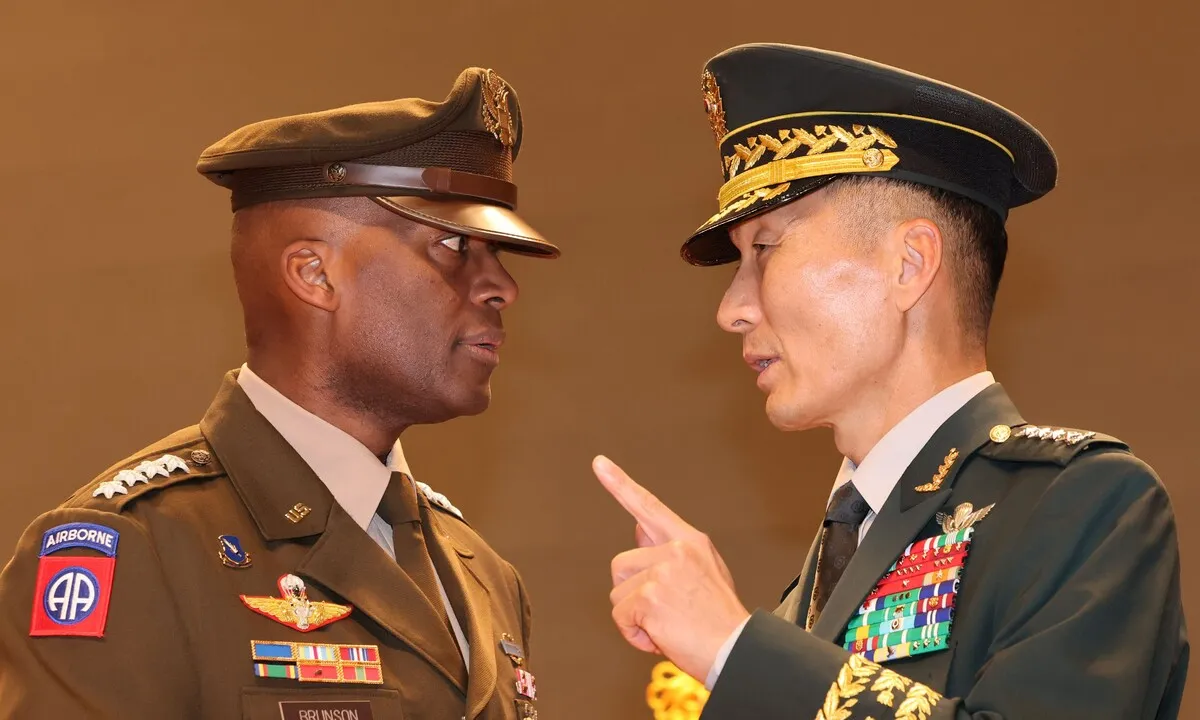
A commander crossed a line no one asked him to draw
On September 14, Brig. Gen. Xavier Brunson stood before a seminar at the Goldstein Institute of Strategic Studies in Washington and told an American audience something that would have sounded like a routine operational briefing — if the audience hadn’t been half Korean.
He described the Military Demarcation Line as a border. He pointed to the southern wire fence, roughly two kilometers south of that line, and declared that from his vantage point as commander of UN Command, “the Republic of Korea starts” there. The implication: everything between the MDL and that southern fence belonged to his jurisdiction, not Seoul’s. The phrase spread faster than any diplomatic retraction could follow.
Within days, South Korea’s Defense Ministry was doing damage control. Their response was blunt: the remarks were Brunson’s personal opinion. They also insisted, with visible frustration, that South Korea’s sovereignty extends into the DMZ and is not up for debate by anyone wearing a uniform — least of all a foreign one.
UN Command itself issued a statement within 48 hours, walking back the apparent intent. It said Brunson’s words referred only to administrative responsibilities under the armistice agreement — things like gate access and civilian relief in the zone — and did not alter South Korea’s sovereign territory. The statement carried the sterile language of crisis management. It did not, and could not, undo the damage.
What Brunson actually got wrong
The core error is foundational. The Military Demarcation Line was never drawn as an international border. It was established by the 1953 Armistice Agreement as a military control line — a buffer separating North and South Korean forces during a pause in fighting, not a settlement of sovereignty. The armistice gave UN Command certain administrative duties within the Demilitarized Zone, including the Joint Security Area at Panmunjom. Those duties are narrow and well-defined. They do not confer territorial authority.
Brunson appears to have conflated the two. Speaking in Washington to an audience that likely had no deep familiarity with Korean geopolitics, he treated a military control line as a territorial one and then declared where South Korea begins and ends. That is not a minor precision error. It touches the most sensitive nerve in Korean-American relations.
The political fallout in Seoul is unusual
What makes this episode striking is not just the content of Brunson’s remarks but the speed and breadth of the backlash inside South Korea.
Defense Minister Kang Shin-cheol confirmed at a legislative hearing on September 15 that Seoul had formally protested to Washington over the comments. That is a diplomatic step rarely taken publicly against a senior allied commander. It signals that the frustration runs deeper than irritation at a clumsy sound bite.
Lawmakers from the ruling Democratic Party — traditionally the party most attentive to alliance management — did not hedge. Kim Byeong-ju, the president’s defense policy advisor and a senior party figure on the National Assembly Defense Committee, called the remarks a line-crossing infringement on sovereignty. He demanded a retraction and an apology to the Korean people. Kim Sung-jun, the committee chairman himself, expressed shock and dismay, noting that the person making such claims held three commander titles simultaneously: UN Command, Combined Forces Command, and USFK.
The fact that sitting members of the governing party are using language this sharp about a US commander is notable. In a relationship where public criticism of American officials has traditionally been muted, even among progressive factions, this represents a shift.
The operational control question hangs over everything
Brunson did not limit his remarks to the DMZ. He also raised the question of wartime operational control — the authority to direct combined forces in a conflict — and suggested that the rapidly changing security environment means South Korea needs new benchmarks for the transfer.
That directly challenges the Yoon administration’s stated timeline of returning operational control to Seoul by 2028. If the US commander on the ground is publicly reframing the conditions for that transfer, he is not just speaking about a fence line. He is signaling that Washington may not consider Seoul ready, or may want to set the terms unilaterally.
This is not abstract. The question of when and how operational control transfers has been one of the most contentious issues in the alliance for years. South Korea wants certainty. The US has repeatedly implied that readiness, not calendar dates, should drive the decision. Brunson’s comments give voice to the American position in a way that no State Department spokesperson would dare.
The civilian control dimension
Western scholars of Korean civil-military relations have raised a sharper concern. Jaesung Lee, a visiting scholar at Duke University, noted that Brunson’s public statements on sovereign territory and operational readiness cross into political territory that should be reserved for civilian officials — the defense minister, the president, elected legislators.
The principle of civilian control is not just a Korean concern. It is a cornerstone of allied military relationships everywhere. When a four-star general in uniform tells a host country where its territory begins, he is making a political statement. That the UN Command felt the need to clarify it was not trying to redefine sovereignty suggests the original remarks carried precisely that weight.
Why this matters beyond the diplomatic row
The episode reveals a structural tension that has been building for some time. South Korea’s government, particularly under President Yoon, has been pushing to normalize the alliance — to treat it as a relationship between fully equal sovereigns rather than a protectorate arrangement inherited from the Cold War. The return of operational control is the centerpiece of that project.
Brunson’s remarks, whether intentional or not, communicated the opposite message: that the US still sees itself as the arbiter of Korean sovereignty boundaries and readiness benchmarks. That is a message that will resonate differently depending on who you ask. Older generations that lived through decades of American protection may dismiss it. Younger Koreans, particularly those who view the alliance through a lens of strategic autonomy, will not.
The timing amplifies the stakes. South Korea is simultaneously negotiating with UN Command over the civilian use of the DMZ — a sensitive domestic issue that already pits Seoul against the command’s wartime restrictions. Brunson’s comments add a sovereignty dimension to an already frictional relationship.
What comes next
Expect the apology circuit to continue. Brunson will likely face private diplomatic pressure to clarify his position. UN Command will double down on its statement that sovereignty is not in question. Washington may issue quiet guidance to commanders about the sensitivity of public remarks on host-nation sovereignty.
But the underlying disagreement will not disappear. The question of operational control remains unresolved. The question of who speaks for the alliance in public forums remains open. And the question of whether a US commander in Seoul can afford to make territorial claims without triggering a diplomatic incident will now have a clear answer: no.
Seoul made that answer unmistakably clear. The harder question is whether Washington heard it.