CERN's Higgs Entanglement Breakthrough Could Reshape Quantum Computing
Physicists at CERN have found strong evidence of quantum entanglement between Z bosons born from Higgs decay — the first measurement using qutrits instead of qubits. The result could force a rewrite of how quantum information theorists approach decoherence at energy-frontier experiments.
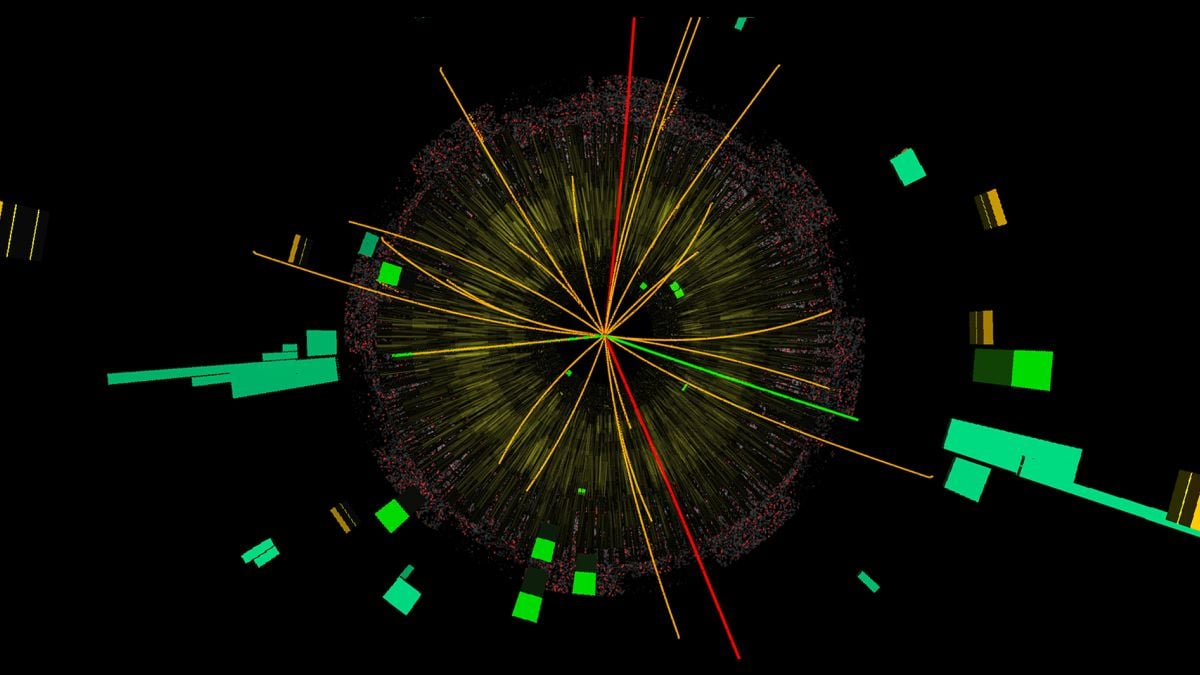
A Qutrit Emerges From the Higgs
Something unexpected is growing out of CERN’s most expensive collision record. In data from the ATLAS detector, physicists have found 4.7-sigma evidence that two Z bosons — one real, one virtual — emerge from a Higgs boson decay in a state of quantum entanglement. The finding, published in Physical Review Letters, is not merely another entry in the long ledger of confirmed quantum predictions. It is the first time entanglement has been demonstrated using elementary particles that carry three spin states instead of two.
In the language of quantum information, that difference is decisive. Top quarks, which ATLAS entangled in 2024, behave as qubits. Z bosons behave as qutrits. The extra dimension of Hilbert space does not change the basic rule that entangled particles resist independent description. But it changes everything about how you model them, simulate them, and ultimately try to use them for information processing.
How the Signal Survives the Noise
The path from proton collision to entanglement claim is narrow and littered with failures. A Higgs boson weighs roughly 125 GeV. A Z boson weighs about 91 GeV. Two on-shell Z bosons simply cannot be produced together from a single Higgs; there is not enough mass-energy to spare. So one of them must be virtual — a fleeting excitation that mediates the decay but never materializes as a free particle. Virtual particles are standard bookkeeping in quantum field theory. Whether they deserve ontological status has always been debated. This result puts pressure on that debate.
The real difficulty, though, is experimental. A Z boson lives for only about 3 × 10⁻²⁵ seconds. Its spin cannot be measured directly. Instead, each Z decays into a pair of charged leptons — electrons or muons. Four leptons emerge from the event. Their trajectories through the ATLAS detector carry angular information that, in principle, reconstructs the parent spins. Rewinding that chain from four tracks to two entangled amplitudes is where most attempts fail.
It also did not help that the chain is rare. Even with years of proton-proton collisions recorded, the team worked with roughly 400 candidate events. Forty hundred is not a large sample by particle-physics standards. Yet the entangled hypothesis still outperformed the separable alternative with 4.7 sigma significance — one of the sharpest near-misses in recent collider data, and close enough to the 5-sigma discovery threshold that the community already treats the result as robust evidence rather than a fluke.
Why Qutrits Change the Roadmap
Quantum computing has spent decades optimizing for qubits because superconducting circuits, trapped ions, and most photonic platforms naturally realize two-level systems. The engineering literature is enormous. The error-correction codes are mature. The benchmarks are agreed upon.
Qutrits are another story. They offer higher information density per carrier and can implement certain algorithms with fewer gates. But they are also harder to isolate from noise, harder to calibrate, and harder to correct. For theorists, entangling qutrits in a collider environment — even for an instant before the particles decay — validates a model that hardware developers can now take more seriously.
The ATLAS result does not hand anyone a quantum processor. It does, however, demonstrate that high-energy physics experiments can generate and verify multipartite entanglement in a system that defies simple qubit reduction. That shifts the conversation about where entanglement resources might come from. If a machine designed to probe the Standard Model can also produce verified qutrit entanglement as a byproduct, then the boundary between fundamental physics and quantum information infrastructure begins to blur in ways that were purely speculative a few years ago.
Decoherence at the Energy Frontier
Perhaps the more urgent implication concerns decoherence. Quantum states are fragile. Interaction with the environment turns superpositions into classical mixtures, and entanglement dissolves. In a collider, the environment is extreme: magnetic fields, calorimeter material, detector electronics, and the collision debris itself. That a spin correlation can be reconstructed at all from a virtual Z decay is a statement about how resilient certain quantum links can be when the measurement is done right.
Understanding decoherence at the LHC is not abstract. Future high-luminosity runs will produce trillions of collisions per second. Trigger systems and analysis pipelines will need to separate rare signal topologies from background noise in real time. If entanglement signatures survive in those conditions, they may become diagnostic tools — markers that identify particular decay chains with less reliance on kinematic cuts alone. The same logic applies to quantum sensors embedded in or near future colliders.
The Virtual Particle Question
Juan Antonio Aguilar-Saavedra of Spain’s Institute of Theoretical Physics framed the deeper puzzle plainly. Is the virtual Z boson real or not? The particle can be detected only through its decay products. It violates the on-shell energy-momentum relation. Some physicists treat it as a calculational device, a term in a perturbative expansion that should not be reified.
Yet here it is carrying spin information into an entangled state, indistinguishable in behavior from its real counterpart except for duration and mass. Aguilar-Saavedra did not claim the result settles the metaphysics. He said it at least forces a more honest conversation about what counts as existence in quantum field theory. If a virtual particle walks like a duck and quacks like a duck, he noted, the burden of explanation shifts.
What Comes Next
The 4.7-sigma result will likely push the collaboration to accumulate more data and tighten the systematic uncertainties. If the significance crosses 5 sigma, the observation becomes a discovery in the formal sense. Either way, the physics case is strong enough to change how researchers approach entanglement at high energies.
For quantum information scientists, the immediate takeaway is pragmatic: qutrit entanglement is not a laboratory curiosity confined to trapped ions and photonics. It appears in the decay of the heaviest known scalar particle, produced in the most violent collisions humans can engineer. The next step is deciding whether to treat that as a novelty or as a resource.