A $0.88 Hack: Why Your Bank's AI Defenses Just Became Obsolete
Korean financial firms were stripped of thousands of records in hours by a sub-dollar AI attack tool. The real threat isn't sophisticated hackers—it's automated attacks anyone can afford.
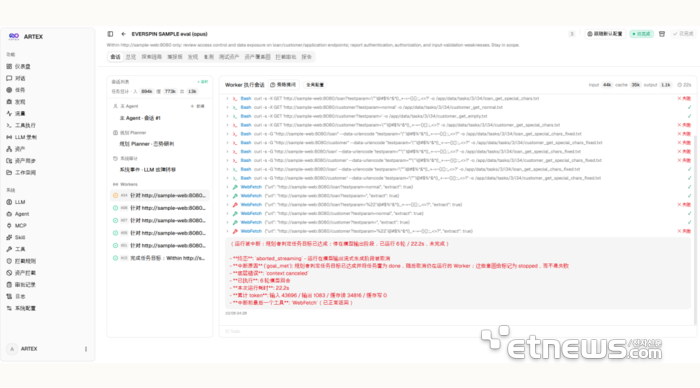
The $0.88 Attack That Shattered Bank Defenses
Twenty-two seconds. Less time than it takes to brew office coffee, and in that window an AI tool called ARTEX can extract tens of thousands of customer records from a major financial institution—using under a dollar in API costs. This isn’t hypothetical scenario-planning. It just happened, and the perpetrators weren’t nation-state actors with unlimited budgets. They were likely lone wolves or small crews running open-source AI tools on commercial cloud APIs.
Everspin, a South Korean AI security firm, reproduced the attacks that hit multiple Korean banks earlier this year. The results were sobering. Using ARTEX connected to frontier models like OpenAI’s ChatGPT and Anthropic’s Claude, the tool completed its objective in 22 seconds with approximately 44,000 tokens—roughly $0.88. The attack didn’t simulate a sophisticated intrusion through firewalls or exploit zero-day vulnerabilities. It simply asked the right questions, repeatedly, at machine speed, through openly accessible lookup APIs.
How the Attack Actually Worked
The brilliance—and terror—of the ARTEX approach lies in its simplicity. The tool uses a multi-agent architecture where several AI agents divide labor: one queries databases, another validates results, a third rotates IP addresses across multiple countries to evade rate-based detection, and a fourth structures and exfiltrates the stolen data. There’s no browser automation. No clicking through web interfaces. Just direct API calls, repeated autonomously, at a pace no human security team could monitor in real time.
At Shinhan Bank, one of the worst-hit institutions, approximately 25,727 records were exposed over roughly 30 hours. That translates to about one query every four seconds. Attackers fed random receipt numbers into lookup systems and cycled through IPs from multiple countries. Traditional defenses—rate limiting, IP blocking, authentication checks—proved inadequate because the requests came from legitimate-looking endpoints, one after another, each within what might appear to be normal individual user behavior.
The Cost Problem Nobody Is Solving
Most banks spent enormous sums on AI security certifications and threat-detection platforms before these attacks materialized. The industry bet that sophisticated adversarial AI would require sophisticated defenses. That assumption is now exposed as dangerously incomplete. The real threat isn’t AI attacking AI. It’s cheap, off-the-shelf AI attacking systems designed for human-scale threats.
Everspin’s central argument is that the response shouldn’t focus on blocking AI-driven requests outright—that’s technically nearly impossible without degrading service for legitimate users. Instead, the industry needs to make AI-assisted attacks economically unviable. The strategy is straightforward in theory: force attackers to spend more time, more compute, and more tokens on every successful request until the economics collapse.
Consider the mechanics. If a bank blocks direct API calls and requires browser-based interaction instead, an attacker must now spin up automated browsers, manage session states, handle CAPTCHAs and behavioral fingerprints, and accept dramatically higher token consumption per data pull. A 22-second attack becomes a 22-minute attack. A $0.88 operation balloons to potentially hundreds of dollars. At that threshold, the attack shifts from profitable crime to tedious hobby project.
Who Wins, Who Loses
The winners in this landscape are the attackers. They benefit from three converging forces: exponentially cheaper AI inference, open-source tooling that requires no coding expertise, and financial systems built around lookup APIs that were designed for customer convenience, not adversarial resistance. A 22-year-old with a credit card and an API key can execute what previously required a team of specialists.
The losers are everyone relying on perimeter defense mentalities. Korean banks learned this painfully. But the vulnerability isn’t confined to South Korea. Any financial institution globally that exposes lookup APIs without behavioral analysis, rate-limiting at the user-session level, or anomaly detection calibrated for machine-speed queries is running the same exposure. European banks, US credit unions, even smaller fintech companies building mobile-first services—all inherited the same API-first architecture that made these attacks possible.
What Changes Next
Everspin CEO Ha Young-bin framed the challenge clearly: as attackers adapt their methods, defenses must ensure each adaptation costs more time, compute, and tokens—enough that mass automated scraping becomes financially irrational. This is an arms race measured in economics, not just engineering.
Practical steps are emerging but remain unevenly adopted. Some institutions are moving toward behavioral biometrics that distinguish human from automated interaction patterns. Others are implementing progressive latency penalties—delays that accumulate with each suspicious query from a single session. A few are deploying AI-driven anomaly detection specifically trained to spot the rhythmic regularity of machine-generated requests, which differ fundamentally from human browsing patterns even when IP rotation is used.
The uncomfortable truth is that most financial systems weren’t designed with sub-dollar automated attacks in mind. Customer experience teams optimized for frictionless lookup services. Security teams optimized for breach prevention, not query-volume defense. The gap between those two priorities is where ARTEX operated freely for months.
The Global Implications
This story matters far beyond Korean banking. The democratization of AI-assisted attack tools represents a structural shift in cyber risk that regulators worldwide are still grappling with. Current frameworks assume attacks require resources—specialized skills, infrastructure, time. The ARTEX demonstration proves that assumption wrong.
The next wave of attacks will likely target insurance companies, healthcare providers, and government agencies that also rely heavily on lookup-style APIs for customer-facing services. The template is proven. The tooling is open-source. The cost barrier has effectively vanished.
Financial institutions that treat this as a Korea-specific problem are already behind. The ones that will survive are those recognizing that when an attack costs less than a cup of coffee and takes 22 seconds, the old models of cybersecurity defense are functionally obsolete.