China bets big as Iran sanctions test Sino-American fault line
Beijing's vow to protect Iranian energy trade after US sanctions expansion signals a growing alternative financial system. The move risks rare-earth retaliation and deepens the US-China split over global energy flows.
China’s counter-offensive begins before Washington’s sanctions land
Beijing’s response to the latest US sanctions on Iran was swift and unusually blunt. Within hours of Treasury Secretary Scott Bessent announcing what he called “Operation Economic Outcast,” Foreign Ministry spokesman Lin Jian declared China would take “all necessary measures” to protect its rights.
The phrasing mattered. China has long reserved the right to respond to what it terms “illegal unilateral sanctions.” But this time, the warning came on the eve of a planned call between President Donald Trump and Chinese President Xi Jinping, just weeks before their face-to-face talks next month.
The subtext was clear: China is no longer merely buying Iranian oil in the shadows of US pressure. It is positioning itself as the guaranteed buyer of last resort for Tehran, and in doing so, it is drawing a line that could redefine global energy and financial architecture.
How far the new US push goes
Bessent described the measures as “the single greatest financial offensive ever” against Iran. The Treasury Department has mapped out financial channels, facilitators, and networks used by Iran to evade sanctions, targeting roughly 60 entities, individuals, and vessels.
The message to banks and businesses was unambiguous: any nation financially partnering with Iran will be isolated. Bessent stressed that “no one was above the reach of US sanctions,” even as he declined to name specific countries.
Trump plans to personally call world leaders with “specific requests to cease their interactions with the regime.” The timing is deliberate—aimed at cutting off Iran’s remaining lifelines before any diplomatic opening reopens.
Beijing’s leverage: rare earths and oil
China is already the biggest buyer of Iranian oil, absorbing roughly 90% of Tehran’s exported crude despite years of US pressure. The trade has declined under blockade conditions, but it persists through a mix of shadow fleets, cash settlements, and increasingly, yuan-denominated transactions.
What makes China’s position especially potent is its dominance over rare earth processing. Beijing controls the vast majority of global refining capacity for critical minerals used in everything from electric vehicles to fighter jets. During previous trade negotiations with the US, China tightened export controls on these materials as a retaliatory lever.
That card remains on the table. If Washington moves against Chinese banks facilitating Iranian trade, Beijing could respond with sudden restrictions on rare-earth shipments—a move that would ripple through global supply chains within weeks.
Why the sanctions may not choke Iran
Analysts are already skeptical about the direct impact. David Oxley, chief climate and commodities economist at Capital Economics, told the BBC the new package would have “only a limited direct impact on Iranian energy flows in the short term.”
The reason is structural: nearly all of Iran’s oil goes to China, which has consistently refused to recognize US unilateral sanctions. Ali Vaez of the International Crisis Group noted that Beijing views such sanctions as “illegitimate” and will likely continue business as usual.
Iran’s own Economy Minister Ali Madanizadeh said Tehran had been “waiting for these plans for a long time” and possessed a two-year contingency plan. “We also have our own tools and know how to play the game,” he told state television.
The calculus is simple. Iran has absorbed years of maximum-pressure campaigns without regime change. Its neighbors—Pakistan, Turkey, Iraq—cannot afford to cut ties with Tehran despite US pressure. Even India and Russia, both important Iranian partners, have yet to comment.
The Strait of Hormuz factor
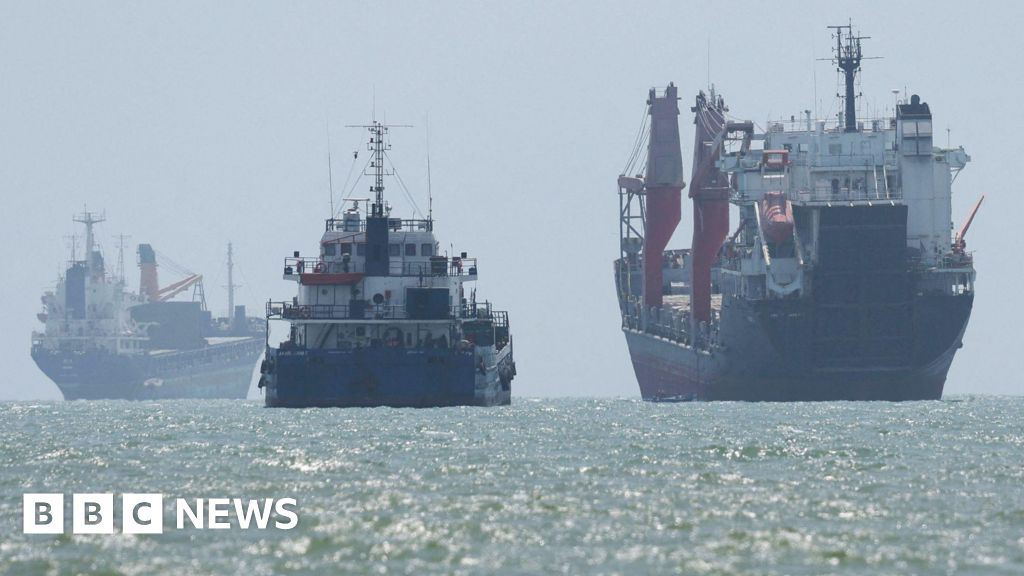
The sanctions announcement arrives amid escalating violence in the Strait of Hormuz, where Iranian-aligned forces have attacked oil tankers and Tehran has effectively blocked exports through the vital waterway. The US has responded with its own naval blockade, slowing traffic and spiking global oil prices.
For China, which imports the majority of its oil through the same strait, the chaos is an existential economic threat. Beijing cannot afford to see Iran collapse into further instability or lose its primary supplier. Supporting Iran’s energy exports is now a matter of Chinese energy security as much as geopolitical alignment.
This dynamic makes China’s public vow to protect Iranian trade more than rhetorical. It is a signal to global markets—and to Washington—that Beijing will treat Iranian energy flows as a red line.
The deeper fault line: a parallel financial system
The real story here is not about Iran alone. It is about what China is building alongside the US-dominated financial system.
Beijing has spent years developing the Cross-Border Interbank Payment System (CIPS) as an alternative to SWIFT, promoting yuan settlement for commodity trades, and stockpiling gold to reduce dollar dependence. Every major US sanctions expansion pushes partner countries—China, Russia, Iran, Gulf states—to accelerate those alternatives.
China’s response to the latest measures is a direct challenge to the US ability to enforce extraterritorial sanctions. By openly shielding Iranian energy trade, Beijing is demonstrating that the US can isolate Iran, but it cannot isolate countries that choose to trade with Iran.
What happens next
The immediate risk is escalation. If the US sanctions Chinese financial institutions facilitating Iranian oil purchases, Beijing could retaliate with rare-earth export controls, disrupting global high-tech manufacturing. A tit-for-tat could quickly widen beyond energy into technology, agriculture, and diplomatic spheres.
Diplomatically, Trump faces a dilemma. He wants to pressure Iran, but also needs Chinese cooperation on other issues—from North Korea to trade imbalances. Pushing too hard on Iranian trade risks locking Beijing into a more adversarial posture just before the Xi-Trump meeting.
For Iran, the sanctions are a reminder that its economy remains vulnerable, but also proof that it has secured a reliable patron willing to absorb US wrath. The two-year contingency plan Madanizadeh mentioned suggests Tehran is preparing for prolonged isolation, not surrender.
Globally, the move reinforces a trend: the erosion of a single Western-led sanctions regime. As China and other major economies carve out parallel financial and trade networks, the US ability to use dollar access as a weapon diminishes.
Who wins, who loses
In the short term, Washington gains political points by showing toughness. But the sanctions are unlikely to cut off Iranian revenue. China’s continued purchases and the existence of alternative payment mechanisms blunt the impact.
China wins by reinforcing its role as an alternative guarantor of energy flows, especially in regions where US influence is waning. It also gains leverage over the US through rare-earth controls.
Iran wins by maintaining its most important economic relationship. The sanctions do not alter the fundamental reality: as long as China buys Iranian oil, Tehran has a lifeline.
The losers are global energy markets, already volatile from Hormuz attacks, and countries caught between Washington and Beijing. Many will face impossible choices: comply with US sanctions and risk Chinese retaliation, or trade with sanctioned partners and risk US penalties.
The fault line sharpens
What began as a targeted sanctions package has become a proxy battle over the architecture of global trade. China’s vow to protect Iranian energy flows is not just about Tehran—it is a statement that Beijing will not accept US jurisdiction over its commercial relationships.
With rare earths as a weapon and oil as a bond, China is signaling that the 21st-century financial system will not be dictated solely from Washington. The US may have broadened its sanctions net, but in doing so, it may have accelerated the very fragmentation it seeks to prevent.