Chinese Firms Sweep Humanoid Robot Market as Scale Race Intensifies
Chinese robotics companies now hold all top five shipment positions globally, with Unitree alone capturing 43% of H1 deliveries. The pivot from proof-of-concept to mass deployment marks a new phase in automation—and a warning for Japan and Korea.
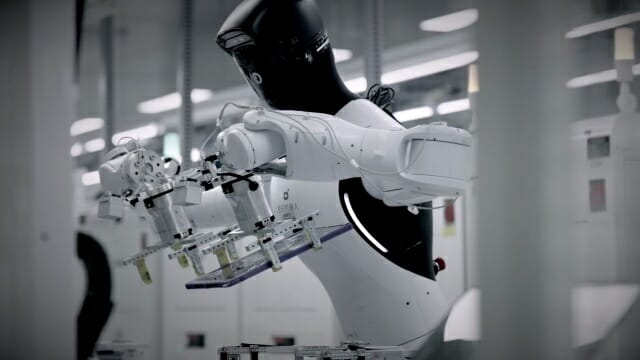
The top five positions in the global humanoid robot market are now exclusively Chinese. That fact alone would merit attention. What makes it consequential is the velocity at which that shift occurred.
In the first half of 2026, global shipments of humanoid robots surpassed 22,000 units, nearly tripling year-on-year. But the headline number masks a more interesting story: the Chinese firms collecting these shipments are not building robots for research labs or trade show floors. They are deploying them on factory lines, in warehouses, and increasingly, in applications that were previously the domain of Japanese and Korean automation specialists.
Who actually is leading the charge
Unitree Robotics commands the largest share at roughly 43% of first-half shipments, delivering approximately 9,700 units. The company entered the Shanghai Stock Exchange ChiNext board in mid-August and saw its IPO price jump 629% on the first trading day, a market signal that investors view the humanoid robotics sector as a genuine growth bet rather than a speculative novelty.
The firm targets 10 billion yuan in annual revenue by 2027. It is not betting on a single product. Its A, G, and X product lines serve different market segments, with the X series—particularly the X2 and its derivatives—capturing the entertainment and performance rental market in China. The G2 line, developed in partnership with Longcheer Technology and Joyson Electronics, is being deployed across IT and automotive parts manufacturing lines in volume.
Counterpoint Research describes Unitree’s strategy as moving beyond technical validation into what it calls a “closed-loop ecosystem” powered by two platforms: ShareBot, a robot-as-a-service subscription model, and Manifolder, a physical AI data infrastructure platform. The implication is that Unitree is treating data collection and model iteration as a competitive moat, not just hardware output.
The second-place finisher, shipping over 7,000 units with a 31% market share, remains unnamed in the source material but is described as profitable and publicly traded on the Shanghai Stock Exchange. A third Chinese firm—Galbot—reported more than 1,100 shipments (approximately 5%), partnering with Meituan to expand its unmanned smart pharmacy operations. Galbot’s wheeled two-handed S1 robot passed a production line test at CATL, the world’s largest battery manufacturer, in March 2026. That single deployment represents the kind of proof point that Chinese robotics firms are stacking one after another.
UBTech, ranked fourth, shipped roughly 1,000 units with a 4.4% share, deploying its Walker S series across automotive and 3C manufacturing lines. The company raised its 2026 shipment target from 2,000–3,000 units to 5,000. Fifth-place LiRo Robotics delivered 650 units (2.9%), placing its Kibo series inside humanoid robot data production and training facilities operated by multiple robotics companies.
The real shift: from demonstration to deployment
The application breakdown tells the story most clearly. Entertainment and performances, combined with data production and research, still account for over 60% of total shipments. But service and guidance roles have reached 19%, intelligent manufacturing 13%, and warehouse and logistics 5%. These are not marginal categories. They represent the sectors where Japanese and Korean robotics companies have built their competitive positions over decades.
The movement from PoC to paid deployment is happening faster than most Western analysts expected. Chinese firms are not waiting for general-purpose humanoid robots to become fully autonomous. They are shipping narrower, task-specific machines into environments where the operational constraints are well understood and the failure modes are contained.
What this means for Japan and Korea
Japan’s robotics industry has long rested on a foundation of industrial automation, precision manufacturing, and deep relationships with automakers. Companies like Fanuc, Yaskawa, and Kawasaki built their dominance on reliability and integration within established supply chains. Korea’s position is narrower but no less significant: Samsung and LG have invested heavily in semiconductor and display manufacturing automation, while companies like Hyundai Robotics and Skild AI have positioned themselves in logistics and vision-based manipulation.
The Chinese entries into humanoid robotics are not displacing these companies on their home turf yet. But they are occupying the same territory that Japanese and Korean firms consider core business. A humanoid robot that can work on an automotive assembly line or navigate a warehouse is, by definition, competing with the same use cases that Motoman arms and Hyundai RoboTech grippers currently serve.
The risk for Japan and Korea is not that Chinese humanoid robots will immediately outperform their existing automation solutions. The risk is that Chinese firms are building the data infrastructure and ecosystem lock-in around humanoid platforms before Japanese and Korean companies have a comparable entry point. Unitree’s Manifolder platform, Galbot’s VLA model trained on CATL’s production data, and UBTech’s repeated deployments across manufacturing lines all generate proprietary training data that is difficult to replicate from outside China.
The technological inflection point
Counterpoint Research identifies the next competitive axis as the convergence of “world models” and visual-language-action (VLA) architectures. These systems enable robots to infer physical causality and execute complex dynamic tasks from limited sample data, rather than relying on exhaustive pre-programming or massive labeled datasets. The firms that build the most complete world models—grounded in real physical interaction data—will likely hold a structural advantage over the next generation of robot buyers.
This is not a small engineering difference. A robot that can generalize from fewer examples requires less simulation time, fewer field re-calibrations, and shorter deployment cycles. For an automaker deciding between a humanoid platform and a traditional robotic arm, the total cost of integration and ongoing adaptation matters as much as the per-unit price.
The scale trap for late entrants
Annual global shipments are projected to exceed 50,000 units in 2026, a 210% increase. The market is scaling rapidly, but the distribution is already heavily concentrated. The top five Chinese firms alone account for well over 80% of known first-half shipments. The remaining market share is fragmented among smaller Chinese players, a handful of American companies, and a few European and Korean entrants.
For Japanese and Korean firms, the challenge is dual: they must match the deployment velocity of Chinese competitors while also securing access to the physical AI training data that determines whether their robots can operate outside controlled environments. Neither task is trivial.
The Chinese approach of bundling hardware sales with subscription-based RaaS models and proprietary data platforms creates a structure that is difficult to penetrate from the outside. A Japanese integrator buying a Chinese humanoid robot does not gain access to the training data or the model improvement pipeline. The robot becomes a black box that improves without the buyer’s involvement.
What happens next
The next 12 to 18 months will likely see continued consolidation among Chinese humanoid robotics firms, with the leaders using their data advantages and subscription revenue streams to accelerate model iteration. Smaller competitors will either be acquired or pushed toward niche applications.
For Japan and Korea, the question is whether they will respond with state-supported industrial policy, private-sector ecosystem partnerships, or a combination of both. The Taiwanese semiconductor industry’s recent exposure to “China-first” robotics AI chip policies, reported in parallel coverage, suggests that the geopolitical dimension is already complicating the technology landscape.
The humanoid robotics market is no longer a demonstration industry. It is a deployment industry. And the firms that control the data, the distribution, and the integration relationships today will define who captures value in the next wave of industrial automation.