China's Robot Smashes Beyond the Demo Floor
China's Kinetix AI just unveiled a humanoid table-tennis system that tracks and returns balls in milliseconds — but the real story is the KAI world model underneath, and what it signals about physical-AI competition.
The Ball Drops in Milliseconds
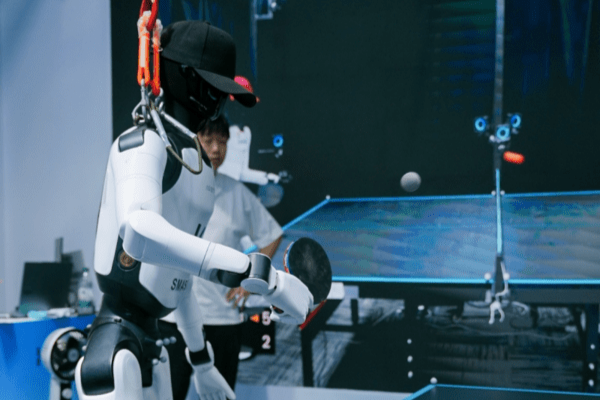
At the World Robot Conference in Beijing, a humanoid robot stood at a ping-pong table and returned a serve. That part was predictable. What made the demonstration notable was the speed: the system detected, tracked, predicted trajectory, and completed a stroke in milliseconds — and did so consistently across long shots and cut shots against a human opponent.
Kinetix AI (超维动力) called the system SMASH 2.0. It is, by the company’s claim, the world’s first fully autonomous humanoid table-tennis system, meaning it handles the full chain from vision to decision to whole-body control without a human in the loop.
The table tennis demo is not the story. The story is what lives underneath it.
The World Model Is the Real Product
SMASH 2.0 runs on an algorithm Kinetix says is generalizable across robot platforms. That claim is standard corporate language — until you look at what else the company showed alongside it: the KAI world model.
A world model, in robotics terms, is a system that learns the physics of the environment through simulation before applying that understanding to the physical world. Kinetix describes its approach as a three-stage closed loop: the robot interacts with a simulated environment, evaluates outcomes through the model, and then transfers that understanding to real-world physical laws.
This matters because table tennis is one of the hardest test cases for embodied AI. The ball travels at speeds that leave humans with barely 400 milliseconds to react. A robot solving this problem has to predict spin, account for table geometry, adjust its own posture mid-motion, and execute with sub-degree precision. Every one of those capabilities — trajectory prediction, dynamic balance, fine motor control — transfers directly to warehouse picking, surgical assistance, or disaster response.
What Western coverage has mostly missed is that China is now running these demos at professional athletic levels, not just lab-speed simulations.
The KAIBot Behind the Arms
Kinetix also revealed the KAIBot, a 173cm, 70kg humanoid with 117 degrees of freedom. The numbers alone do not impress — many competitors have similar specs. What is less common is the tactile skin: 18,000 contact points covering 80% of the body surface, capable of force control at 0.1-newton precision. That level of haptic feedback is the difference between gripping a fragile object and crushing it, between walking on uneven terrain and twisting an ankle.
The robot also carries a custom solid-state battery rated for over three hours in general use and two hours during continuous walking. Two hours of autonomous mobility is meaningful. Most competitive humanoids in demonstrations manage only minutes before requiring a recharge or swap.
The KAIBot’s head-to-body ratio of 1:8.5 mirrors human proportions. Its independent shoulder, neck, and torso joints allow it to replicate natural movement patterns rather than the stiff, mechanical gaits that still dominate many Western prototypes. During the exhibition, it walked autonomously through the show floor, answered questions, picked up objects, and handed out gifts — tasks that sound simple until you recognize how many simultaneous control loops are required to execute them without falling over.
Why This Timing Matters
The demonstration landed at WRC 2026 in late August, a conference that draws global robotics attention but rarely receives sustained English-language follow-up. By the time Western outlets cover these events, the next round of prototypes is already in development.
This pattern has repeated itself. Reports last year of Chinese robots outrunning Usain Bolt’s estimated top speed made headlines, then disappeared from coverage. The SMASH 2.0 demo follows the same arc: impressive, underreported, and rapidly iterative.
The implication is that the gap between what Chinese companies are shipping and what Western media believes is happening is widening, not narrowing. Boston Dynamics, Figure AI, and 1X all operate from similar premises — embodied AI that can navigate and manipulate the physical world. But none have publicly demonstrated a humanoid playing competitive table tennis against a human.
That is not a verdict on quality. It is a signal of where each company is choosing to invest public attention.
Who Wins and Who Loses
The winners are the companies that treat world models as infrastructure, not as a side project. Kinetix’s KAI model is designed to be the learning layer across multiple product lines — the SMASH system, the KAIBot, and the KAI Hand. That integrated approach compresses development cycles. A competitor that treats vision, control, and manipulation as separate problems will always be playing catch-up on integration.
The losers are the observers who measure progress by singular demos. A robot that can return a ping-pong ball is not immediately useful in a factory. But the sensor fusion, real-time prediction, and full-body control systems required to do so reliably are the same systems that determine whether a warehouse robot can navigate a dynamic environment or whether a care robot can assist an elderly person without causing harm.
The table tennis match is the proof of concept. The world model is the product.
What Comes Next
Expect the next iteration of SMASH to face increasingly skilled human opponents — and then opponents that are other robots. Multi-robot coordination in dynamic environments is the logical progression, and it is exactly the capability that translates to fleet management in logistics hubs.
Kinetix’s embedded-intelligence approach — running large models on-robot rather than relying on cloud compute — is also a strategic choice. Cloud-dependent systems fail when latency spikes or connectivity drops. On-robot reasoning is slower per operation but more reliable in unstructured environments. That trade-off favors deployment readiness over benchmark scores.
The broader signal is this: physical AI is no longer a research topic in China. It is a competitive category with visible hardware, working demos, and rapidly closing iteration cycles. The question for Western investors and policymakers is not whether the technology exists, but how quickly it will move from exhibition halls to factory floors.
The ball is already in motion.