Your DNA Is Holding Its Breath for Eight Letters
E. coli RNA polymerase transcribes an eight-letter synthetic genetic alphabet with near-native fidelity. The breakthrough, published in Nature, removes one of the last mechanistic barriers to expanded genetic code technology.
The four-letter alphabet is about to get crowded.
Life on Earth has always run on four genetic letters: adenine, thymine, cytosine, and guanine. For decades, synthetic biologists have asked whether that number is a hard law of nature or merely a historical accident. A paper in Nature this year shows that at least one step along the path to an eight-letter system is fully tractable. E. coli RNA polymerase reads synthetic P:Z base pairs during transcription with efficiency and fidelity nearly indistinguishable from natural base pairing.
The finding is not merely incremental. It closes a specific mechanistic gap that has lingered since the AEGIS program first demonstrated an expanded genetic alphabet in test tubes. Until now, the B:S unnatural pair had been characterized in E. coli RNAP, and both P:Z and B:S worked with simpler systems like Taq DNA polymerase and T7 RNA polymerase. But multi-subunit cellular polymerases — the kind that actually drive transcription in living cells — had never been shown to handle P:Z. That matters because B:S and P:Z together constitute the core of the eight-letter “hachimoji” system. Getting one pair to work in E. coli was progress. Getting both to coexist without cross-talk was the real hurdle.
How the experiment works
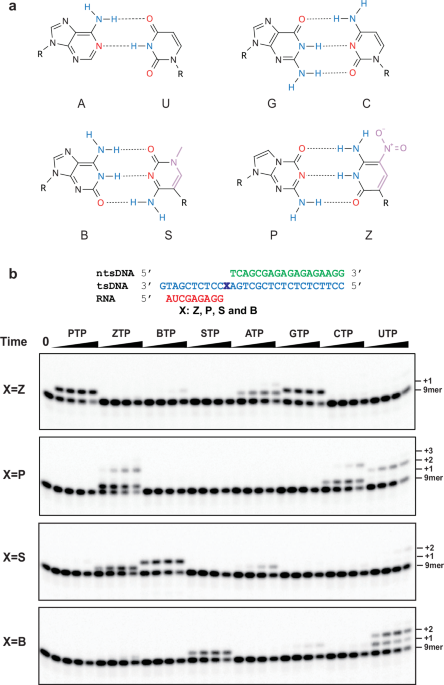
The researchers assembled DNA/RNA hybrid scaffolds with a single unnatural base positioned at the +1 templating site and tested all eight nucleotide triphosphates — four natural and four synthetic — for incorporation by E. coli RNAP. The result was unambiguous: cognate pairing dominated at every tested time point. PTP opposite dZ and ZTP opposite dP produced clear extension bands within 15 seconds. Single-turnover kinetics put the observed rate constants for dZ:PTP and dP:ZTP at roughly two-fold slower than the natural dG:CTP pair. That is slow but far from crippled.
More importantly, the two unnatural pairs operate orthogonally. When B:S and P:Z are present in the same transcription reaction, each selects its own partner and largely ignores the other. That orthogonality is what makes an eight-letter system informationally coherent rather than merely chemically diverse. Without it, the extra letters collapse into noise.
The mispairing problem and a chemical fix
No expanded alphabet comes without baggage, and the P:Z pair has a notable one. The Z nucleotide carries a nitro group in its major groove. Nitro groups are electron-withdrawing. They lower the pKa of the nucleobase to approximately 7.8, which means a fraction of Z molecules deprotonate under physiological conditions. The deprotonated form, Z⁻, presents a hydrogen-bonding pattern that matches guanine. In other words, Z can mispair with G — and the transcription assays showed exactly that. dZ:GTP misincorporation was the single largest fidelity breach observed across all 32 template–NTP combinations tested.
This is not a quirk of E. coli RNAP. The same Z:G mispairing has been documented in PCR with Taq polymerase and in earlier replication studies. It is an intrinsic property of the chemistry, not a protein–nucleic acid misrecognition event. The consequence is practical, though: any system built on P:Z has to deal with G misinsertion unless the pKa is pushed well above neutrality.
The authors addressed this with a modified nucleotide called Z*. By replacing the nitro group with a carboxamide and adding a 2′-fluorine substituent, they raised the pKa above 10. Deprotonation becomes negligible at physiological pH, and the mispairing signal collapses. Transcription assays with dZ* templates showed dramatically reduced GTP misincorporation and clean single-nucleotide extension. ZTP itself also misincorporated far less than ZTP across multiple template contexts. The trade-off is that Z is a new chemical entity requiring new biosynthetic pathways, but the fidelity gain is substantial enough to justify the effort.
What the structures show
Cryo-EM structures at 2.42 angstroms resolution captured the pre-catalytic state of E. coli RNAP with dZ paired against incoming PTP. The trigger loop — a mobile element in the β′ subunit that folds into the active site upon cognate substrate binding — is fully engaged. Key residues M932 and H936 on the trigger loop, along with T790 on the bridge helix, stabilize the unnatural base pair through hydrophobic and hydrogen-bonding contacts. The geometry of the P:Z pair inside the active site is canonical Watson–Crick. The triphosphate adopts the expected chair conformation, coordinated by two catalytic magnesium ions in the standard two-metal-ion arrangement.
In plain terms, the polymerase cannot tell that P and Z are foreign. It accommodates them the way it accommodates A:T and G:C. That is the structural punchline. It also means the enzyme does not stall or pause after incorporating an unnatural pair. NTP-chase assays showed efficient continuation of elongation past the P:Z site, with no observable stalling at the next position.
Who wins and who loses
The immediate winners are synthetic biologists working on expanded genetic information systems. The AEGIS program has spent years building orthogonal base pairs, polymerases, and nucleotide salvage pathways. The B:S pair cleared the first few hurdles; this work confirms the second. Together, B:S and P:Z support a complete eight-letter transcription system in a cellular polymerase context. The next step — getting that system to function inside a living organism over multiple replication and transcription cycles — remains unsolved, but the mechanistic uncertainty has shrunk considerably.
The biotech industry should also be watching. An eight-letter alphabet means exponentially more information density per strand of nucleic acid. Each additional letter multiplies coding capacity. That translates into more complex aptamers, more diverse oligonucleotide therapeutics, and potentially new classes of encoded proteins beyond the 20 natural amino acids. Companies building synthetic gene circuits or high-density data storage media will find the fidelity numbers here encouraging.
The losers, if there are any, are the skeptics who assumed multi-subunit RNAP would prove a harder wall than single-subunit enzymes. It did not. The trigger loop mechanism is remarkably permissive when geometry and hydrogen bonding are preserved, as they are in AEGIS pairs.
What happens next
Three questions dominate the near term. First, can E. coli import and regenerate all eight NTPs endogenously? Current systems rely on exogenous supply or engineered salvage pathways that work for individual pairs. Full eight-letter metabolism has not been demonstrated. Second, what happens to translation? The B:S pair has already been used to expand the amino acid lexicon in vitro, but coupling eight-letter transcription to eight-letter translation in a single organism remains hypothetical. Third, what are the error rates in long transcripts? Single-nucleotide assays are clean. Full-length mRNA production with multiple unnatural bases introduces compounding misincorporation risk that this study does not address.
There is also a quieter implication worth noting. The Z* modification demonstrates that the fidelity problems of expanded alphabets are often chemical, not enzymatic. Small structural changes — a carboxamide for a nitro group, a fluorine for a hydrogen — can resolve mispairing without requiring new polymerases or new protein engineering. That shifts the bottleneck from protein evolution to organic synthesis, which is a more tractable problem for most laboratories.
The broader implication is equally concrete. For the search for extraterrestrial life, this work reinforces the view that four-letter genetic systems are not uniquely constrained by physics or chemistry. Life elsewhere could plausibly use a different alphabet size. The fact that E. coli RNAP accommodates synthetic bases with native-like geometry means the molecular door is open. Whether life anywhere chose to walk through it is another question entirely.
For now, the message from this study is direct. E. coli RNA polymerase transcribes an eight-letter genetic alphabet. The mechanism is familiar. The fidelity is adequate and improvable. The next barrier is not the polymerase.