Why FEMA Wants Your Coastal Home to Collapse Before It Pays You
Federal flood insurance rules are forcing homeowners to wait for their houses to fall into the ocean before receiving payouts — creating a perverse incentive structure that costs taxpayers millions and leaves toxic debris scattered across beaches.
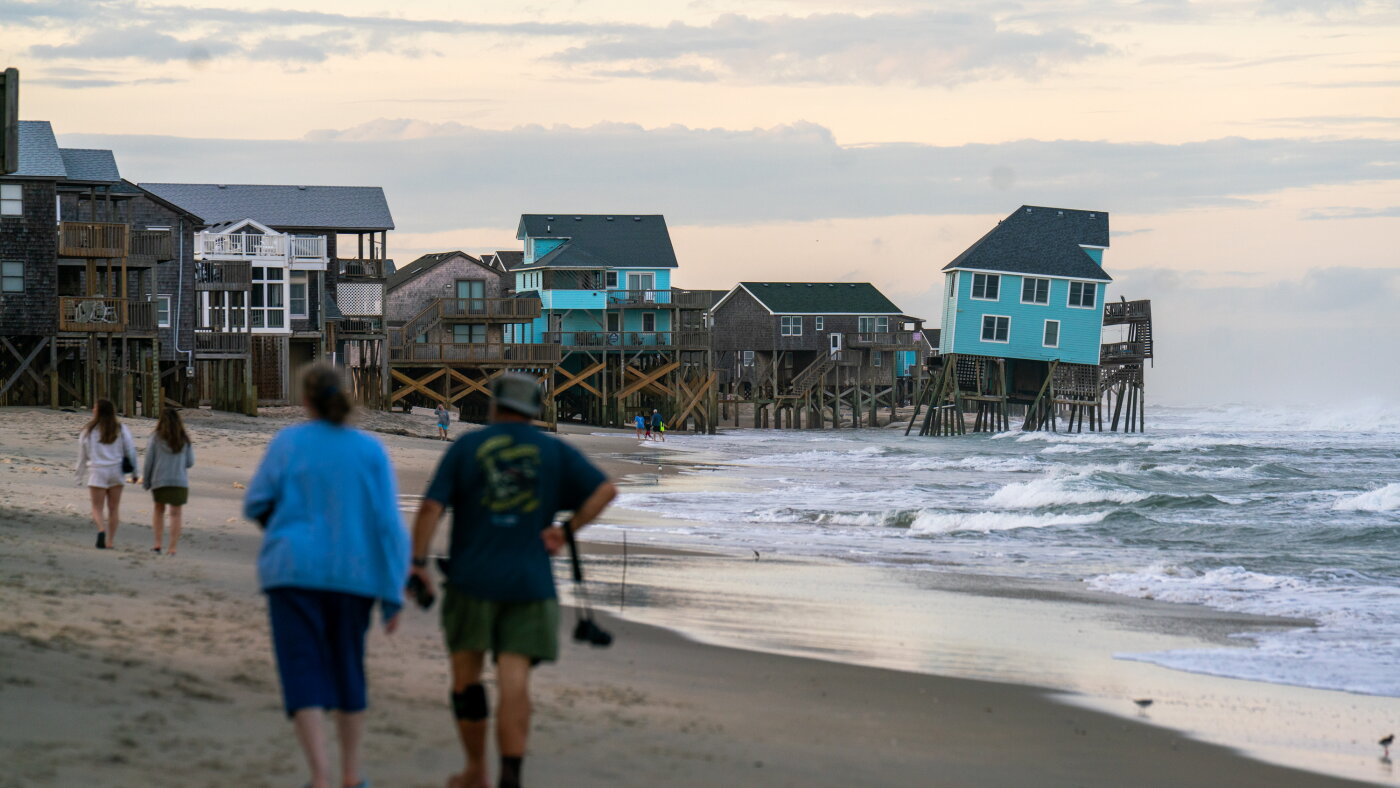
The House That the Ocean Is Slowly Eating
Richard Foreman’s beach house in Rodanthe, North Carolina, no longer has stairs. The waves took them years ago. What remains is a two-story structure perched thirty feet above the sand on stilts designed to survive hurricanes — but there haven’t been any hurricanes worth mentioning. Just the ocean, year after year, eating the beach from below.
Six years ago, this was Sea ’n Delight, a vacation rental where families booked summer weekends. Today, the name is gone along with the driveway, which is now underwater at high tide. At low tide, the Atlantic laps at what used to be solid ground. Inside, everything is exactly where it was left: couches, a refrigerator, every steak knife and beach towel, all waiting to drop into the sea.
“It looked like we had just left for dinner,” Foreman says.
He knows it will collapse eventually. Four neighboring homes have already fallen into the ocean in the last two years. More than 30 homes in Dare County alone have met that fate since 2020. At least half a dozen properties on North Carolina’s barrier islands face imminent danger, according to the National Park Service, which manages the area as part of Cape Hatteras National Seashore. In June, a high tide combined with large waves was enough to take another house.
Foreman would tear it down tomorrow if he could. But there is no plan to remove most threatened houses or empty their contents, and the reason has nothing to do with engineering or geography. It has to do with a federal insurance rule that creates a perverse incentive: FEMA will pay homeowners after their house collapses, but not before.
The Incentive to Wait
This is the central contradiction at the heart of America’s climate displacement policy. As sea levels rise and erosion accelerates along coastlines from Maine to California, the federal government is effectively rewarding homeowners for doing nothing while their properties disappear.
Bill King, president of the North Carolina Beach Buggy Association, travels to Washington regularly to push for rule changes. His argument is simple: the current system forces people to watch their homes fall into the ocean before receiving any financial help. “The homeowner is incentivized to wait for collapse and get a payout,” says John Ryan-Henry, a policy analyst at the Coastal States Organization, a nonprofit advocating for coastal state governments.
The consequences extend far beyond individual financial loss. When houses collapse, they pollute the water and leave wreckage scattered across the beach. Lisa Sharrard, a flood insurance agent in North Carolina who previously chaired the Association of State Floodplain Managers, describes the aftermath: “There’s a lot of debris that comes with these collapses. It leaves a legacy of hazard on the beach. It’s almost impossible to get everything.”
The National Park Service collected more than 480 tons of home debris from the area in the last 18 months alone. Some of it washed miles down the North Carolina coast.
The Forgotten Law
Congress actually solved this problem once. In the mid-1980s, lawmakers responded to growing alarm about coastal erosion by creating the Upton-Jones Amendment to the National Flood Insurance Program. Named after representatives from erosion-prone states Michigan and North Carolina, the law allowed homeowners to access insurance payouts before a house fell, enabling them to demolish it or move it to safety.
The policy took effect in 1988. Partial claims records obtained by NPR through public records requests show that more than 400 homes in 27 states were demolished or relocated under Upton-Jones. The program worked as intended: houses came down before they could collapse into the sea.
But Congress hated the results.
In a series of 1990 hearings, experts testified that some property owners were deliberately delaying action. Spencer Rogers, who managed Upton-Jones claims for North Carolina, told lawmakers: “They have chosen to repair the building as it stands, get another season’s rent and then look toward the possibility of demolition at a later date. There is no particular incentive that I can see for any early action.”
Lawmakers worried about the cost to taxpayers. “Policyholder benefits come at the government’s expense,” said then-Rep. Doug Bereuter of Nebraska. Others feared the program could bankrupt the National Flood Insurance Program if every eligible home took advantage of it. After years of debate, Congress repealed Upton-Jones in 1994.
The Cost of Inaction
Three decades later, the repeal appears to have been a mistake. The proposed replacement bill, introduced by a bipartisan group including Rep. Chellie Pingree, D-Maine, attempts to address the behavioral problems that killed Upton-Jones. Under the new version, homeowners who fail to remove threatened houses before they collapse would receive reduced payouts. The process for determining imminent danger from erosion has also been simplified.
But the bill is stalled in the House. The Trump administration’s efforts to slash FEMA’s workforce and budget have made reform even harder.
Meanwhile, the cleanup costs mount. Federal and county governments estimate spending more than half a million dollars cleaning up debris in coastal North Carolina since 2020. Those figures don’t account for closed beaches, polluted ecosystems, or the economic harm to communities that rely on tourism.
Dare County Manager Robert Outten is frustrated. “If there are waves breaking under the house, that’s clearly threatened,” he says. “It’s money they’re going to spend either way. It’s cheaper to tear it down.”
The data supports him. Claims records obtained by NPR show that the average cost to demolish a home under Upton-Jones was roughly the same as the cost of a federal home buyout program, which purchases repeatedly damaged homes at market value. In higher-cost areas, Upton-Jones was actually cheaper. The proposed program would cap payouts at $250,000, while the existing buyout program pays full market value. More than 90% of homes that have fallen in Dare County since 2020 were assessed above $250,000.
The Human Cost
Michael McDaniel bought his Buxton house, nicknamed the Sea Star, for about $500,000 in 2011 after retiring from the Navy. He planned to move there full time with his wife. When he bought it, 250 feet of dune separated the front porch from the Atlantic. Two years ago, the property was worth nearly $1 million.
Today, the beach has disappeared. The house is uninhabitable. McDaniel can’t afford to move it — his first choice — or demolish it. He has flood insurance that will pay $250,000 if it collapses, plus up to $100,000 for lost belongings.
“If it’s teetering, you’ve got to sit and wait for it to fall in the ocean,” he says.
His daughter Bonnie Clarke Lattimore lost her family’s beach home, Dreamhouse 1, to the ocean in 2025. Her eight-year-old son Clarke still looks out the window of their remaining house and watches the water.
Many at-risk properties in Dare County are vacation homes owned by people who rely on rental income to pay mortgages, taxes, and insurance. As the ocean encroaches, houses get damaged and become uninhabitable, eliminating income at the exact moment owners need cash most.
The Global Pattern
North Carolina is not alone. Erosion threatens neighborhoods in Maine, Massachusetts, Michigan, Illinois, Virginia, and California. Last week, erosion exacerbated by a storm caused catastrophic damage to multiple homes in Southern California.
The pattern is repeating worldwide. As climate change accelerates sea level rise, governments from Bangladesh to the Netherlands to Indonesia are confronting the same question: do you protect existing structures, or do you paid people to leave?
The United States has chosen a third option: neither. The federal government provides most residential flood insurance in the country but refuses to pay for pre-emptive action. Homeowners are left to choose between financial ruin and watching their property disappear.
What Comes Next
Reide Corbett, a climate scientist at East Carolina University, has delivered the same message to county residents at public meetings: “There is no way to maintain homes where they currently are. The only solution is to back off that front line.”
But backing off requires money, and the federal government isn’t providing it. Counties are turning to expensive alternatives like beach nourishment and seawalls. Dare County has two multimillion-dollar projects underway: an $8.6 million jetty repair and a $15 million beach nourishment project that will pump more than 2 million cubic yards of sand. The sand from the last nourishment project lasted less than three years.
“Beach nourishment is temporary,” Corbett says. “You’re buying sand to buy time. You can’t simply buy time and not plan for what is next.”
Not every neighborhood gets sand. At this rate, Foreman doesn’t see a path to protecting or removing his stranded house. “Which leads you to believe they’re really just hoping [the homes] will fall instead,” he says. “It’s nuts. Absolutely nuts.”
The data suggests he’s not wrong. The current system creates incentives that align perfectly with inaction: homeowners wait, houses collapse, taxpayers clean up, and everyone moves on to the next crisis. Until Congress acts, that cycle will continue — and the ocean will keep winning.