GitHub Just Made the Model Arms Race Obsolete
GitHub's new HydraFusion feature routes coding tasks across multiple AI models at runtime, claiming frontier-level quality at up to 67% less than Claude Opus 5. The move reframes the AI-tooling competition from raw model capability to orchestration intelligence.
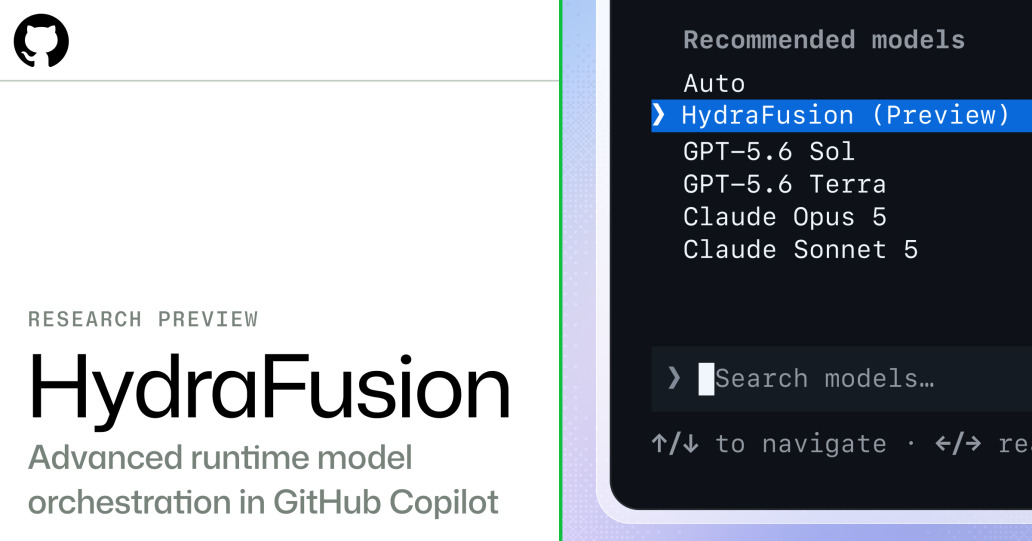
The Model Quality Race Is Over. The Routing War Has Begun.
GitHub just made something uncomfortable for everyone selling AI models by themselves. On September 4, the company shipped Project HydraFusion as a research preview inside GitHub Copilot, a feature that abandons the single-model approach entirely and instead routes each coding task across multiple AI providers at runtime — claiming frontier-grade results at up to 67% less than Claude Opus 5.
The implication is stark: the next competitive advantage in AI tooling may not come from training a bigger model but from building a smarter broker.
How HydraFusion Actually Works
HydraFusion sits inside the GitHub Copilot CLI and activates through the /experimental command chain. Users update their CLI, flip experimental mode on, and select HydraFusion from the model picker. From there, everything runs automatically.
The system evaluates each request and chooses one of three execution patterns:
Single routes the task to one model. This is the baseline — no orchestration, just a direct call. Useful when the task is straightforward and adding complexity won’t help.
Cascade starts with a cheaper, faster model to produce a draft solution. A quality gate then evaluates whether that draft is sufficient. If it passes, the user gets a fast, inexpensive result. If it fails, the task escalates to a more capable model. The key insight here is that most coding tasks don’t need the strongest model — they just need the right one.
Critique splits the work between two model families. One generates a draft while the other, reading only, acts as a reviewer. The drafting model then revises based on that feedback. This is closer to multi-agent reasoning but without the overhead of running both models simultaneously on the same task.
Pricing follows standard per-token rates for each model used. There is no discount for orchestration — the savings come purely from routing decisions that avoid unnecessary upgrades to expensive models.
The Benchmarks Tell a Nuanced Story
GitHub published results across three agent-type coding benchmarks, comparing HydraFusion against Claude Opus 5. The numbers are worth examining closely because they reveal what kind of workloads benefit most from orchestration.
On TerminalBench 2.1, HydraFusion not only cut costs by 67% but actually improved quality by 4.9 points compared to Opus 5 running the same task. This is the headline number and it matters — it suggests that for terminal and command-line-oriented coding tasks, a routed approach can outperform a single top-tier model.
DeepSWE showed a 36% cost reduction but a 1.5-point quality drop. CheckpointBench delivered 65% savings with only a 0.1-point decline.
The pattern is clear: when the task demands deep software engineering reasoning across complex codebases, the cascade may sometimes land on a weaker result than Opus 5 alone. But for the majority of everyday coding work — the kind that fills most developer minutes — the savings are substantial with minimal quality trade-off.
This is not a uniform improvement. It is a distribution shift.
Why This Matters Beyond GitHub
OpenAI built its moat on the premise that its models are categorically better and that developers should pay for that superiority. HydraFusion inverts that logic. It says: the best model in the room is not always the right model for the job, and a system that knows when to escalate and when to save money will beat a system that always reaches for the best.
This reframes the competitive landscape in several ways.
First, it weakens the single-model lock-in that OpenAI, Anthropic, and others rely on. If GitHub can demonstrate that orchestration beats a single Opus 5 call on meaningful benchmarks, other tool builders will have an incentive to adopt similar strategies — and the value proposition of any one model provider diminishes.
Second, it positions GitHub as an infrastructure layer rather than just a Copilot seller. The real asset here is not the models but the routing logic. Once developers experience HydraFusion’s cost-quality tradeoffs, switching to a competitor’s single-model offering requires both a quality justification and a willingness to pay more.
Third, this puts pressure on model providers to either lower their prices or accept that they will only see traffic on the hardest tasks — the ones that actually require their full capability. The commoditization risk is real.
Who Wins and Who Loses
Developers win immediately. Lower costs for comparable or better quality on routine tasks means more Copilot usage, fewer budget concerns, and less guilt about burning tokens on simple completions.
GitHub wins strategically. It differentiates Copilot not just on model access but on orchestration intelligence — something harder to replicate than a model API connection.
Single-model providers face margin pressure. Even if their models remain technically superior on hard tasks, the routing layer ensures they only see the tail end of the workload distribution. The volume business goes to cheaper models.
OpenAI faces the sharpest challenge. Copilot’s historical positioning has leaned heavily on GPT-4 and beyond. If HydraFusion proves that orchestration beats GPT-4-level models on cost-adjusted quality, the narrative around OpenAI’s supremacy loses credibility in the developer tooling context specifically.
What Comes Next
HydraFusion is still a research preview. GitHub explicitly noted that specifications may change. The three execution patterns are a starting point, not a finished architecture. Expect iterative additions — more routing strategies, finer-grained quality gates, possibly model-specific optimizations.
The broader question is whether this becomes a standard pattern across AI tooling. Cursor, Tabnine, and other coding assistants could adopt similar orchestration layers. If they do, the competitive metric shifts permanently from “which model is best” to “which routing system is smartest.” That is a different race, and one where GitHub has early positioning advantage.
For now, the signal is clear: the industry is moving past the era where raw model quality alone guarantees a competitive edge. The routing layer is becoming the product.