Hormuz Attacks Push Brent Past $105, Reshaping Global Energy Routes
Tanker attacks in the Hormuz Strait are reviving supply fears just as the IEA's reserve release plans were cooling markets. Korean refiners and global inflation are feeling the pressure.
The Strait Is Squeezing Again
Brent crude hit $105.02 a barrel on the back of renewed attacks in the Strait of Hormuz, wiping out the relief gains from the International Energy Agency’s announcement the day before. WTI followed, climbing to $92.69. The market had been buying the IEA story — G7 consensus on releasing 100 million barrels of strategic reserves, accelerated timelines, all the right signals. Five percentage points of relief vanished in a single trading session.
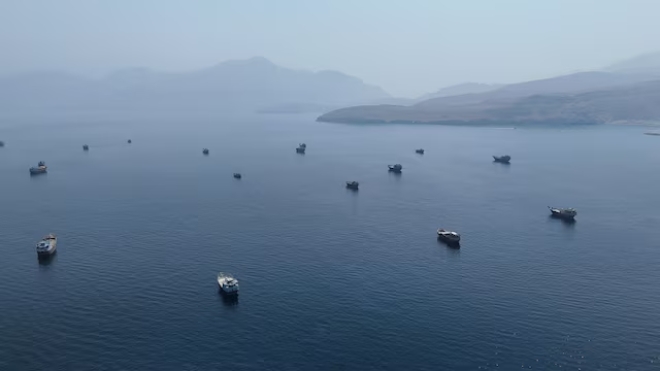
What makes this spike different from the usual Hormuz drama is the speed of the reversal and the depth of the underlying supply anxiety. Twelve attacks on tankers in the strait were recorded between September 28 and October 2, according to US Naval maritime intelligence. Ship traffic through Hormuz fell to its lowest level since late July, data from Kpler shows. The attacks are not blocking the channel outright — vessels are still moving — but they are making the passage expensive and unpredictable in a way that markets hate.
The psychological shift is arguably more consequential than the physical disruption. Traders who had gone flat on geopolitical risk just weeks ago are now scrambling to rebuild their hedges. Put options on Brent have steepened across the curve, and the cost of insurance for tankers transiting the strait has climbed to levels not seen since the height of tensions in early 2024. Every attack sends a ripple through futures markets that extend far beyond the immediate supply question.
Where the Pressure Hits First
The immediate economic fracture line runs through Korean refining. South Korea’s three major refineries — S-Oil, GS Caltex, and SK Innovation — process vast quantities of Middle Eastern crude that transit Hormuz. When the strait tightens, crack margins compress not because demand falls but because input costs jump faster than product pricing can adjust. Korean refiners buy Brent-linked feedstock and sell into regional diesel and jet fuel markets that are already thin on spare capacity. A $105 Brent environment leaves little room for maneuver.
The Korean won’s movement adds another layer. A stronger dollar driven by energy import costs can weaken the won, which makes every barrel more expensive in local currency terms even before the crude reaches the dock. Korean energy desks are watching this dynamic closely, ahead of Western wires that tend to focus on the price number without connecting it to the refining margin squeeze downstream.
South Korea’s refining margins for Middle East-sourced crude have already contracted by roughly 18 percent since the beginning of the quarter, according to Argus Media data. That erosion was underway before the latest round of attacks, but the Hormuz escalation has turned a slow bleed into an acute crisis. Refiners are now cutting run rates at older, less efficient units — the kind of decision that signals structural stress rather than cyclical adjustment. Some analysts project that if Brent sustains levels above $100 for more than a month, at least one major Korean refinery could announce an unplanned turnaround simply to limit losses.
Why the IEA Can’t Outrun This
The IEA’s reserve release plan was always partial. The organization signaled acceleration of the 100 million barrel commitment, but that figure is only a slice of the roughly 400 million barrels the IEA proposed releasing back in March. Most of that earlier proposal had already been absorbed into pricing. The market had priced in a portion of the supply cushion and then priced in the rest when the G7 coordination looked concrete. What came before the Hormuz escalation was essentially a flat line.
Strategic reserves are a buffer, not a replacement for flowing supply. They can blunt a spike for weeks or months. They cannot replicate the continuous daily throughput of 17 to 20 million barrels of oil that historically move through the Strait of Hormuz — roughly one fifth of global consumption. Until alternative export routes scale up, which analysts at ANZ say they are not close to doing, the reserves function as a temporary shock absorber with a finite capacity.
There is also a coordination problem that the IEA has not fully resolved. The United States has signaled willingness to release from its Strategic Petroleum Reserve, but European and Asian IEA members have been slower to match the pace. Japan, the world’s third-largest oil importer, has yet to announce a specific volume for its latest release window. That hesitation matters because Asia is where the physical deficit will bite hardest — the region consumes roughly 45 million barrels per day and imports the vast majority of it through the very strait that is under attack.
The Shipping Calculus Has Shifted
A telling detail from the latest round of attacks is how producers are responding. Han Jeong-won, a commodities analyst at Australia and New Zealand Banking Group, noted that unlike previous episodes where tanker attacks led to an immediate pullback in Gulf shipments, current producers are absorbing hull damage risk rather than diverting cargo. The reason is structural: there is no credible alternative corridor at scale. The East-West pipeline from Saudi Arabia to the Red Sea moves a fraction of what flows through Hormuz. Iraq’s pipelines run near capacity. The UAE has some routing flexibility. None of it comes close to replacing what the strait carries.
That means each attack is not just a headline risk — it is a direct reduction in effective supply. Tankers reroute, insurance premiums rise, delivery schedules stretch. The physical market absorbs the cost before the financial market fully reprices it.
The insurance dimension deserves particular attention. War-risk premiums for the Persian Gulf have climbed to levels that make some charterers reconsider entirely. Lloyd’s syndicates are reportedly tightening terms on new policies, and the waiting period for claims settlement has lengthened. That creates a feedback loop: higher insurance costs slow shipping activity, which reduces throughput, which tightens the physical market further, which pushes prices higher, which justifies even higher insurance costs.
A Hurricane Adds to the Noise
While Hormuz tightened, a storm moving toward the US Gulf of Mexico forced some offshore producers to shut in output and refineries to brace for disruption. The overlap is notable. The US Gulf accounts for a meaningful share of global refined product exports — diesel, gasoline, jet fuel — and any sustained shutdown there narrows the alternative supply that normally eases Middle Eastern disruptions. Two stress points in two different basins, happening at the same time, is exactly the pattern that keeps trading desks awake.
The Gulf of Mexico incident is weather-driven and likely transient, but its timing amplifies the Hormuz story. When the IEA’s reserve releases were supposed to provide a safety net, the simultaneous disruption in the US Gulf means that cushion is being drawn down from both ends. Analysts at Goldman Sachs estimate that the combined effect of reduced Gulf production and Hormuz-related shipping friction could shave 1.2 million barrels per day off available global supply in the coming weeks — a figure that exceeds the IEA’s announced reserve release volume for the same period.
Second-Order Effects Already Emerge
The ripple effects are extending well beyond oil markets. Natural gas prices in Northeast Asia have ticked upward as refiners consider switching feedstock to lighter crude alternatives that compete with LNG-fired power generation. Airlines are locking in fuel hedging contracts at premiums that rival late-2022 levels. Trucking companies in the United States, already operating on thin margins, are passing fuel surcharges onto shippers for the first time in six months.
Currency markets are reacting as well. The Iranian rial strengthened slightly on speculation that energy revenue would hold, while the Turkish lira came under pressure from the import bill outlook. In Europe, industrial consumers facing dual pressures from gas and diesel costs are weighing whether to curtail output before winter.
Who Wins, Who Loses, What Comes Next
Refiners in import-dependent Asia lose first. Margin pressure compounds as feedstock spikes and product markets struggle to pass through costs quickly. Consumers in Europe and Asia face higher pump prices within weeks, not months. Airlines and shipping lines that hedge further out feel the pain later but harder. Producers with low-cost inland output — shale in the Permian, offshore Brazil, North Sea late-cycle fields — gain relative leverage as Hormuz-dependent supply becomes risk-weighted higher.
The next few weeks will test whether the IEA’s reserve releases actually move the physical market or just the sentiment around it. If tanker attacks continue at the current pace, even partial reserve injections will look like bandages on a bleed. If traffic through Hormuz stabilizes, the $105 level could prove to be a ceiling rather than a floor.
One thing is clear: the market is learning again that strategic reserves and diplomatic assurances are weak substitutes for an open strait. The 100 million barrels the IEA has pledged represent roughly eight days of global consumption — a meaningful buffer, but one that disappears faster than political processes can replenish it. Until the fundamental geometry of global oil flows changes, which it is not close to doing, every incident in the Strait of Hormuz will carry the same disproportionate weight it has carried for decades.