Hormuz Chokehold: How Iran's Strike on Saudi Oil Could Redraw Global Fuel Markets
Brent crude just breached $107 after Iranian strikes hit Saudi infrastructure and commercial shipping in the Strait of Hormuz. The disruption threatens to reshape Asian fuel costs, OPEC+ leverage, and central bank inflation strategies.
The numbers are already moving
Brent crude surpassed $107 a barrel on Monday morning, up nearly 3 percent from the prior session. West Texas Intermediate, the North American benchmark, climbed toward $103. The trigger was straightforward: Iranian strikes on Saudi oil infrastructure and an escalation of attacks against commercial vessels transiting the Strait of Hormuz.
But the price move tells only the first sentence of the story. The real story unfolds in the second-order effects — the ways a disrupted Hormuz reshapes who pays what for fuel across Asia, how OPEC+ recalculates its leverage, and how central banks already juggling stubborn inflation now face a new input cost they cannot control.
Who pays first: Asian refiners
The Strait of Hormuz handles roughly 21 million barrels of oil per day, according to industry estimates. That is nearly a fifth of global petroleum consumption. When commercial vessels stop moving through it with any confidence, the freight premiums appear first in places that import heavily and hold thin inventories.
South Korea, Japan, and India are the immediate casualties. These three economies refine massive volumes of crude and ship most of it through the strait on their way home. A sustained disruption forces them onto longer routes, raises insurance premiums, and narrows the window between when cargoes are ordered and when they arrive. The penalty is not abstract. It lands on the price of diesel and jet fuel at the pump.
China has more storage and more alternative supply routes, but even Beijing feels pressure when Hormuz tightens. The country is the world’s largest oil importer, and its refineries are calibrated for a steady flow of Middle Eastern crude. Diverting shipments around the Cape of Good Hope or sourcing heavier, more expensive grades from other basins raises margins across the board.
Trump said over the weekend that global diesel shortages were not a Middle East problem but a Russian one, directing criticism at Ukraine for strikes on Russian oil facilities. The claim is strategically useful for domestic politics, but it does not change the physics of supply. Diesel is a refined product, and refining capacity is concentrated in Asia and Europe. When the crude feeding those refineries becomes scarce or expensive, the product follows.
OPEC+ recalibrates
Oil prices above $107 change the math for every producer in the OPEC+ framework. The cartel and its allies have spent years managing supply to keep prices in a band that satisfies members with different fiscal breakeven points. Saudi Arabia needs roughly $85 to $90 per barrel to balance its budget under normal conditions. Iran needs far less. Russia needs somewhere between $55 and $65 depending on the discount it accepts on Urals crude.
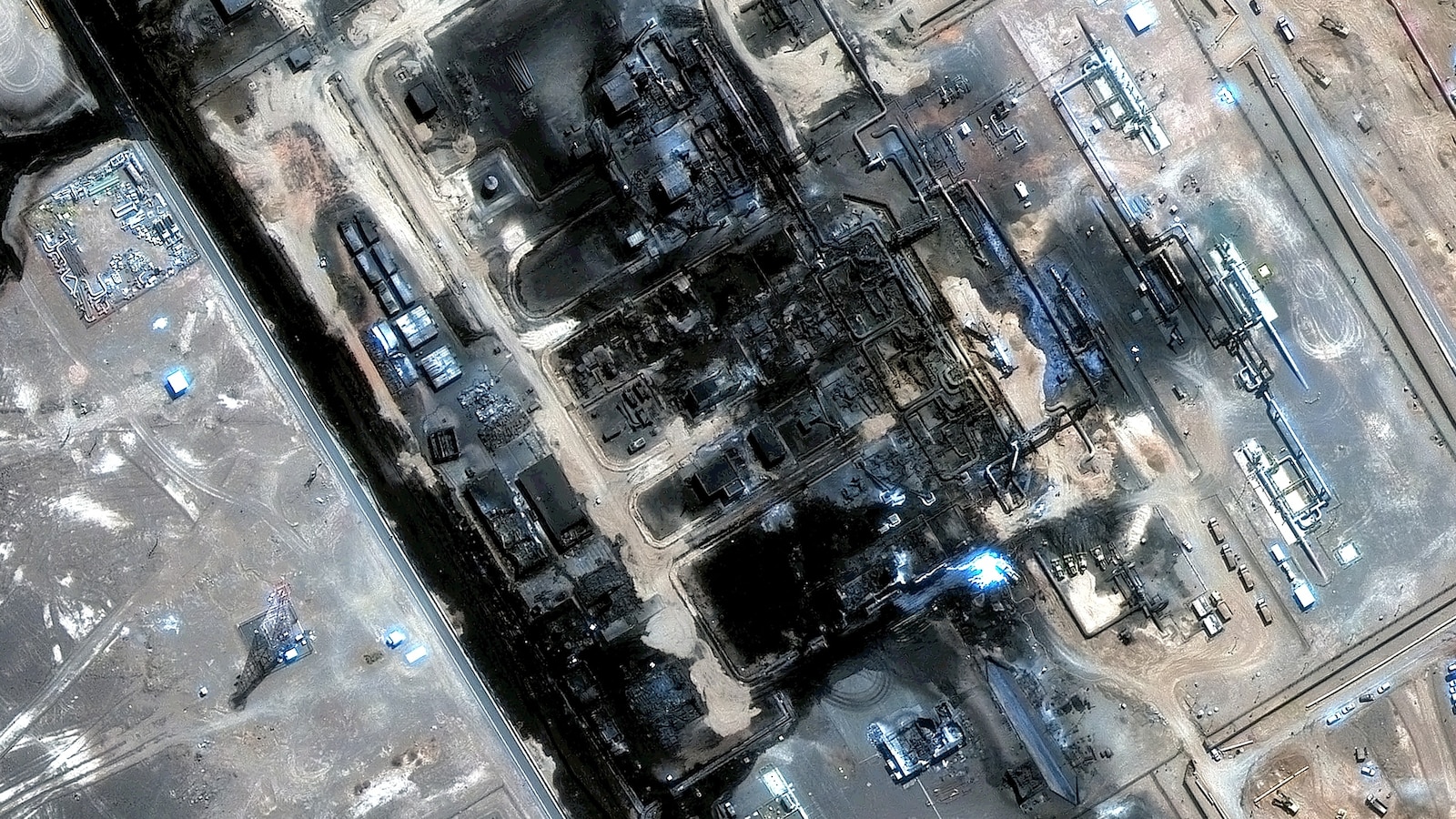
When prices spike without OPEC+ production increasing, the alliance faces a credibility problem. Members will argue that the rise is exogenous — caused by war, not by their own output decisions — and therefore they should not be asked to add barrels. That argument carries weight when the disruption is as visible as the Iranian strike on the East-West pipeline pumping station near al-Mesabaah, which satellite imagery from Vantor confirmed was struck and set ablaze on September 13.
Saudi Arabia’s East-West pipeline is a strategic artery. It moves crude from the eastern production fields to the Red Sea coast, bypassing the Strait of Hormuz entirely. If that pipeline is damaged, Riyadh loses one of its few credible alternatives to the strait. That is a double hit: it reduces export capacity and signals that even the bypass routes are vulnerable.
The postponed meeting in Salalah, Oman, between Iranian and regional representatives was meant to discuss shipping arrangements through the strait. Its cancellation tells you something about the temperature in the room. If no one is willing to meet, no one is willing to negotiate a de facto ceasefire for commercial shipping. Without that, the disruption will persist long enough to reshape forward curves and force buyers to pay higher risk premiums.
Central banks face a new input
The Federal Reserve, the European Central Bank, and the Bank of England all entered this cycle watching inflation that refused to behave the way models predicted. Energy prices were a known variable, but they were manageable — or so policymakers assumed. A Hormuz disruption injects a shock that no model trained on peacetime data can fully capture.
Higher oil prices feed into transportation costs, which feed into food prices, which feed into wage demands. The transmission is slower than a direct tax increase but broader in scope. Central bankers cannot raise rates to fight an oil-driven inflation spike without deepening a separate problem: slowing growth.
Trump suggested on Sunday that the war would end right after the midterm elections and that gasoline prices would drop quickly once it did. That framing assumes markets will believe the timeline and adjust prices accordingly. History is not kind to politicians who bet on rapid price corrections after supply shocks. The 1973 oil embargo ended, but prices did not return to pre-crisis levels overnight. The 1990 Gulf War saw a similar pattern. Supply disruptions create price trajectories that outlast the conflict itself.
What happens next
The next two to four weeks will determine whether this episode remains a sharp price spike or becomes a structural repricing of Middle Eastern supply risk. Several variables matter:
- Whether Iran continues to target commercial vessels in the strait. Even intermittent attacks raise insurance costs and slow throughput.
- Whether Saudi Arabia can repair the East-West pipeline damage quickly. Each day of reduced capacity keeps more crude trapped in the kingdom and pushes global supply tighter.
- Whether OPEC+ responds by adding volume. If the alliance holds firm, prices stay elevated. If it concedes and opens taps, the price reaction may soften but the political signal weakens.
- Whether diplomatic channels revive. The Salalah meeting was postponed, not abandoned. Oman has historically played a quiet mediator role. If Muscat can deliver a tentative understanding on shipping, the worst of the disruption may ease without a broader political settlement.
The market will price in these outcomes incrementally. For now, Brent above $107 is a warning, not a verdict. The question is whether the warning gets ignored or acted on.
The political calculus
Trump’s comments about blaming Ukraine for diesel shortages and dismissing the Oman meeting were consistent with a political strategy that separates the conflict from domestic cost pressures. He also hinted that the U.S. might eventually secure access to Iranian oil, drawing a comparison to Venezuela. The message is clear: whatever the disruption costs the world, America can extract a deal that benefits it.
That framing may resonate domestically. It does not change the fact that the global economy is now pricing in a higher risk premium for Middle Eastern crude. Asian buyers feel it first. European refineries feel it second. American consumers feel it last, but they feel it still, because the dollar is the settlement currency and global benchmarks move in tandem.
Central banks will watch the data carefully. If energy-driven inflation proves persistent, rate decisions that were already in question become harder to justify. Growth forecasts that assumed stable energy input costs require revision. The cost of doing nothing rises with every week the strait remains contested.
The strikes on Saudi infrastructure and the targeting of Hormuz shipping are not isolated military events. They are economic events with geopolitical roots. The prices moving today reflect that reality. The question for the rest of the year is whether policymakers treat them as background noise or as a signal worth responding to.