Hormuz Attack Record Reshapes Shipping Costs and Oil Markets
Thirty-seven vessel attacks in the Strait of Hormuz last month mark a brutal escalation. Non-Iranian tanker traffic also hit a record 418 ships — a paradox that reveals how insurance, rerouting, and oil pricing are being rewired in real time.
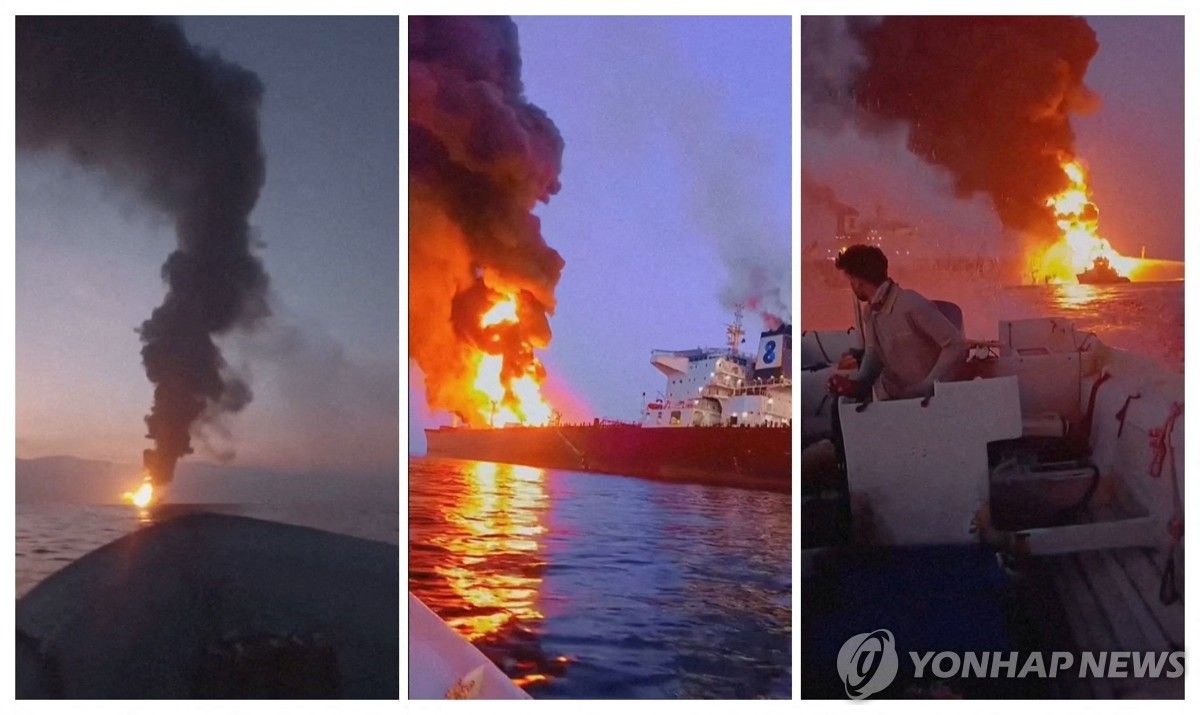
The Paradox at the Bottom of the Persian Gulf
Here is a number that should keep every energy trader up tonight: thirty-seven. That is how many vessels were attacked in or near the Strait of Hormuz last month alone, according to Yonhap News Agency citing foreign media. It is the highest monthly tally since full-scale war erupted in February following US and Israeli strikes on Iran.
Fourteen more attacks have been confirmed this month. On the 13th, Iran’s Islamic Revolutionary Guard Corps announced that a liquefied gas carrier struck a mine in eastern Hormuz and suffered a massive explosion.
And yet — and this is where the story gets uncomfortable — 418 non-Iranian tankers transited the strait last month, also a monthly record.
Traffic is flowing. The water is not empty. But calling this “normal” would be dangerously naive. Foreign correspondents reporting from the region have noted exactly that: the strait is recovering, yes, but it is not restored. And another deliberate attack is highly likely.
Who Is Attacking Whom — and Why It Matters for Your Gas Bill
The perpetrators matter less than the pattern. Iran’s IRGC Navy is conducting a systematic campaign against vessels it claims lack authorization to operate in Iranian waters. The legal framework is thin — the Hormuz Strait is a natural chokepoint, and under international law no single country can suspend transit. But authority and enforcement are two different things, and the IRGC has made abundently clear it intends to enforce its own version of the rules.
Meanwhile, the Houthi rebellion in Yemen — Iran’s most capable regional proxy — is expanding its strike zone. Two ballistic missiles recently hit a Saudi military troop concentration in Jizan province, home to an Aramco refinery processing 400,000 barrels per day. The Houthis have also claimed strikes against Saudi Arabia’s East-West petroleum pipeline and Aramco facilities near Riyadh, though Saudi officials have neither confirmed nor denied those attacks.
This is not a contained maritime dispute. It is a multi-front energy siege.
The Insurance Math Is Already Changing
Here is what English-language coverage of Hormuz has largely missed: the war algebra is happening in reinsurance markets in London, Geneva, and Bermuda right now.
When attack frequency triples in a single month while transit volume simultaneously hits record highs, the risk model breaks. War-risk premiums for the Persian Gulf corridor do not adjust linearly — they jump. Every incident forces a reassessment of hull-and-machinery policies, crew safety protocols, and alternate routing viability.
The key question is whether insurers will continue to cover vessels transiting Hormuz at current premium levels or whether they will impose geographic exclusions that force shippers onto longer routes. A vessel diverting around the Arabian Peninsula instead of cutting through Hormuz adds roughly 3,000 to 4,000 nautical miles to certain routes — significant fuel cost, significant delay, significant carbon footprint.
This is why the record tanker traffic figure is actually alarming rather than reassuring. If 418 tankers are pushing through a corridor where 37 were attacked in a single month, the risk transfer mechanism — insurance — is either being bought at wildly elevated prices or is about to become unavailable for a large segment of fleet operators.
What follows from that failure is worth tracking closely. Charter rates for covered vessels will escalate sharply as supply shrinks. Smaller and mid-tier operators who cannot absorb the premium differential will be forced out of the market entirely, concentrating capacity among a handful of well-capitalized firms. That concentration creates fragility — a single hull loss or crew casualty among that reduced fleet would amplify disruption far beyond what the raw tonnage numbers suggest.
Secondary markets in P&I (protection and indemnity) clauses are already showing stress signals. Clubs in London that typically handle long-tail liability are pulling back on new placements in the Horn of Africa corridor, forcing vessel owners to seek ad hoc coverage at premiums that can exceed 5 percent of a ship’s insured value — a figure that would have been unthinkable before 2024.
The Aramco Vulnerability Nobody Is Talking About Enough
Jizan’s 400,000-barrel-per-day refinery sits in a province that is now within proven missile range of Houthi launch positions in Yemen. The East-West pipeline — Saudi Arabia’s primary export route for Eastern Province crude to the Red Sea coast — has been claimed as a target multiple times. Riyadh’s Aramco facilities sit deep inside the kingdom but remain vulnerable to drone and missile incursions that have become routine across the region.
Saudi Arabia processes roughly 9 million barrels per day of crude. Jizan alone accounts for nearly 5 percent of that capacity. A sustained disruption to Jizan operations or the East-West pipeline would create an immediate supply gap that cannot be quickly absorbed by other terminals — particularly if the Strait of Hormuz itself degrades further.
The knock-on effect extends beyond Saudi borders. refineries in India and South Korea that depend on Eastern Province feedstock would face allocation decisions — and allocation decisions in tight markets always mean higher prices somewhere else. Japan’s LNG term contracts, heavily weighted toward Qatari and Saudi volumes routed through Hormuz, would feel the pinch first, followed by European spot buyers competing for alternative cargoes already stretched thin.
Second-Order Effects Already Evident
The Strait of Hormuz crisis is generating ripple effects that extend well beyond crude futures. Freight forwarders report that container shipping rates through the Suez Canal have ticked upward as some cargo operators test alternatives to Gulf-bound routes, even though the detour around Africa remains prohibitively expensive for most dry-cargo flows. The result is a partial congestion shift rather than a clean rerouting — something that raises port dwell times and storage costs across Southeast Asia.
Gold prices have drifted higher as investors price in energy-supply uncertainty, while petrochemical equities in the Gulf Cooperation Council states have seen widened spreads relative to European peers. The dollar-denominated nature of Gulf hydrocarbon trade means that any sharp move in oil futures feeds directly into sovereign wealth fund valuations and, by extension, global capital markets through those funds’ diversified holdings.
Even unrelated regions feel the tremor. Philippine and Indonesian coal importers, whose freight curves run parallel to oil tanker schedules in parts of the Indian Ocean, have reported slower vessel availability as tanker owners hold positions longer in high-premium corridors rather than cycling to lower-yield trades.
What Happens Next
Three scenarios deserve serious attention over the coming weeks:
First, the status quo hardens. Attack rates stabilize at current levels, insurance premiums climb steadily, and shippers absorb the cost through freight rate increases. This is the most likely path and it means higher transportation costs embedded in every barrel of crude and every container of LNG moving through the Gulf.
Second, a single catastrophic incident — a tanker fire, a casualty among crew, a blockage of the strait — triggers a rapid escalation. Insurers pull coverage. Vessels reroute en masse. Oil prices spike on supply fear rather than actual supply disruption, which is sometimes worse because panic moves faster than infrastructure.
Third, diplomacy creates breathing room. This remains unlikely given the current trajectory of Iran-US tensions, but even temporary de-escalation would immediately compress insurance differentials and restore some certainty to chartering markets.
There is a fourth possibility that deserves mention precisely because no one wants to discuss it publicly: a negotiated arrangement under which Iran agrees to limit mining and harassment in exchange for tacit economic concessions — relaxed sanctions enforcement, unofficial revenue channels reopening. This has happened before in smaller forms and could resurface. If it does, the insurance market would restart pricing from yesterday, not from zero, meaning volatility would persist even amid calm. Markets remember the last rupture longer than participants wish they did.
The Data Point That Should Anchor Everything
The data point that should anchor policy discussion is this: the strait carries approximately 20 percent of global oil consumption and roughly a third of all traded LNG. Thirty-seven attacks in one month is not a regional incident. It is a stress test on the global energy system — and the system is currently passing it by default, not by design.
Every tanker that transits Hormuz this month is doing so because the alternative — a four-thousand-mile detour, a withdrawn insurance policy, a missed delivery window — is worse in the short term. That calculus will hold until it does not. When the moment of rupture arrives, it will not look like the previous thirty-six attacks. It will look like one attack that everyone wishes had been treated as the warning sign it was.