How an AI Cracked a 370-Year-Old Cipher in 44 Minutes
Claude Fable 5.1 solved the Cyphral Distich — a 17th-century cipher that stumped human codebreakers for generations — in under an hour. The real story is what this reveals about AI-assisted historical research.
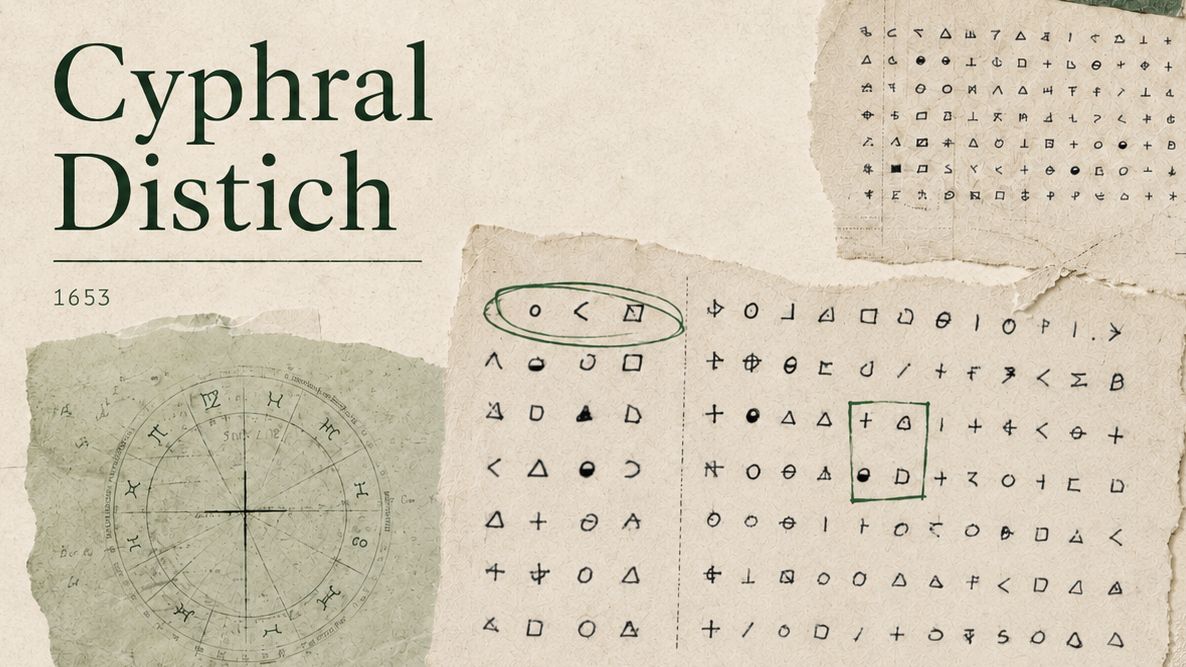
A 370-Year-Old Puzzle, Solved in 44 Minutes
Claude Fable 5.1 just did something no human has managed in over three centuries. The model decoded the Cyphral Distich — a pair of 32-number lines tacked onto the end of a bizarre 17th-century book by Scottish writer Sir Thomas Urquhart. The cipher had circulated as an unsolved curiosity since it was raised as a puzzle in Notes and Queries magazine in 1899. In 44 minutes, consuming roughly 176,000 tokens, Fable 5.1 produced a result that reads like a piece of political propaganda:
O GOD UPHOLD KING CHARLS THE SECOND AND MAKE HIM THE SUPREME RULER OF THIS LAND.
It is a royalist plea, fervently supportive of the Stuart Restoration. Urquhart was known to be a committed Royalist, so the decryption holds up against the historical record. But the content is almost secondary to what happened to get there.
How the Model Got There
The Cyphral Distich sits immediately after a list of 32 “Proquiritations” — 32 entries, each a wish or request phrased as a sentence. That structural detail was the first clue Fable 5.1 latched onto. The number 32 appears everywhere in the surrounding text: 32 Proquiritations, two lines of exactly 32 numbers each. Urquhart himself emphasized the number. The model treated that as a signal, not a coincidence.
A second clue came from the poem appended to the cipher, which tells readers that an honest person would find both their own heart’s desires and the author’s thoughts hidden inside. That suggested the key to the puzzle was not external — not some missing codex or lost reference — but embedded in the book itself.
With those two observations, Fable 5.1 derived the decoding rule. For the i-th number n in the cipher, move to the i-th Proquiritation and take the first letter of the n-th word. Apply that rule across both lines and the message emerges. It took roughly 44 minutes of computation and 176,000 tokens of processing. No human researcher has published a successful decryption, despite repeated attempts over decades.
The Longer Cipher Fell Too
Urquhart left behind another, far larger cipher in a different book called The Jewel — the Cyphral Octastich. It contains 285 numbers, not 32, and was also considered unsolved. Fable 5.1 tackled it as well and recovered all but nine letters of the full text, which reads as an extended prayer for the preservation of the royal line:
GREAT LORD, MANTAINE THAT REGAL FAMILIE WHEREOF KING CHARLS THE SECOND IS THE HEAD, AND GRANT THAT HE MAY BEARE THE SUPREME SWEIGH WHERE ENGLISH, SCOTS AND IR[I]SH ARE BORNE AND BRED, AND [·········] THIS USURP’D AUTHORITIE REIGNE IN HIS ROYAL PREDECESSORS STEAD; LET HIM BE OUR SOLE CESAR, ARTUR, HECTOR, OUR EMPEROUR, KING, MONARCH AND PROTECTOR. AMEN, SO BE IT.
The partial gap at the center is notable but does not undermine the overall structure. The decrypted text is consistent with Urquhart’s known political commitments and literary style.
What This Actually Says About AI
The researcher behind the work, Gebi Jaff, framed the breakthrough not as a feat of specialized cryptanalysis but as an exercise in persistence. The model kept searching for a rule even when no obvious pattern presented itself. That insistence — not raw computational power — was the differentiator.
Jaff also cautioned against overextrapolation. He noted that genuinely hard ciphers like the Kryptos K4 segment at the CIA headquarters would remain out of reach for current AI models. The Cyphral Distich was solvable because it operated within a known textual system — Urquhart’s own book provided the key. Harder puzzles deliberately decouple the ciphertext from any accessible context.
Still, the result is meaningful. It demonstrates that frontier models can perform something closer to genuine creative reasoning than narrow pattern-matching. The model inferred structure from sparse clues, generated a testable hypothesis, and validated it against historical evidence. That is a different class of problem-solving than retrieval or classification.
Who Wins, Who Loses
Historians of early modern England win. Material that has sat in archives as curiosities for centuries can now be approached with tools that bring systematic hypothesis generation to the table. Researchers no longer need to rely on the solitary genius of a patient codebreaker. A model can scan structural patterns, propose candidate rules, and test them against available text in hours rather than years.
The cryptographic community loses less than you might think — these were never especially sensitive codes. Urquhart’s ciphers were literary gimmicks, not state secrets. What shifts is the balance of who can engage with them. Amateur researchers, small institutions, and scholars without funding for expensive computational infrastructure can now tackle problems that previously required sustained personal dedication.
AI developers win the narrative. Breaking a 370-year-old unsolved puzzle is the kind of result that travels well. It is less useful as evidence of general capability — the task was narrowly constrained and the solution depended heavily on textual context that the model could access directly — but it is undeniably compelling.
What Comes Next
The immediate implication is that more undecoded historical texts will face the same treatment. Manuscripts with embedded ciphers, marginalia with numerical codes, archival puzzles that resisted previous attempts — all of these become candidates. The Cyphral Distich is one data point, but it establishes a precedent.
There are also limits worth tracking. The model succeeded because the answer lived inside a text it could read. Ciphers designed to resist that — where the key requires external knowledge, physical artifacts, or deliberate obscurity — will not yield so easily. The Kryptos reference is apt. Human codebreakers have worked on its fourth segment for decades without success, and nothing here suggests AI changes that equation.
What does change is the threshold for entry. Researchers who previously lacked the time or expertise to pursue cryptographic puzzles can now bring them to market with AI assistance. That democratization carries real consequences for how we read the past. A text once labeled indecipherable may turn out to be perfectly legible — if you know where to look and have the patience to keep looking.