How Iran's Air Blockade Could Backfire on the Dollar System
The US air blockade on Iran is the most aggressive financial chokepoint yet, but it risks accelerating dollar defection among Middle Eastern and Asian partners — especially China, Turkey, and the UAE.
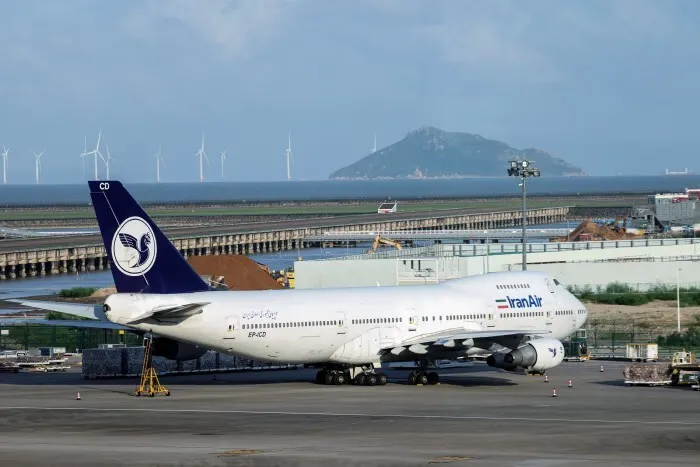
The Sky Falls on Tehran
The United States has moved from maritime pressure to total aerial containment of Iran. On January 22, the Treasury Department announced it would penalize any foreign company providing fuel, landing services, or ticketing to Iranian carriers. The list of targeted entities includes Mahan Air — Iran’s largest civilian airline, long linked to the Islamic Revolutionary Guard Corps — along with 27 additional airlines.
Scott Bessent, the US Treasury Secretary, did not mince words during a CNBC interview the day before. If an Iranian plane lands on your tarmac and you refuel it, you cannot sell tickets to its routes and you will be expelled from the dollar system.
This was not a subtle message. It was a threat to every airport, every airline, and every bank that has kept even minimal commercial ties with Iran.
Neighbors Close Their Doors
The response from regional capitals was swift. Iran’s own Civil Aviation Organization confirmed on January 23 that all flights from Tehran to Baghdad and Muscat were cancelled effective midnight. Georgia and Azerbaijan — the latter a close Israeli ally — immediately banned all Iranian carriers from their airspace and airports.
The most consequential shift came from Turkey. Ankara had consistently resisted implementing the full range of US secondary sanctions on Iranian trade, maintaining commercial flights and shipping routes through Tehran. Last week, Turkey announced it would suspend Iranian passenger flights and formally join the sanctions framework against Iranian banks. For a NATO member that has served as one of Iran’s primary economic lifelines to Europe, this represents a significant strategic realignment.
But the map of who stays open tells its own story. Flights continue to operate between Tehran and Moscow, Shanghai, Guangzhou, and Dubai. China’s Foreign Ministry issued a statement on January 22 calling Sino-Iranian cooperation under principles of mutual respect and mutual benefit legitimate — a clear signal that Beijing does not recognize Washington’s extraterritorial authority over bilateral trade.
Vietnam, Thailand, Afghanistan, and Pakistan also maintain flights to Iran, suggesting a growing gap between Washington’s declared policy and the actual behavior of non-Western governments.
The Dollar as a Deterrent, and a Warning
Bessent’s threat to expel violators from the dollar system is the most consequential element of this escalation. The US Treasury is effectively declaring that the world must choose between maintaining commercial ties with Iran and retaining access to dollar-denominated clearing, settlement, and reserve systems.
This is not new in principle. The US has used dollar access as a sanction tool for decades, most notably against China’s Huo Xing Bank in 2018 and later against multiple Russian financial institutions after the Ukraine invasion. But the scope of the Iran announcement is broader than previous actions. It targets not just Iranian entities but any foreign business — including in allied countries — that provides routine commercial services to Iran’s aviation sector.
The effect should not be underestimated. Airlines cannot fly without fuel. Airports cannot function without landing rights. By making both contingent on US approval, Washington is extending its financial jurisdiction across the skies of the Middle East and Central Asia.
Who Wins, Who Loses
Mahan Air is the immediate target. The Washington Institute’s Matthew Levitt, a former Treasury official, noted that the sanctions represent a formal, rigorous enforcement effort that could reduce Iran’s international carriers to domestic-only operators if global service providers comply.
Iranian civilians bear the heaviest cost. Airlines have long served as conduits for pharmaceuticals, auto parts, and other essential goods into Iran. The Wall Street Journal reports that overland routes through Iraq are already experiencing severe bottlenecks as maritime access has been constricted by the parallel naval blockade. Adding an air blockade deepens the logistics crisis.
Regional allies lose influence. Turkey’s compliance signals that even countries previously willing to buffer Iranian trade are reconsidering their posture under US pressure. The UAE, home to Dubai — a major aviation hub — faces an uncomfortable calculation: continue commercial relations with Iran and risk US financial retaliation, or enforce the blockade and alienate a significant trading partner.
The US gains tactical leverage in the short term. It narrows Iran’s mobility, restricts its capacity to import goods, and signals to other adversaries the cost of maintaining ties with Tehran. But the strategic costs are less visible and likely to accumulate.
The Dollar Defection Risk
Here is what Western reporting has largely missed. Every time the US weaponizes dollar access to enforce unilateral sanctions, it accelerates the incentive for other countries to build alternative financial infrastructure.
China already operates the Cross-Border Interbank Payment System, an alternative to SWIFT. Russia has expanded use of its own system following sanctions after 2022. Iran has long pursued alternative payment mechanisms with China and others. These systems are not yet comprehensive replacements, but they are incremental, practical, and growing.
The latest sanctions announcement effectively dares countries like China, Turkey, and the UAE to find workarounds. It is the same dynamic that has driven gradual de-dollarization in other sanctioned economies — not through grand design, but through repeated necessity.
For Korea, which imports a significant share of its energy through Middle Eastern routes and maintains trade relationships across the region, the stakes are direct. Seoul depends on stable Gulf shipping lanes and has historical commercial ties with Iran that predate current tensions. The question for Korean policymakers is not whether to choose between Washington and Tehran, but how to position financial channels in an environment where US secondary sanctions are expanding into aviation and regional trade corridors.
What Comes Next
Iran’s aviation sector is now functionally partitioned. International routes to Western-aligned states are closed. Routes to Russia, China, and a handful of other partners remain open but increasingly isolated. The domestic network will survive, but the economic hemorrhage from restricted imports will intensify.
The deeper consequence is structural. The US has now explicitly tied daily commercial aviation services to dollar-system access for the first time on this scale. Other countries watching — particularly those subject to or sympathetic toward US sanctions enforcement — are recalculating the reliability of dollar intermediation for their own essential trade flows.
Bessent warned that noncompliance means expulsion from the dollar system. The implicit counter-warning is that such expulsions, multiplied across enough actors, may eventually leave the dollar system itself less dominant than it was before the sanctions began.
That tension — between coercive power and systemic erosion — is the real story behind Iran’s closed skies.