Hyundai's Louisiana Steel Play Is a Bet on America's Industrial Future
Hyundai and POSCO are building America's first electric-arc furnace steel plant for auto-grade steel, producing 2.7 million tons annually by 2029. CEO Jeong On-Sun says the output will power cars, robots, rockets and data centers—part of a wider $260 billion US industrial push.
A blast furnace for the next century
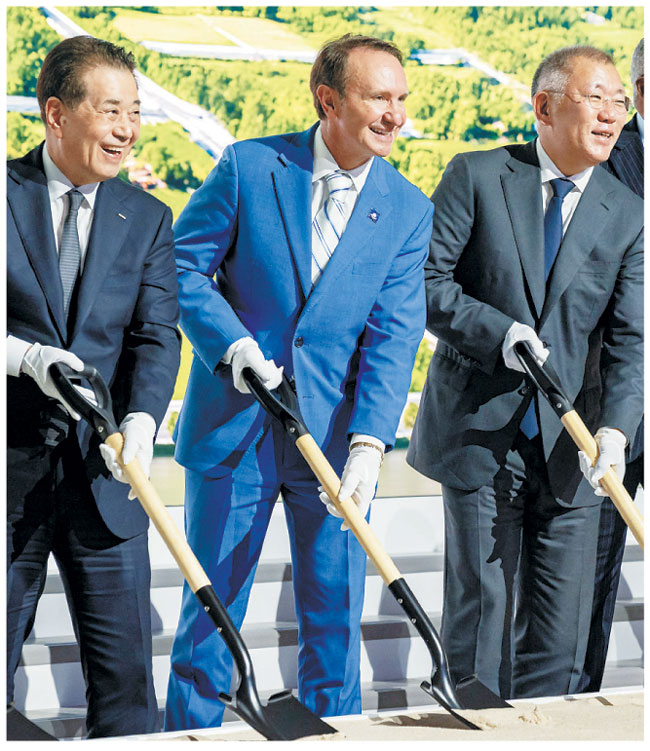
Jeong On-Sun stood on a patch of Bayou Teche farmland in Ascension Parish, Louisiana, and told reporters his company would soon make steel there—not just for cars, but for robots, rockets and data centres.
His words were measured. The gesture beneath them was not.
The groundbreaking on 4 July marked the first real step in what is now being called the “Jeong On-Sun model” of American investment: $260 billion committed across multiple projects, starting with a steel mill that Korea’s Hyundai Steel and parent POSCO are building together. The mill, formally known as HPLS, is designed to produce 2.7 million tonnes of hot-rolled, cold-rolled and coated steel sheet annually by 2029, half of it dedicated to automotive applications.
The site covers 73.7 million square metres—that is roughly 2.5 times the area of Yeouido, Seoul’s financial district. It is the first electric-arc furnace (EAF) plant in the United States built specifically for auto-grade steel. No one has done this at scale before.
Why the electric arc matters
A traditional integrated steel mill uses coke ovens and blast furnaces to turn iron ore into crude steel. An EAF melts scrap and direct-reduced iron (DRI) using electricity. The difference is not merely technical; it is geopolitical.
The US imports roughly 20 million tonnes of steel each year. Most of that is commodity-grade plate and rebar. The segment Jeong on-Sun is targeting—low-carbon, high-value specialty steel for vehicles—is thinner and harder to fill from overseas, especially as tariffs, shipping costs and Chinese overcapacity reshape trade routes.
By sourcing DRI from natural gas, which is abundant and cheap in the Gulf Coast region, HPLS can produce steel with a significantly lower carbon footprint than the average Asian mill. That matters for two reasons: US buyers increasingly demand lower embedded emissions, and federal incentives under the Inflation Reduction Act reward domestic low-carbon steel.
Hyundai Steel’s North America steel strategy lead, Kim Taek-jun, said the plant is expected to generate about $4 billion in annual revenue at full capacity, with operating margins comparable to other US EAF producers. He did not disclose a specific margin target, but the implication is clear: the company is betting that proximity to customers and lower carbon intensity will command a price premium over imported steel.
From cars to robots to rockets
What made Jeong On-Sun’s remarks unusual was not the steel plan itself, but where he said it would end up.
He named Boston Dynamics’ Atlas humanoid robot. He named SpaceX and other rocket manufacturers. He named AI data centres. All of these are emerging demand nodes that need strong, lightweight, precision-grade steel—and none of them currently have a reliable US-based supply.
Most Americans do not realise that the robotics and aerospace industries still depend heavily on imported specialty steel, much of it from Japan and Europe. A domestic source changes the cost curve. It also changes the risk profile for companies like Boston Dynamics, which already moves its manufacturing toward the US to stay close to its biggest market and its defence contracts.
SpaceX’s Starship programme, which requires vast quantities of high-strength, low-weight steel for its Super Heavy booster, is another obvious potential customer. Whether HPLS can supply rocket-grade steel at the volumes and specifications needed is an open question. But the intention is there, and the mill’s design is flexible enough to accommodate it.
Who wins, who loses
For Hyundai and POSCO, the play is vertical integration on American soil. Both companies have spent years building EV plants, battery factories and casting lines across the US Southeast. Steel is the missing upstream piece. Control it, and you control a critical input for every other investment in the chain.
For US automakers, including Ford and GM, the benefit is mixed. Hyundai is building this mill partly for its own use. But the company explicitly said it would sell to other American manufacturers as well. A competitive, low-carbon steel source near the heart of the US automotive corridor is a genuine addition to the landscape.
For Chinese steelmakers, the signal is less about direct competition and more about containment. China produces more than half the world’s steel and is flooding global markets with excess capacity, particularly in auto-grade variants. By anchoring a modern, clean mill in Louisiana, Hyundai is helping close the door on one of the channels through which Chinese steel could reach North American buyers.
For the US government, this is exactly the kind of industrial move it has been trying to encourage. The mill creates jobs, uses domestic natural gas, reduces import dependence and produces lower-carbon steel. It is hard to argue against it on any metric that currently matters in Washington.
What happens next
The plant breaks ground this quarter and targets production in 2029. That is a long runway, during which tariff policy, natural gas prices and global steel demand could all shift significantly.
The bigger question is whether Hyundai’s strategy scales. One mill is a statement. Multiple mills, or a network of specialised processors feeding different industry verticals, would be a transformation. Jeong On-Sun clearly imagines the latter. He framed this announcement not as an expansion of Hyundai’s automotive business, but as the foundation of an American industrial ecosystem.
Whether that ecosystem takes shape depends on execution, on demand from customers who may not yet know they need this steel, and on a US policy environment that has a habit of changing every four years.
What is certain is that the era of Korean automakers simply assembling cars in America is over. Hyundai is now building the raw material that goes into those cars—and then into the robots and rockets that may define the next decade of manufacturing.