Iran's Sanction Trap: Why Economic Warfare Is Backfiring at Home
The US has declared an 'economic D-Day' against Iran, but the target may not be the regime. New secondary sanctions are squeezing the very channels ordinary Iranians use to survive — and the protest geography is shifting in ways Washington may not expect.
The Lifelines Are the Target
Treasury Secretary Scott Bessent called it an “economic D-Day.” The goal was clear: sever Iran from the global financial system the way bombs once severed its infrastructure. But Esfandyar Batmanghelidj, who runs the Bourse & Bazaar Foundation think tank in Tehran, offered a simpler reading of the five targeted sectors — digital assets, technology, gold, aviation, and shipping — on X: these are the lifelines of ordinary Iranians, not the regime.
That distinction matters. The US Treasury is right that crypto, front companies, and informal gold trades help Tehran skirt sanctions. But they also help Iranians protect savings when the rial is in freefall, receive remittances from abroad, and access medicines and food that never arrive through official channels. Blurring those two categories is the strategy. And it is producing a specific kind of political damage.
A Currency Collapse With No Floor
To understand why this matters on the streets, you need to see the numbers. Inflation has surpassed 80 percent. Food prices for some staples have doubled. The rial, which triggered nationwide protests after its late-2023 collapse, has shed another 30 percent this year. The IMF projected a 6.1 percent contraction in April — the worst in decades. A labor ministry official estimated over one million jobs lost by late May.
That is not abstract data. It is the arithmetic of a household that now needs twice as many tomans to buy the same bread, cannot cash in crypto without being flagged, cannot access gold through formal channels, and finds the pharmacy shelves empty because shipping insurance has dried up.
The Blockade’s Hidden Logic
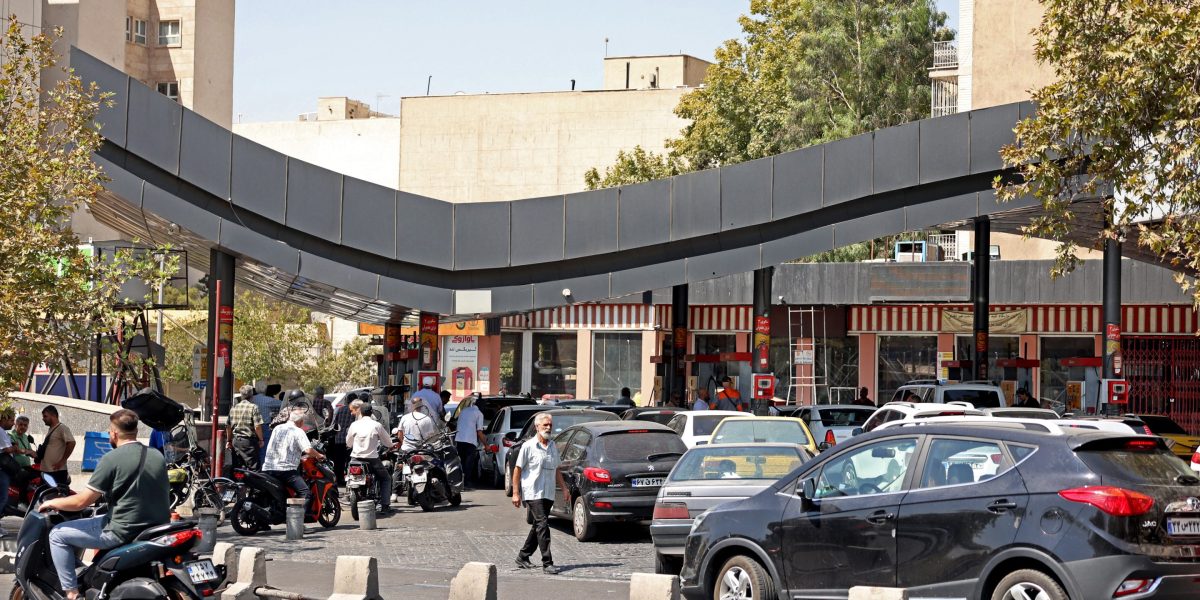
The naval blockade adds a layer that deserves more attention. Iran is a major oil producer. It should not be struggling to refine its own crude into gasoline. Yet refined-fuel imports have been blocked alongside exports, creating shortages and long gas-station lines. The government deepens subsidies to keep prices low and avoid inflaming demand further — but subsidies without foreign exchange are just promises. The result is a self-reinforcing loop: subsidies encourage consumption, consumption exceeds supply, shortages breed anger, and anger makes subsidy hikes politically toxic.
No official has admitted this is unworkable. But Mohammad Bagher Ghalibaf, the parliamentary speaker and chief negotiator, came closest during a trip to Iraq: “No matter how strong we are militarily, if the people are hungry and we do not have financial circulation, economic growth and domestic production, we will not endure.”
Note the phrasing. He did not say the regime will not endure. He said the country will not. That is a quiet admission of fracture.
Who Is Already on the Streets
Washington’s policy briefings tend to treat Iran as a monolith. The protest map tells a different story.
In Asaluyeh, the southern energy hub, oil and gas workers protested on Monday over a cost-of-living crisis that hit while they kept production online. Earlier, roughly 100 laid-off workers took to the streets at the Shadegan steel complex in the west. Petrochemical workers in the coastal city of Bandar-e Mahshahr protested layoffs. Teachers’ union members have publicly reported not receiving pay. None of these movements overlap. They are not coordinated. And they are not large enough yet to replicate the scale of January’s demonstrations, which drew millions before the government killed thousands in a brutal crackdown.
But the geography is telling. Asaluyeh, Mahshahr, and Shadegan are all industrial nodes — places where the economy still functions enough to generate workers who can afford to strike. When those nodes begin to fracture, the regime loses both revenue and the social contract that comes with employment.
The UAE Cut-Off
The United Arab Emirates shut down all trade and transactions with Iran earlier this month, removing another vital conduit to the global economy. For Iranian businesses and families who relied on the UAE as a financial and logistical bridge, that closure is immediate and personal. Remittances slow. Shipments stall. The informal economy — the one that kept much of Iran functioning under prior sanctions — loses a node it cannot easily replace.
The result will not be regime change. It will be a slower, more grinding crisis that makes the existing repression increasingly expensive for the state. Every protest demands security forces. Every security deployment costs money and legitimacy. Every loss of life stores resentment.
What Comes Next
Two scenarios deserve attention.
In the first, the Iranian government doubles down on repression while subsidizing essentials it can no longer afford. That buys time but deepens the fiscal hole. Subsidy hikes — whether implicit through inflation or explicit through policy — risk reigniting the kind of street-level anger that the January crackdown temporarily suppressed. The protest geography suggests that anger is already organizing around employment and basic survival, not ideology. That makes it harder to isolate or negotiate away.
In the second, hardliners block any diplomatic opening while moderates signal that time is running out. Ghalibaf’s remarks to Iraqi counterparts and his Wednesday address — describing “great, complex, and multiple open and hidden challenges” — point to an establishment that sees the economics clearly even as it refuses to concede politically. The regime will wait out economic hardship longer than Americans can endure high gas prices. But waiting assumes the hardship stays contained. It may not.
The Unintended Consequence
The Trump administration’s pivot from military action to economic warfare assumes that strangling Iran’s economy will pressure the regime into concessions. The evidence so far suggests the pressure is landing on civilians first, and civilians are already responding with localized strikes and protests. Whether that translates into sustained political change depends on whether the unrest can bridge the gap between dispersed grievances — workers in Asaluyeh, steel workers in Shadegan, laid-off petrochemical employees in Mahshahr, unpaid teachers — into a shared frame.
The sanctions are accelerating that pressure. They are also expanding the number of people who have something concrete to lose. That is the second-order effect no policy memo captures: when the state cannot provide, and the market cannot function, and the diaspora cannot remit, the grievance becomes personal. Personal grievances do not need a central organizer. They只需要 a spark.
The US may be right that economic warfare will accomplish what bombs could not. The question is what it will accomplish instead.