Japan's 100-Trillion-Yen Defense Just Failed
The largest joint forex intervention in history couldn't keep the yen above 160 a month later. What happens next for global carry trades and Japanese asset pricing could reshape how the world thinks about Tokyo's currency defense strategy.
The $100 Billion Lesson
Japan and the United States spent roughly $100 billion defending the yen in late July. They lost. A month after the intervention pushed the dollar below 158, the pair had slipped back to 160 by the end of August — the same level that triggered the original intervention. The market simply shrugged off the biggest coordinated forex action in history.
What happened is not a puzzle. It is a signal.
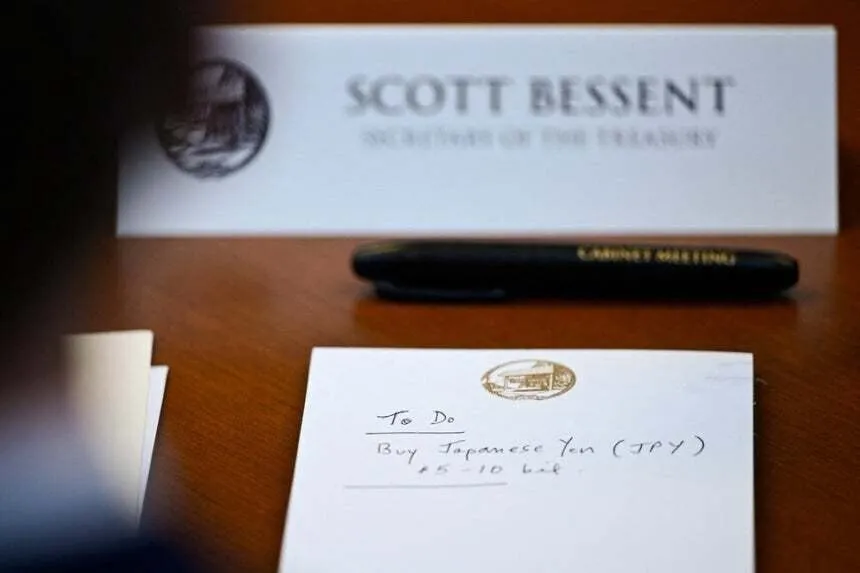
The numbers are instructive. Japan’s Ministry of Finance deployed 15.4 trillion yen ($103 billion) between June 30 and July 26, according to Hani’s reporting, with the vast majority hitting the market on June 30-31. The US side remains opaque but likely contributed between $5 billion and $10 billion, based on Treasury Secretary Scott Bessent’s confirmed memo reading “To Do, Japanese Yen purchase, $5-10 billion.” Combined, this was an unprecedented display of dollar-yen coordination. And it lasted three weeks.
But the mechanics of the failure deserve scrutiny. The intervention worked precisely as designed in the short term — yen buying pressure forced the dollar down from 162 to roughly 157.5 within days. What it did not do was alter the underlying calculus driving institutional sellers. Hedge funds that had piled into yen shorts during the spring did not unwind. Corporate importers continued converting dollars into yen at scale. And the carry trade, far from retreating, found new legs as traders borrowed cheaply in yen and rotated into higher-yielding assets across emerging markets and US Treasuries.
Warsh Changed the Rules Overnight
The turning point came at the Jackson Hole symposium on August 28. Kevin Warsh, the Federal Reserve chairman celebrating his first 100 days, delivered a speech that effectively handed the yen another blow.
“If we do not have confidence that baseline inflation is moving sustainably toward our 2% symmetric goal, then the Fed has a responsibility to act,” Warsh said. His words were carefully calibrated but unambiguous: the Fed was not done hiking, and the 9-month treasury yield was already pricing in a September increase. The yield curve shifted. The yen sold off immediately.
Yomiuri reported that bond market flows accelerated dollar buying and yen selling the same day. The 160 level, once treated as a firewall, became a magnet again.
Warsh’s speech did something more consequential than move a currency pair. It redefined the boundary between monetary sovereignty and bilateral obligation. For decades, Japan operated under an implicit understanding that the Fed would moderates its pace when the yen faced extreme pressure. That understanding died at Jackson Hole. The Fed, answering to domestic inflation targets rather than alliance management, signaled it would prioritize American price stability over Japanese currency stability. That message reverberated through every portfolio decision made by institutions holding yen exposure.
The Structural Problem Tokyo Ignores
Interventions cannot fix what Warsh’s speech exposed: the interest rate gap between the United States and Japan is widening, not narrowing. The Bank of Japan would need to raise rates aggressively just to stabilize expectations — and it has shown no appetite to do so.
Adam Posen of the Peterson Institute nailed the dynamic when he told Yomiuri that even a BOJ rate hike in September would be largely absorbed by the Fed’s momentum. “The US Treasury is actually hoping the BOJ raises rates,” Posen noted, because higher Japanese yields would strengthen the yen and reduce the need for further foreign exchange intervention. But hope is not policy.
Meanwhile, the Sanae Takaichi government in Tokyo is considering tax cuts and increased defense spending that would widen Japan’s already massive fiscal deficit. These are the exact policies that depress the yen over time. The government wants the economic stimulus and the geopolitical positioning, but it does not want to pay for them in currency terms. That math simply does not work.
Nomura’s research division flagged the same contradiction: intervention buys time, but the fundamental drivers — falling oil prices, a hawkish Fed, Japan’s own fiscal drift — are moving against the yen every day.
The BOJ faces a trap that no amount of forex spending can untangle. Raise rates too fast and risk breaking the fragile recovery in domestic demand. Raise rates too slowly and watch the yen continue its erosion. The central bank has chosen slow, and the market has priced that choice into every yen position.
Second-Order Effects Already Erupting
The consequences of this failed intervention extend well beyond currency quotes. Japanese pension funds and insurance companies, which hold enormous portfolios of foreign assets denominated in dollars, are watching their yen-denominated returns shrink as the currency weakens. The GlycoTech case that sent shockwaves through Asian markets last year was a warning. Similar pressures are building beneath the surface now.
Emerging market central banks are recalibrating. Thailand, South Korea, and Indonesia all hold substantial yen-denominated debt. A weaker yen raises rollover costs and forces tighter monetary policy at home, even when domestic conditions might call for easing. The IMF has flagged this contagion risk in recent briefing documents, though it stopped short of calling for coordinated action.
Japanese multinationals face a paradox. The weak yen boosts reported earnings when translated back to yen, making quarterly results look stronger. But it raises input costs for energy, food, and raw materials — everything Japan imports. The net effect is a redistribution of income from wage earners and savers toward corporate shareholders, deepening the inequality gap that Prime Minister Takaichi campaign promises to address.
Who Wins, Who Loses
The immediate winners are US exporters, American tourists in Japan, and the carry trade. The yen’s persistence below 160 means American companies can import Japanese goods cheaper and Japanese travelers face punishing costs abroad — a domestic political headache for Tokyo that the government seems willing to tolerate given its growth priorities.
The losers are clearer: Japanese households saving in yen, BOJ policymakers trying to normalize without breaking the economy, and emerging market central banks that relied on cheap yen funding to finance dollar-denominated debt. A weaker yen means higher rollover costs across Asia.
Global investors have also been wrong-footed. Many positioned for a sustained yen floor after the intervention, buying yen calls and shorting the dollar-yen spread. Those positions have been systematically squeezed. The next wave of losses will come from funds that assume the Japanese government will intervene again at 160 — because the mechanism is now predictable, and predictability is the enemy of intervention.
What Comes Next
Two scenarios dominate. The first is repeated intervention: Tokyo and Washington step in again if the yen breaches 165, pushing it back toward 160 for another few weeks before the cycle repeats. This is the status quo — expensive, ineffective, and destabilizing for market discipline.
The second is a fundamental shift: the BOJ raises rates significantly, the Fed pauses or cuts, and the yen finds a new equilibrium above 150. Neither side is moving in that direction. The Fed is talking about more hikes. The BOJ is talking about gradualism. Japan’s fiscal trajectory is expansionary. The path of least resistance remains a weaker yen.
The real question is whether the Japanese government recognizes that it has crossed a threshold. Past interventions in 2022 and 2024 failed at lower magnitude. This time, the combined US-Japan effort was the largest ever recorded, and it still failed within weeks. The market has learned that 160 is not defended with conviction — it is negotiated with exhaustion.
What English-language markets often miss is that this is not a crisis — it is a recalibration. The intervention window proved that even $100 billion cannot override monetary divergence. The yen will remain a vehicle for carry trades and a liability for Japanese importers until the rate differential changes. Until then, 160 is not a floor. It is a reminder.