Korea's AI Sprint: A Tricky Trio and a Government That Won't Score
SK Telecom, Kakao, and KT are racing to launch a national AI platform by year's end — backed by billions in government spending and a hidden scoring system that tells you everything about how Seoul plays the tech game.
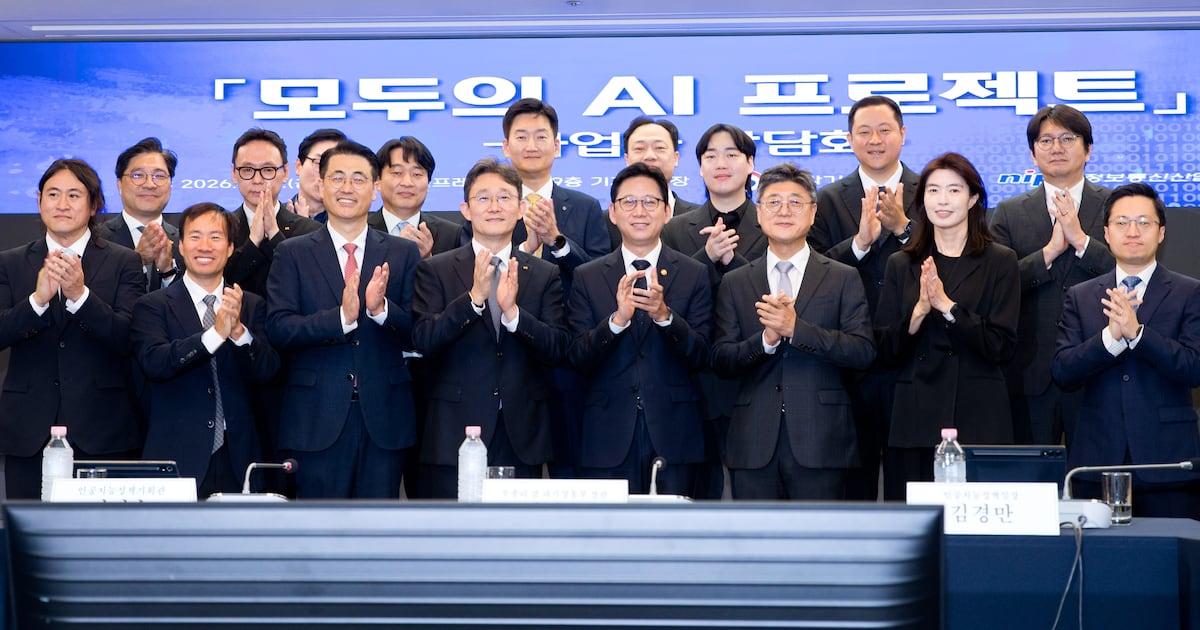
The Scoreboard Nobody Will Publish
The South Korean government just awarded three companies — SK Telecom, Kakao, and KT — a national AI project worth 2.5 trillion won ($1.8 billion) next year alone. It also gave them 512 Nvidia B200 GPUs right now. What it did not publish is the single most useful piece of information about the competition: the scores.
Deputy Prime Minister and Science and ICT Minister Bak Kyung-hoon’s ministry has drawn a line. Six consortia applied. Three were selected — the same three that dominate Korea’s digital life. The other three were rejected. The government says the margin between the winners was razor-thin and the gap between them and the losers was wide. That is the entire briefing on scoring.
It is a strategic choice. In a previous project, the DOKPAMO foundational model program, the government disclosed individual company scores after Motive’s consortium filed an objection. The fallout made officials uncomfortable this time around. So they let the companies decide whether scores would be revealed. The leader wants transparency; the lower-ranked players do not. The result is silence. What the government finally confirmed is that the three winners were essentially tied.
That ambiguity is the story here. It reveals how South Korea is trying to manufacture a competitive AI ecosystem from scratch — without the market signals that usually separate winners from losers.
Three Giants, Three Different Paths
The project, called Modu-ui AI (Everybody’s AI), is a government mandate to build a national chatbot and public AI agent platform rooted in Korean models rather than American or Chinese ones. The logic is blunt: if your citizens rely on foreign AI services, their lives can halt if prices spike or access is cut.
Each of the three consortia is pitching a different entry point.
SK Telecom is positioning itself as the utility play. Its service, built around the A.X K2 model, lets users call or text the number 1532 instead of opening an app. CEO Jung Jae-heon framed the argument in stark terms — Korea cannot afford to have the nation’s digital life stop because a foreign AI raises its prices. It is a sobering pitch aimed at an older demographic that has not fully embraced smartphone-first AI.
Kakao is playing the social-graph angle, partnering with LG Uplus, LG AI Research, LG Electronics, and LG CNS. Its large language model will combine Kakao’s own models (51 percent) with ExaOne’s (49 percent). The hook is simple: a dedicated entry point on the KakaoTalk friends tab, the messaging app that virtually every Korean uses daily. The goal is 5 million monthly active users this year and 30 million by 2030. CEO Jeong Sun-ah said the ambition is not to build a demo product but to make AI part of how Koreans live.
KT is taking a search-first approach through Daum, its portal search engine. It is aggregating Korean models from Upside, Motive Technologies, NC AI, and Salt Robotics to route requests to the best-fitting system. CEO Park Yoon-young called the project “Leeum” (Connection), emphasizing that the service must actually work in government, education, finance, and shopping — not just answer questions but execute tasks.
The Real Competition Is Hidden in the Budget
Here is where the design gets interesting. Of next year’s 2.5 trillion won budget, 170 billion won is earmarked specifically for GPU usage costs — enough to lease 2,000 B200 chips. But it will not be divided equally. The money will be settled based on actual usage. More users, more activity, more budget.
In other words, the government has built a competitive feedback loop into the infrastructure spend. The three winners are supposed to present a united front — Bak even insisted they operate as one brand — but the funding mechanism ensures they are also competing for usage data and user attention. The winner of that race gets the most compute next round.
Another 300 billion won goes directly to the three consortia — 100 billion each — while 500 billion won is reserved for expanding the AI agent ecosystem. That ecosystem investment is the longer bet: building the tools, the connectors, the infrastructure that turns a chatbot into a service platform.
Why the World Should Watch
South Korea is not Japan. It does not have a deeply domestic cloud market or a massive homegrown model like DeepSeek in China. Its tech champions — Samsung, SK Hynix, LG — are hardware and materials companies. The software layer has always been thin.
That makes the current push both ambitious and fragile. Korea has excellent semiconductor manufacturing and strong consumer internet companies, but those strengths do not automatically translate into AI platforms. The DOKPAMO foundational model effort was supposed to close that gap. Modu-ui AI is the commercial deployment phase.
The stakes are not abstract. If Korean AI remains dependent on US or Chinese models, two scenarios worry policymakers: price volatility in foreign services, and the risk that geopolitical shifts could cut off access. Both are real concerns for a country sandwiched between major powers.
But there is another risk the government is sidestepping by keeping the scores secret: accountability. Without transparent evaluation criteria, it is harder for companies like Eastsoft, MKD, and Zenon — the three that lost — to challenge the process or improve. The government insists the gap was wide, but it would be useful to see the numbers.
Who Wins, Who Loses
The immediate winners are the three consortia, each with guaranteed GPU access and a subsidized path to launch a national AI service. SK Telecom gains credibility as a national infrastructure provider. Kakao deepens its moat around everyday digital interaction. KT positions itself as a model aggregator in a space where it has previously been peripheral.
The losers are less visible. The three rejected consortia may carry talent and ideas that now lack a funding runway. Korean model developers outside the big players — especially those who pitched alone or in smaller groups — may find the ecosystem consolidating around the three incumbents faster than diversity would allow.
And Korean users are both the target and the collateral. The government’s framing suggests that if this project fails, Korea falls further behind. If it succeeds, it could produce a genuinely usable national AI service rather than a polished demo.
Bak Kyung-hoon’s warning was direct: if Modu-ui AI cannot demonstrate clear differentiation from foreign models, it will be counted a failure. The scoring system may be opaque, but the performance metrics will not be. Usage numbers, model quality benchmarks, and user satisfaction scores will tell the real story — eventually.
Until then, South Korea is running a three-horse race with a finish line it refuses to publish.