Korea Just Broke Into the US and European Defense Markets
Hanwha's K9 howitzer deals in the US and Spain signal a structural shift in global arms exporting — one that bypasses traditional Western gatekeepers and forces NATO to rethink its supply chain.
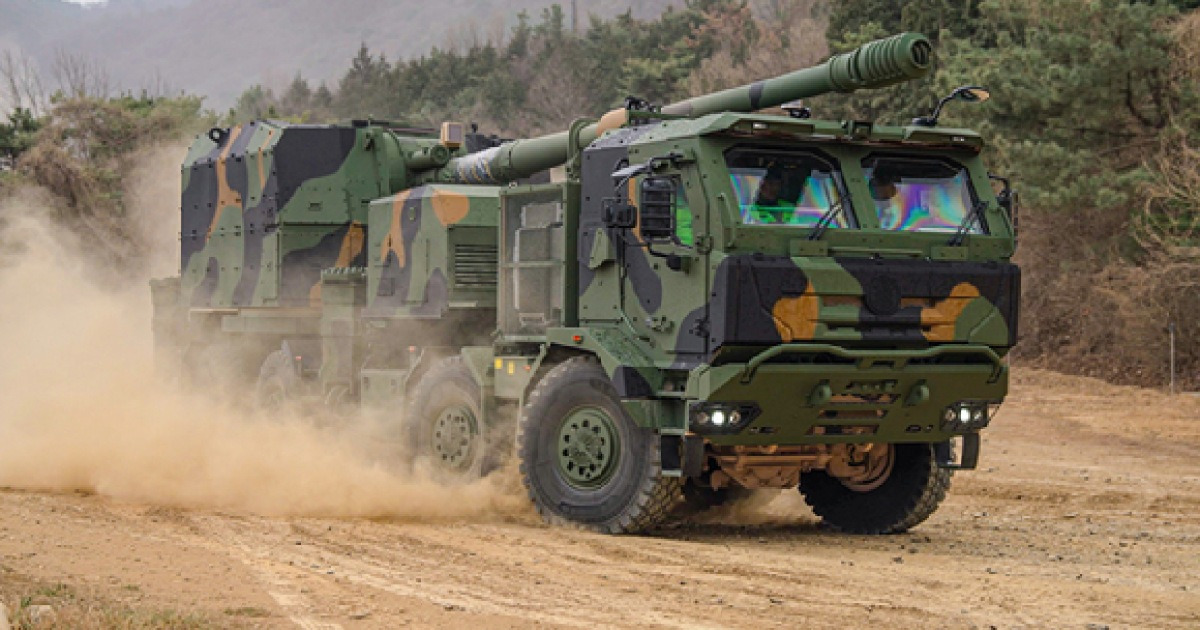
South Korea just became a serious contender in the world’s most protected defense market.
Hanwha Aerospace’s recent export deals with the United States and Spain are not incremental wins. They represent a structural break. For the first time, a Korean defense company has entered the US market with a completed weapon system — not as a subcontractor to Lockheed Martin or BAE Systems, but as the prime contractor. In Spain, Hanwha went further, transferring core technology to local firm Indra Sistemas so the howitzer could be built on Spanish soil.
Together, these deals bring the K9 self-propelled howitzer operator count to 11 countries. The track record — Turkey, Poland, Finland, India, Norway, Estonia, Australia, Egypt, Romania — already made K9 the most successful Korean artillery system in history. But the US and Spain deals change the genre entirely.
What the US deal actually means
Hanwha Defense USA was selected by the US Army as the developer and supplier of a prototype for the Mobile Tactical Cannon (MTC) program — a next-generation wheeled howitzer. The company will first deliver six K9MH (wheeled variant) prototypes, with an option for 12 more. This is not a backdoor entry. It is a ground-floor one.
What made this possible was not price alone, though cost competitiveness is real. It was a strategy of localization that went well beyond assembling kits at a foreign factory. Last April, Hanwha leased a vacant facility in Opelika, Alabama, for three years, creating a production base before the contract was even signed. In the US defense industrial landscape, where local content and supply chain presence are de facto requirements for winning contracts, that move was strategically decisive.
The K9MH itself — a wheeled variant developed specifically to meet US Army mobility requirements — represents a bet that Korean engineering could answer a niche the traditional primes had deprioritized. The US has not fielded a new medium-caliber towed or wheeled howitzer in decades. Hanwha moved into that gap while the major American defense contractors were focused on higher-priority programs.
The Spain play is even more interesting
Spain’s deal goes further than the US one in a key respect: technology transfer. Hanwha is not just selling guns to Madrid — it is enabling Indra Sistemas to manufacture the K9 and K10 ammunition carrier at a plant in Gijón, northern Spain, with core technology shared and the local supply chain actively supported.
This is the model Korea is now deploying across multiple markets, and it is precisely the model that European defense industrialists will find most threatening. Traditional Western suppliers sell systems. Hanwha is selling the ability to build them — locally, under license, with Korean engineering as the foundation.
It mirrors what India and Egypt experienced earlier. In Egypt, Hanwha revived a dormant state-owned tank production facility and bundled K9, K10, K11 command vehicles, training, maintenance, and local production into a single package. In India, the Arjun tank program’s struggles created an opening that Korean firms were willing to fill with joint production arrangements.
Why NATO is paying attention
The implications for NATO defense industrial policy are significant. Europe has been spending years trying to reduce dependence on American primes while simultaneously encouraging non-NATO suppliers like Korea to fill capability gaps. Those two goals are in tension.
Korea’s approach — localized production, technology transfer, MRO integration — is exactly what European defense ministers have been calling for. It is also exactly what European primes find最难 to match. The big Western defense companies operate in a different ecosystem: they are locked into legacy procurement frameworks, their supply chains are structured around national industrial policy rather than export flexibility, and they have less incentive to transfer core technology to foreign partners.
Hanwha has neither the baggage nor the constraint. It is building its European footprint through H-ACE Europe, a new joint production facility in Romania for K9 and K10 systems, while simultaneously pursuing deeper cooperation in Poland on K9A2 co-production, maintenance, and parts supply chains.
The company is essentially running a parallel industrial strategy — one that treats every market as a potential production site rather than a sales territory.
Who wins, who loses
The winners are clear: Hanwha, Korea’s defense industry, and the countries that want reliable artillery without political strings attached. The K9’s 155mm caliber and NATO-standard electronics make it interoperable by design. Its wheeled variant adds strategic deployability that heavy tracked systems cannot match.
The losers are less dramatic but real. Traditional European artillery producers — especially those with older tracked designs — now face a competitor that is not only cheaper but willing to build alongside them. The German PzH 2000 program, once the benchmark, has stalled in modernization. French Nexter is pivoting toward tracked systems. Neither has a wheeled 155mm option that matches the K9MH’s combination of range, mobility, and price.
American primes are not directly threatened — the MTC program is a separate requirement — but the symbolic impact matters. A Korean company winning a US Army prototype contract changes the hierarchy of defense procurement in a way that reverberates beyond artillery.
What happens next
The K9 story is unlikely to stop here. Poland is already discussing K9A2 co-production. Romania’s factory is under construction. The US presence in Alabama signals a longer-term commitment.
What is less certain is whether other NATO members will follow Spain’s technology-transfer model or prefer the simpler import arrangement. The answer will depend on how aggressively Korea pushes local production — and whether European governments are willing to trade industrial sovereignty for capability faster than their domestic primes can deliver.
For now, the signal is unambiguous: South Korea has graduated from arms importer to arms exporter to defense industrial partner — in the US, in Western Europe, and across the Middle East. The K9 is the proof of concept. The question is whether it becomes the pattern.