How Korea's Chip Boom Is Silently Rerouting Inflation Worldwide
South Korea's semiconductor upcycle is no longer staying on the factory floor. Rising export income is now feeding directly into domestic demand and inflation—a second-order signal every global investor needs to watch.
The Semiconductor Boom Just Stopped Being Just About Chips
South Korea’s semiconductor supercycle is doing something the data didn’t fully anticipate. It’s leaking from the export ledger into the living room.
A new analysis from the Bank of Korea, released August 28, lays out the mechanism with unsettling clarity. Strong chip exports have improved Korea’s terms of trade, pushing real Gross Domestic Income (GDI) growth well ahead of GDP growth. That extra income isn’t staying in corporate balance sheets. It’s flowing into household wallets. And households, once they have more money to spend, tend to spend it.
That’s the part global markets are not yet pricing in with full conviction.
What the Bank of Korea Found
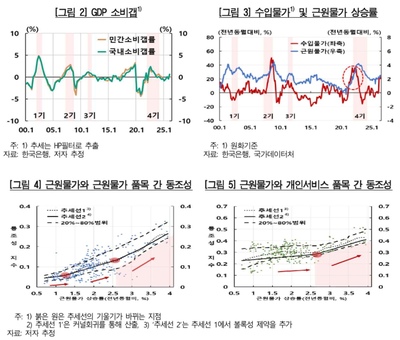
The central bank’s research divides post-2000 Korea into four episodes where demand-driven inflation took hold—periods when the GDP gap stayed positive and core inflation ran above 2.5% for two consecutive quarters or more. Those windows were:
- Early 2002 through mid-2002, before the credit card crisis
- Mid-2007 through early 2008, right before the global financial crisis
- Mid-2011 through late 2011, during the post-crisis recovery
- Early 2022 through early 2024, during the pandemic recovery
The pattern across all four is identical. Households gained purchasing power through wages or asset appreciation. Demand picked up. Companies, facing stronger consumer appetite, passed previously absorbed cost increases onto prices. The result was a self-reinforcing loop: higher demand drove higher prices, which reinforced expectations that prices would keep rising.
The most important threshold, the BOK found, sits at 2.5%. Once core inflation crosses that level, price movements stop being idiosyncratic and start becoming synchronized. Items that were rising in isolation begin rising together. Personal services—travel, dining out, hospitality—are the canary in the coal mine. They led the inflation surge during the pandemic recovery phase, and they would likely lead again.
The Multiplier That Matters
The BOK quantified the relationship with reasonable precision. When demand pressure is elevated, each one-percentage-point expansion of the GDP gap pushes core inflation up by roughly 0.1 to 0.4 percentage points. The economy-sensitive price measure reacts even more sharply, at 0.2 to 0.4 percentage points. Total core inflation registers around 0.14 percentage points per GDP gap point.
The duration effect is equally notable. In low-demand environments, a demand shock lifts core inflation by just 0.2 percentage points three quarters later—and fades quickly. In high-demand regimes, that same shock can amplify to 0.6 percentage points six quarters after impact. The inflation doesn’t just arrive louder. It arrives slower to leave.
And then there’s the terms-of-trade channel the BOK explicitly flags. If the income boost from better trade conditions converts into consumption rather than saving or asset accumulation, an additional 0.05 to 0.2 percentage points of upward pressure lands on core inflation. The conversion rate is the unknown variable. If Korean households save the chip windfall instead, inflation stays contained. If they spend it—which history suggests they will—the pressure multiplies.
Why This Matters Beyond Korea
Korea accounts for roughly one-third of global DRAM production. When the chip cycle turns, Korea feels it first and hardest. The current upcycle, driven by AI infrastructure buildout and memory demand from hyperscalers, is the strongest in the cycle’s recent history. Export values are at multi-year highs. The terms-of-trade improvement is real and sustained.
For global markets, Korea is a leading indicator for export-dependent economies that face the same structural setup: Japan, Taiwan, and to a lesser extent China’s equipment sector. If Korean households are spending their chip windfall into inflation, those same dynamics are building in Seoul’s neighbors. The difference is mostly in timing.
More broadly, the episode exposes a blind spot in how many forecasters model open economies. The standard approach treats export booms as net-positive for growth with neutral or ambiguous effects on domestic inflation—because the revenue supposedly stays in tradable sectors. The BOK’s analysis overturns that assumption. Export income becomes household income through wages, dividends, and employment. Household income becomes consumption. Consumption becomes inflation. The link exists. The question is only speed and magnitude.
What the Fed and Other Central Banks Should Be Watching
The implicit warning from the BOK is straightforward: don’t confuse a goods-side inflation decline with a services-side disinflation confirmation. The initial shock of any chip-driven income burst tends to show up in tangible goods and experiences—travel, restaurants, hotels. Those categories are sticky. They don’t reverse when commodity prices fall. They reverse when demand actually weakens.
If the current trajectory holds, Korea could re-enter a demand-driven inflation window within the next two to three quarters. That would complicate the domestic policy stance precisely when the global cycle is demanding accommodation elsewhere. A hawkish BOK in a softening global environment creates friction for emerging market currencies and capital flows.
The Bottom Line
The semiconductor upcycle is no longer confined to Taiwan and Korea’s export statistics. It is migrating into the domestic demand equation. The Bank of Korea has mapped the mechanics, quantified the thresholds, and sounded an explicit caution.
Investors who treat Korea’s chip boom as purely a growth story without an inflation tail risk mispricing both the Korean won and the broader EM FX complex. The data says the inflation effect is real, conditional, and historically repeatable. The only open question is how fast households convert export earnings into spending—and how quickly the rest of the world notices.