Korea's 209% Chip Export Surge Masks a Quiet Decoupling From China
South Korea's semiconductor exports just hit a record $46.6 billion in August, up 209 percent year over year. But the real story is where those exports are going — and where they're not.
The Number That Rewrites the Clock
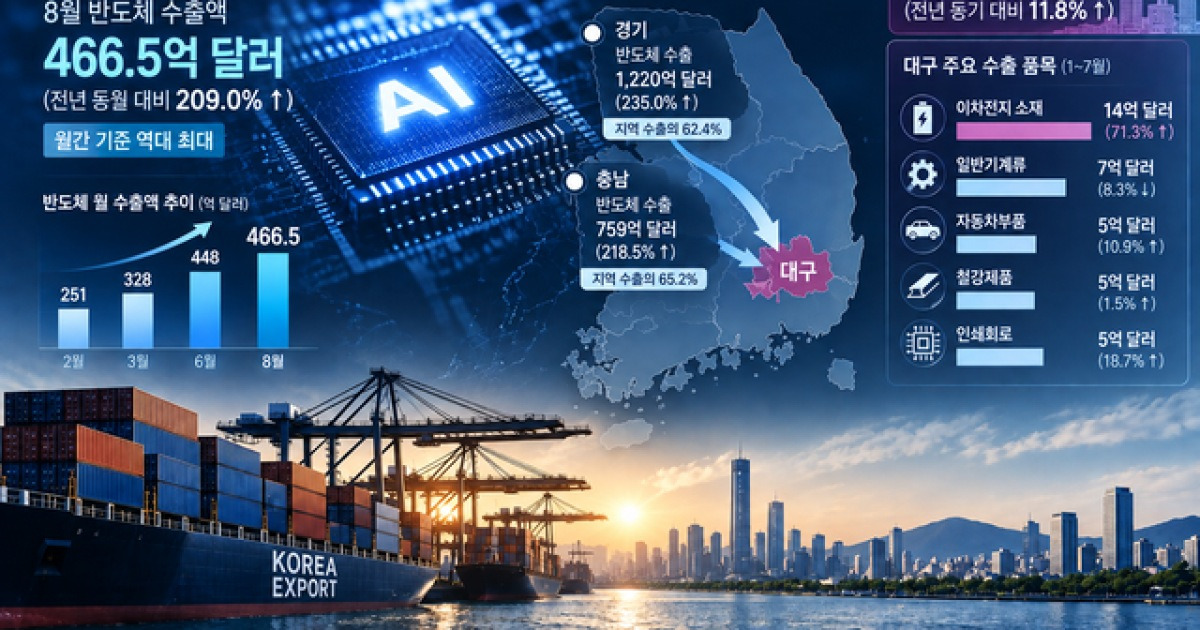
South Korea shipped $46.65 billion in semiconductors in August alone — a 209 percent jump from the same month last year. It was the third consecutive month the figure cleared $40 billion, and the single highest monthly total in the country’s history.
The first reaction in Seoul was celebration. The second, quieter one, was recognition that the shape of this boom looks nothing like previous cycles.
This is not a story about memory chips flooding back into Chinese data centers. It is a story about where new chip demand is actually coming from — and what that means for the geopolitical architecture of East Asia.
Who Is Buying Korean Chips Now
The driver is unmistakable: artificial intelligence infrastructure spending by American big tech. Memory semiconductor demand has exploded, and DRAM and NAND flash prices continue climbing. But the geography of that demand has shifted in ways that matter far beyond trade statistics.
China, historically South Korea’s largest semiconductor customer, is no longer the gravitational center. The U.S. CHIPS Act, tightened export controls on advanced chips to China, and the sheer capital expenditure wave from companies like NVIDIA, Amazon, and Google have rerouted Korean semiconductor exports toward new destinations.
Gyeonggi Province — home to Samsung’s sprawling Hwaseong complex and SK Hynix’s facility in Icheon — recorded $122 billion in semiconductor exports from January through July, up 235 percent year over year. That figure accounted for 62.4 percent of the province’s total exports. Chungcheong, home to SK Hynix’s massive Giheung campus, saw semiconductor exports reach $75.9 billion, up 218.5 percent, representing 65.2 percent of the region’s total.
The concentration is extreme. Two provinces now carry the overwhelming weight of Korea’s chip export story. And both are anchored by facilities that have been aggressively expanded with U.S. subsidies and policy support.
The Daegu Counter-Narrative
Here is where the national picture fractures.
Daegu, a city long associated with textiles and traditional manufacturing, posted $5.8 billion in exports from January through July — up just 11.8 percent. Its top export category is not semiconductors. It is secondary battery materials: lithium salts and other organic and inorganic compounds, which surged 71.3 percent to $1.4 billion and now account for 24.4 percent of the city’s total exports.
Daegu’s second-leading export category is automotive parts at $700 million, up 10.9 percent. Printed circuit boards come in third at $500 million, up 18.7 percent — and notably, Daegu-region companies now capture 15 percent of South Korea’s total PCB exports.
Steel products, broadcasting equipment, and telecommunications gear round out the Daegu-Gyeongbuk region’s $30.8 billion export total, which grew 16.4 percent over the same period.
The contrast with the national narrative is stark. While Seoul and Gyeonggi ride the chip wave, Daegu is being pulled in a different direction — one that traces not to AI servers but to electric vehicles, energy storage, and the materials that make batteries work.
What This Split Means for the Chip Cycle
Most analysts treat the current semiconductor upcycle as monolithic. It is not.
The memory chip boom is real and it is cyclical — prices will eventually soften, inventory will rebalance, and the euphoria of Q3 2026 will meet the accounting reality of Q1 2027. But the structural shift underneath that cycle is more durable: South Korea’s semiconductor industry is reorienting its customer base away from China and deeper into the U.S.-aligned supply chain.
That reorientation is reinforced by physical infrastructure. Samsung is building a foundry in Taylor, Texas. SK Hynix is expanding its San Jose design center and has commitments for U.S. memory production. Both moves were catalyzed by the CHIPS Act and U.S. security guarantees around advanced chip sourcing.
The Daegu trajectory tells a different but complementary story. Battery materials are not cyclical in the same way memory chips are. They are structural. The global transition to electrification — in vehicles, in grid storage, in industrial applications — creates demand that does not disappear when chip prices correct.
The Alliance Geometry
What emerges is a three-part realignment.
First, the U.S.-Korea semiconductor relationship is hardening into something closer to a strategic partnership than a commercial one. Export controls, subsidy conditions, and facility siting decisions now reflect security calculations as much as market logic.
Second, Japan’s role is quietly expanding. Tokyo has positioned itself as the materials pillar of the chip supply chain — photoresists, fluorine polyimide, high-purity chemicals. Korean battery material producers like the ones in Daegu occupy a parallel niche: the energy materials pillar. Together, they form a corridor of industrial policy that runs from Kyushu through the Sea of Japan to Daegu and on to Gwangju.
Third, China is being systematically excluded from both corridors. Not through a single policy but through the accumulated effect of export controls, tariff structures, and the gravitational pull of subsidized production capacity in allied countries.
The Risk in the Numbers
The danger for Korea is overconcentration. When 62 percent of one province’s exports and 65 percent of another’s depend on a single product category, the economy becomes fragile to any shock in that sector. A memory price correction, a demand downturn in AI infrastructure spending, or a geopolitical disruption could compress those figures dramatically.
Daegu’s diversification — battery materials, auto parts, PCBs, steel — may look less glamorous than semiconductor records. But it is also less exposed to the boom-bust rhythm that defines memory chip markets.
The broader lesson is that South Korea’s export engine is no longer powered by a single cylinder. The semiconductor surge is real and it is historic. But the city-level data reveals an economy that is already hedging its bets — and in doing so, quietly mapping the shape of a post-China supply chain.
What Happens Next
Watch two indicators over the next six months.
First, whether the U.S. further tightens restrictions on Korean semiconductor exports to China. Any move in that direction would accelerate the geographic reorientation that is already visible in the data.
Second, whether Daegu and the surrounding Gyeongbuk region attract additional investment in battery material production. The 71 percent growth in that category is not accidental — it reflects real demand and real capital allocation. If Chinese firms face barriers to accessing Korean battery materials, the Daegu corridor could become even more consequential.
The 209 percent export number is headline-worthy. But the story beneath it — a regional economy rebalancing away from chip dependency, a national export structure decoupling from China, and a geopolitical realignment taking physical form in industrial zones — is the one that will define the next cycle.