Why Korea's Constitution Fight Is About More Than Words
A bitter dispute over constitutional reform in South Korea reveals a deeper power struggle that could reshape the country's governance. With President Lee facing multiple trials, the question is whether the amendment debate is about democratic renewal or self-preservation.
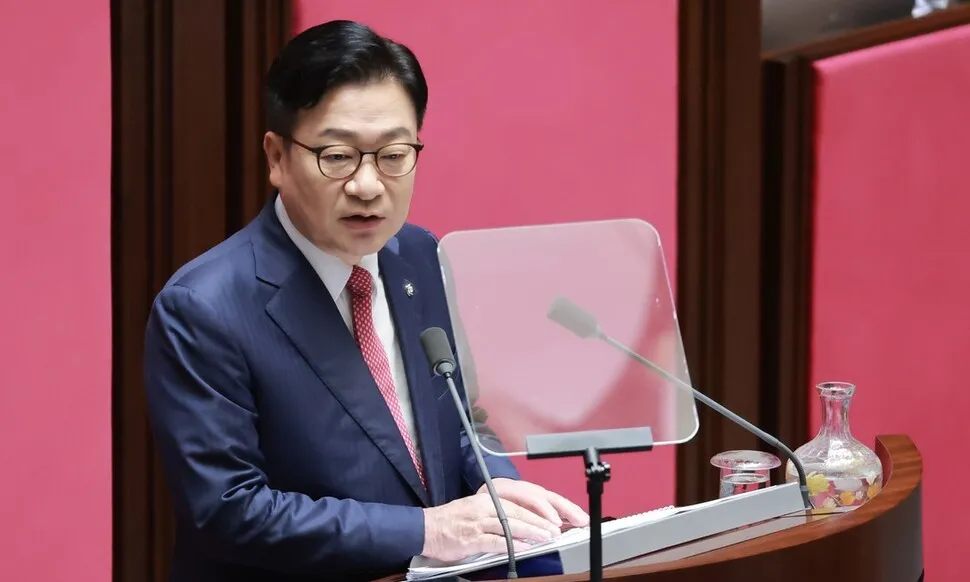
The Constitutional Amendment Debate That Could Reshape Korean Governance
South Korea’s ruling Democratic Party is facing an unexpected challenge from within its own ranks. While the party has been pushing for constitutional reform, there’s a growing divide over how far the changes should go. At the center of this debate is the question of whether the current administration should be allowed to extend its term limits — a proposition that has ignited fierce opposition not only from rival politicians but from civic groups and legal scholars who warn of democratic backsliding.
The immediate trigger came from Jeong Jup-sik, the floor leader of the opposition People Power Party, who made it clear on the 8th that he would not entertain any discussion of constitutional amendments during the current administration. His comments were a direct response to Kim Min-seok, the Democratic Party leader, who the day before suggested that “power structure reform could go as far as the people want.” The exchange, played out in the national media and echoed across social platforms, laid bare a political fault line that runs deeper than policy disagreement.
But this isn’t just about policy differences. The underlying tension is about power, legitimacy, and what happens when a president faces multiple legal challenges. The constitutional amendment debate in South Korea is never merely academic — it carries the weight of the nation’s authoritarian past and the hard-won safeguards of its democracy.
Who’s Behind the Push for Reform?
Kim Min-seok’s comments suggest that the Democratic Party is seriously considering a push for constitutional amendments that could potentially allow for extended presidential terms. This is a sensitive topic in South Korea, where the one-term limit has been a cornerstone of the post-authoritarian democratic system since the late 1980s. The provision was enshrined as a direct response to decades of military dictatorship, particularly the twenty-two-year rule of Park Chung-hee and his successor Chun Doo-hwan, who manipulated constitutional provisions to cling to power.
The timing of the push is significant and widely viewed as politically convenient. President Lee Jae-myung is currently facing five separate trials — charges that span allegations of electoral interference, abuse of power, and corruption-related offenses. Any discussion of extending term limits naturally raises questions about whether such changes might be motivated by a desire to delay or avoid legal consequences. Legal experts note that even the perception of self-serving motives can undermine public confidence in the institution of the presidency itself.
Jeong Jup-sik was blunt in his criticism, delivering a withering rebuttal during a National Assembly session. He accused the president of suggesting that he would never say he wouldn’t seek re-election, and that he would never face trial. “Are they trying to prolong their term through constitutional amendment and delay their trials? Are they using constitutional reform as a tool to justify their crimes?” he asked, his words drawing sustained applause from opposition members and widespread commentary from political analysts.
The opposition leader went further, stating that he would never negotiate with “forces that clearly commit unconstitutional acts and seek to profit from constitutional amendment.” His language reflected a broader frustration within the opposition that the ruling party appears to be treating the constitution as a flexible instrument rather than a foundational constraint — a shift that many Koreans view as deeply threatening to the democratic order.
The Cabinet Appointments Controversy
Jeong’s criticism wasn’t limited to the constitutional debate. He also took aim at the president’s cabinet appointments, which he described as a disgrace to the office and evidence of a pattern of prioritizing loyalty over competence.
Kim Seung-won, the Justice Ministry nominee, was described as “the head of the organization formed to withdraw prosecution against the president” and was linked to suspicions of new drug fraud — allegations that have yet to be substantiated in court but have nonetheless drawn significant media coverage and public attention. Yong Hye-in, the Gender Equality and Family Ministry nominee, was called “a symbol of privilege and injustice” who wants to serve as a proportional representative twice while also holding ministerial and legislative positions — a conflict of interest that critics argue violates the spirit of public service.
Two other nominees, Lee Hyung-il from the Finance Ministry and Hong Ji-sun from the Land and Infrastructure Ministry, were both criticized as former vice ministers who failed in their policies. “They’re all about making the president’s crimes legal,” Jeong said, framing the appointments as part of a coordinated effort to neutralize judicial accountability.
The nomination controversies have triggered secondary effects beyond the immediate political fallout. Civil society organizations have called for public hearings to be held, while several legal professional groups have issued statements expressing concern about the independence of the justice system. Industry groups have also weighed in, with business associations warning that political instability and perceived erosion of institutional checks could dampen investor confidence.
What’s at Stake for Korean Democracy
The constitutional amendment debate touches on something fundamental about South Korea’s democracy. Since the democratization movement of the 1980s — culminating in the June Democratic Uprising of 1987 — the one-term limit has been seen as a bulwark against authoritarianism. It is a provision that ordinary citizens defended in the streets, and it has become a deeply embedded norm. Changing it, even for legitimately argued structural reasons, risks reopening old wounds and undermining public trust in the very institutions meant to protect democratic governance.
But the current situation is complex. President Lee argues that the amendments are necessary to address structural issues in Korean governance — including legislative-executive gridlock, short-term policy horizons that discourage long-term planning, and the inefficiencies of a highly centralized presidential system. His supporters point to examples from other democracies where flexible term structures have coexisted with strong institutional checks. Critics, however, see a transparent attempt to extend his time in office while legal troubles mount, and they argue that structural reform can be pursued without touching the one-term limit.
The opposition is also making broader demands. Jeong called for the restoration of prosecutors’ supplementary investigation rights, which the government has moved to abolish as part of a wider justice reform agenda. He argued that removing these powers would lead to inadequate investigations and ultimately harm citizens by weakening a critical check on executive overreach. The debate over prosecutorial powers has become another front in the larger struggle over institutional balance.
The Bigger Picture
This isn’t just about one president or one party. The constitutional debate reflects deeper tensions in Korean politics about the balance of power, accountability, and democratic norms. South Korea’s democratic institutions, while robust by regional standards, remain comparatively young and have never been tested by a sitting president facing multiple criminal trials. The outcome of this confrontation will shape the country’s institutional trajectory for decades.
If the current administration succeeds in pushing through amendments, it could set a precedent that future presidents might follow — or abuse. Political scientists warn that once the norm of the one-term limit is broken, even for seemingly benign reasons, it becomes significantly easier to erode in the future. The slippery slope concern is not abstract; it is grounded in the region’s history of democratic regression.
The stakes are high because South Korea has experienced periods of authoritarian rule, and the memory of those years still influences political discourse in profound ways. Citizens who lived through the democratization struggle, and the generations that followed, view the one-term limit not as a technical detail but as a sacred safeguard. Any move to extend presidential terms will be viewed with deep suspicion by a large segment of the electorate, regardless of the stated rationale.
Second-order effects are already visible. Public approval ratings for the president have declined as the controversies accumulate, while opposition parties report surging membership and grassroots energy. Media outlets are reporting increased scrutiny of government actions, and academic institutions have begun hosting symposia on democratic resilience. International observers, particularly from liberal democracies, have issued cautious statements calling for adherence to constitutional norms — a development that adds diplomatic dimension to what was previously an internal political dispute.
As the National Assembly continues its regular session, the constitutional amendment question remains unresolved. The ruling party retains its legislative majority, but majority alone has not proven sufficient to carry significant constitutional changes in South Korea’s political culture, where broad consensus has traditionally been required for such transformative measures. What’s clear is that this debate will have lasting implications for Korean governance, regardless of how it ends. The country is being forced to confront questions about power, accountability, and the durability of its democratic compact — questions that every nascent democracy must eventually face, and that South Korea is now facing under extraordinary circumstances.