Korea's K9 Howitzer Penetrates Western Europe via Spain
South Korea's first K9 sale to Western Europe signals a structural shift in the global arms-trade map. Spain's 4.55-billion-euro artillery modernization program opens the door for local production and a new competitive dynamic inside NATO.
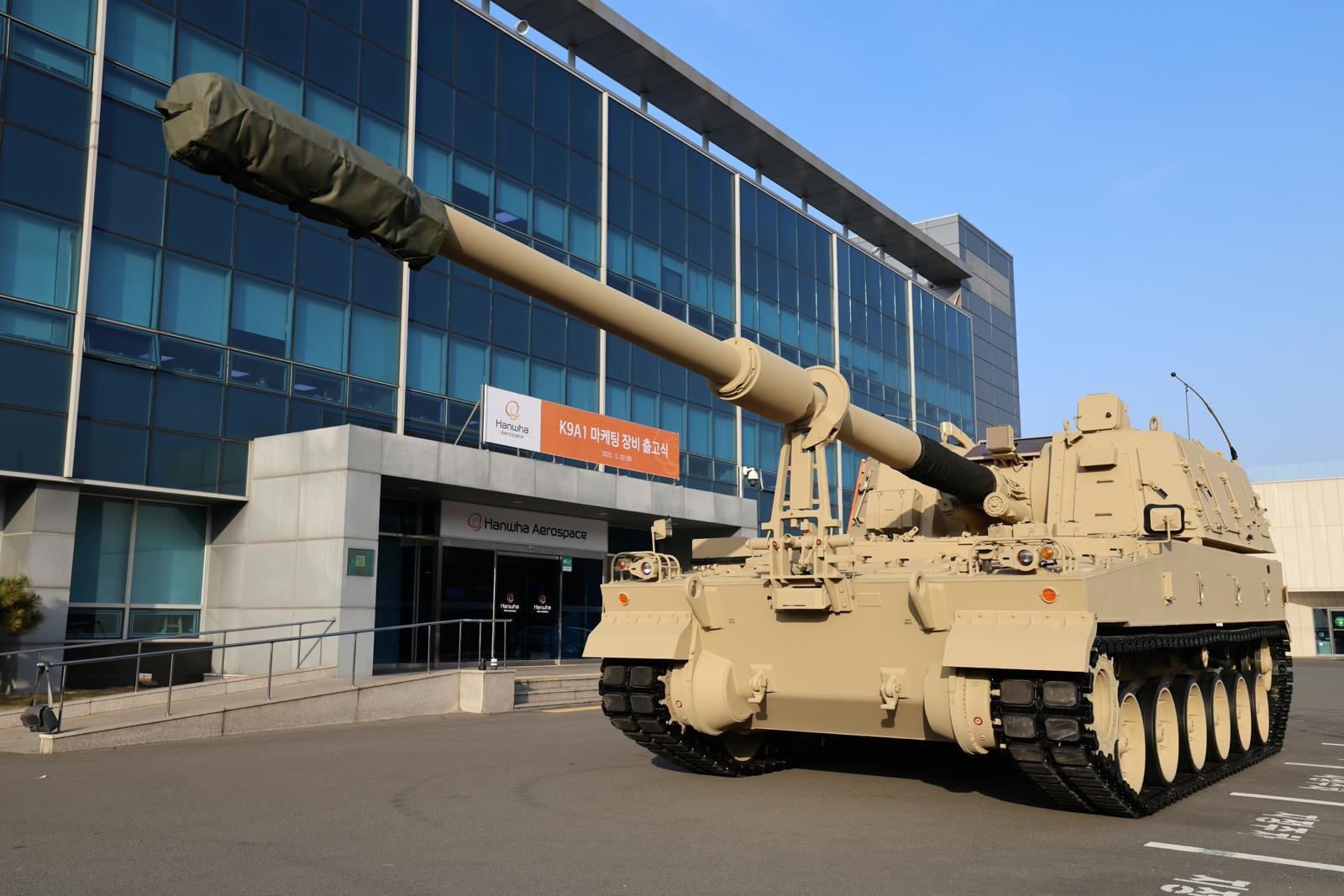
Western Europe Finally Gets Knocked on the Door
For two decades, K-defense has carved out dominant market share across Eastern Europe, the Asia-Pacific, and the Middle East. But Western Europe — home to Germany, France, Britain, and Italy — remained largely off-limits. Not anymore.
Hanwha Aerospace confirmed on August 31 that it signed an execution contract with Spanish defense firm Indra Sistemas to export K9 self-propelled howitzers. This is the first time the K9 has entered the Western European market, a threshold that previously seemed structurally impassable. Defense analysts estimate the contract exceeds 667.5 billion won — roughly $500 million — based on Hanwha’s recent annual revenue of 26.7 trillion won and the 2.5 percent disclosure threshold for large corporations.
The specific number of units, delivery timeline, and exact price remain undisclosed. But the symbolic and strategic weight of this deal extends far beyond its immediate financial footprint.
A Larger Program Behind a Single Contract
Spain’s military is not buying a handful of howitzers. It is overhauling its entire artillery modernization program, which InfoDefensa reports could reach 4.55 billion euros — approximately 7.7 trillion won — at the ceiling. That is a market large enough to transform a supplier relationship into something closer to a strategic partnership.
Korean officials have signaled an aggressive local-production roadmap. Initial K9 units will arrive from South Korea, but the plan calls for expanding Spanish manufacturing over time. Indra Sistemas is expected to gain design authority for a Spain-specific variant, and by 2027 the country intends to add local production capacity capable of outputting up to six K9 units per month. This is the same playbook Korea has used in other markets — initial imports, followed by technology transfer and localized assembly — but applied for the first time inside Western Europe.
The European Union’s defense procurement framework rewards in-region production with funding advantages and preferential contract terms. By committing to Spanish manufacturing, Hanwha and Indra are positioning the K9 program squarely within that incentive structure. A Korean-only import model would have faced headwinds from the start; a co-production model rewrites the rules.
Who Wins, Who Loses, and What Changes
The winners are clear. Hanwha gains access to a market it has never successfully penetrated, backed by a partner with deep institutional knowledge of Spanish and EU defense procurement. Indra Sistemas acquires a proven artillery system and, critically, the design authority to adapt it — a rare upgrade for a European defense contractor that has long struggled to compete with Rheinmetall and BAE Systems.
Spain’s military benefits most immediately. Its aging artillery fleet will be replaced with one of the most capable systems on the market. The K9 holds an estimated 60 percent global market share in self-propelled howitzers, with users ranging from Norway and Finland to India and Australia.
The losers are the European incumbents. Rheinmetall’s 155-mm PzH 2000 has long been the benchmark in Western Europe, and Nexter’s CAESAR has made inroads in Eastern Europe. Neither company anticipated Korea arriving at their doorstep with a system that competes on price, performance, and now, increasingly, on local production terms. Germany’s defense industry, already grappling with chronic underinvestment, faces a new variable: a Korean competitor willing to build factories instead of just shipping weapons.
The Air Defense Front Also Opens
While the K9 deal dominated headlines, a parallel move signals that Korea’s push into Western Europe is not limited to artillery. In June, LIG D&A signed a strategic partnership with Germany’s Rheinmetall to develop and sell mid-to-long-range air defense missiles — including the Cheonkung-II — across Europe and NATO markets. The two companies are exploring a joint venture that would localize production, modification, and sales within Europe.
Ram Kim, Korea chair at the UK’s International Institute for Strategic Studies, framed the strategic logic plainly: the United States is prioritizing its own and Middle Eastern air defense missile needs, leaving Europe increasingly exposed. Korean systems like the Cheonkung-II, built for rapid production and delivery, could fill a gap that transatlantic suppliers are structurally unable to cover.
This is not speculation. European air defense orders have surged since 2022, and NATO members are struggling to meet their own production timelines. A Korean supplier offering faster lead times and local manufacturing commitments carries genuine strategic value — not just commercial appeal.
The Second-Order Effects
What makes this moment structurally significant is that Korea is no longer competing only in markets where Western defense firms have low presence. It is entering the core of NATO’s industrial base and doing so through partnerships with Western firms rather than against them.
Hanwha is working with Indra. LIG D&A is working with Rheinmetall. Both arrangements bypass the traditional zero-sum framing of defense competition and instead embed Korean systems inside European supply chains. That is a durable competitive advantage — one that is much harder to displace than a transactional export deal.
The broader implication is a gradual rebalancing of NATO’s defense industrial landscape. The United States will remain the dominant supplier, but Korea is now a credible second-source provider for critical platforms — artillery and air defense — at a time when Western European producers are chronically constrained by capacity and investment gaps. The EU’s push for strategic autonomy, long stalled, may find an unlikely ally in Korean defense manufacturers who have spent the past decade building exactly the kind of production agility that Brussels is desperate to replicate.
What Comes Next
The K9 contract with Spain will face scrutiny through EU and Spanish parliamentary channels. Local production commitments will determine whether the deal survives political cycles. Rheinmetall’s partnership with LIG D&A will reveal whether Germany’s defense giant sees Korean collaboration as competitive threat or complementary capacity.
One thing is certain: the map of global arms trade no longer runs only from West to East. Korea has crossed into Western Europe, and it is building factories there while it ships systems.
That changes everything.