Korea's Record Trade Surplus Is a Semiconductor Trap
South Korea posted a $23 billion trade surplus in September's first twenty days, driven almost entirely by chips. The numbers look stunning — but they also reveal how dangerously narrow the economy has become.
Half the Economy, One Product
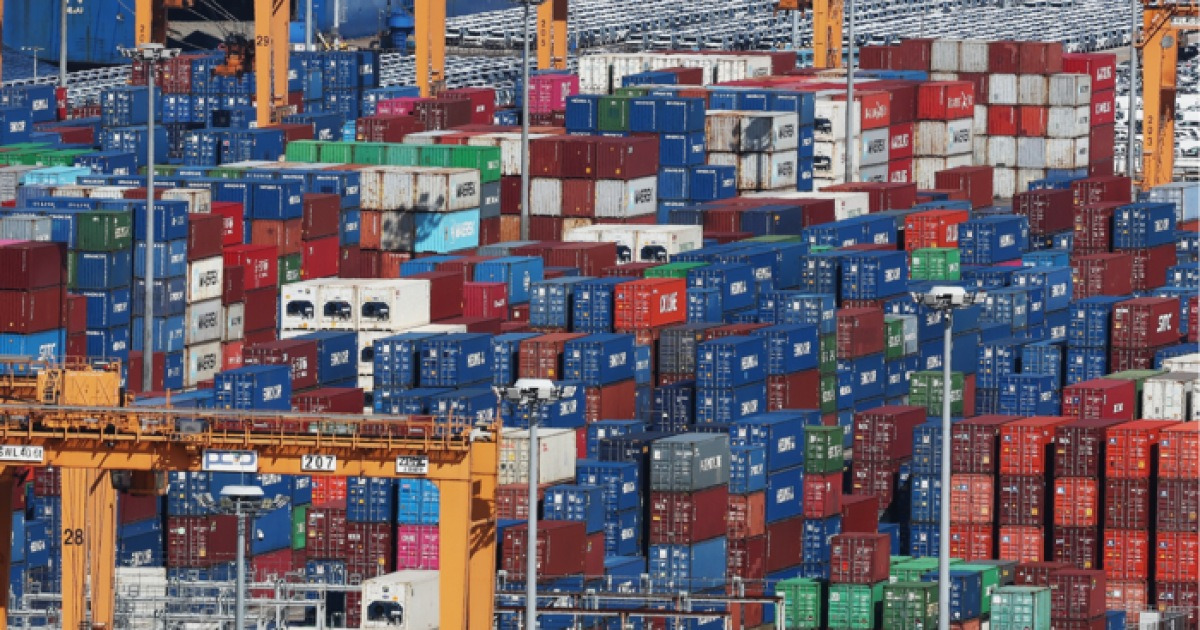
South Korea exported $71.4 billion worth of goods in the first twenty days of September. That is a number no one saw coming a year ago. The trade surplus for the same period hit $23 billion — an all-time record. The surplus would likely have been even larger if the Chuseok holiday had not interrupted the second half of the month.
But dig into the composition and the headline evaporates.
Semiconductor exports climbed 259.4 percent year over year to $34.1 billion. Chips now account for 47.8 percent of all Korean exports, up 24.1 percentage points from the same period last year. By virtually any measure, South Korea is exporting nearly half its goods through a single industry.
That is not a diversified economy. It is a one-product economy wearing a diversified outfit.
The Math That Should Worry Seoul
Let us be clear about what the Customs Service data actually shows. Exports rose 78.3 percent, but Korea operated fewer working days — 15.5 compared to 16.5 a year earlier. On a per-working-day basis, export growth reached 89.8 percent, averaging $461 million daily. That is extraordinary. But it is also almost entirely concentrated in memory chips, where prices have been climbing on AI demand and supply constraints.
The Bank of Korea’s most recent input-output tables confirm the structural shift. Korea’s external trade volume — exports plus imports — as a share of GDP expanded to 31.1 percent, up 1.5 percentage points year over year. The economy is trading more of itself away with each passing year.
Semiconductor value-added jumped from 38.5 percent in 2023 to 50.3 percent in 2024, according to BOK data. In plain language, more than half of the economic value created inside a chip export now stays in Korea rather than flowing to foreign suppliers. That is impressive engineering. It is also dangerously concentrated geographic and industrial risk.
Song Sang-don, a BOK official, noted plainly that export-driven production and value-added have both expanded significantly. Translation: the Korean economy is becoming more exposed to whatever happens to global chip demand next.
The Second-Order Effects
There are consequences rippling outward from this concentration that go well beyond trade statistics. Domestic investment is being pulled into chip infrastructure at an accelerating rate. Samsung and SK Hynix have together committed hundreds of billions of dollars to new fabrication plants — in Suwon, Hwaseong, and Gyeyang — while also expanding overseas in Texas and Saxony. This capital expenditure cycle is reshaping regional economies, pulling labor away from other sectors and driving up wages in semiconductor-adjacent industries.
The result is a quiet crowding-out effect. Other manufacturing sectors — shipbuilding, petrochemicals, consumer electronics — are watching their workforce drain toward chip facilities and their cost structures rise accordingly. Korean companies outside the semiconductor space are finding it harder to compete globally when domestic input costs climb on chip-driven demand. The very success of the sector is making the rest of the economy more expensive to run.
Currency dynamics compound the problem. The won has appreciated modestly against the dollar as chip revenues flow in, but the relationship is fragile. When memory chip prices soften — and they have softened before, sharply — the won tends to weaken on expectation alone. This creates a feedback loop: a weaker won raises the cost of imported energy and raw materials, which widens the non-chip trade deficit, which makes the overall surplus appear even more dependent on semiconductors than it already is.
What the Surplus Masks
The trade surplus is real. The dependency it reveals is the story underneath.
South Korea imports nearly everything except chips and increasingly refined petroleum products. When the won weakens — as it tends to do when global risk sentiment turns — the import bill grows faster than the export bill. A 260 percent surge in chip revenue looks like strength. It also means that any downturn in memory pricing, any shift in AI infrastructure build-out, or any further diversification by Samsung or TSMC customers away from Korean suppliers would hit Korea far harder than it would hit, say, Japan or Germany.
Taiwan feels this too, but differently. Taiwan’s export base is broader across electronics components and advanced logic chips. South Korea’s is narrower and more memory-heavy. If the global AI build-out slows or if major buyers lock in multi-year supply deals with Samsung and SK Hynix at favorable terms, the Korean surplus could deflate quickly. The government is celebrating today’s number. It should be watching tomorrow’s.
The Bigger Picture Nobody Is Discussing
Korea’s surge in chip exports is happening alongside a broader Western push to diversify semiconductor supply chains away from China. That diversification is real — TSMC is building in Arizona and Dresden, Samsung is expanding in Texas, and new fabrication plants are rising across Southeast Asia. But South Korea is benefiting most from the current cycle precisely because it has not diversified its customer base or its product mix. It is doubling down on the one thing that is working.
The risk is not that chip demand will disappear. It is that it will shift. Advanced logic chips, where TSMC holds dominance, may capture more of the AI investment going forward. Korean memory chips remain essential, but they are commoditized relative to leading-edge logic. The pricing power is thinner. The margins can compress faster.
Memory chip prices are cyclical by nature. They surged during the pandemicmining boom, collapsed in 2022 and 2023, and have recovered sharply in 2024 and 2025. The current upcycle is being fueled by AI data center demand, but memory is not the bottleneck in AI training — high-bandwidth memory is, and even that segment faces incoming capacity from Samsung, SK Hynix, and Micron ramping up production. When that capacity hits the market, which analysts expect within 18 to 24 months, prices could correct again.
What Comes Next
The second half of September will tell us whether the Chuseok holiday cut the surplus short or whether the monthly figure will hold. Even if it does, $23 billion in twenty days projects to roughly $34.5 billion in full-month surplus — another massive number, but one that rests on a foundation Korea cannot easily rebuild if the ground shifts.
The Korean government will likely respond with more incentives for chip investment, more subsidies for next-generation packaging, and more diplomatic effort to lock in long-term supply agreements. Those are rational moves. They are also moves that deepen the very dependency the surplus reveals.
What the data should make Seoul do — if it is paying attention — is ask whether a $23 billion surplus powered 48 percent by a single product category is a victory or a warning. The answer determines what policy looks like in the next downturn. And it will come.
Right now the chips are carrying everything. That is either the best strategy Korea has or the riskiest one. History tends to punish economies that confuse a cycle for a structure. The question is whether Seoul treats this surplus as a ceiling to defend or a signal to diversify before the next downturn makes diversification far more expensive.