Korea's 7% Crash Reveals the Cracks Under Global Risk Appetite
South Korea's market posted its steepest decline since July as AI investment doubts, US inflation data, and fading domestic buyback support converged into a synchronized sell-off.
When Korea Falls, Asia Notices
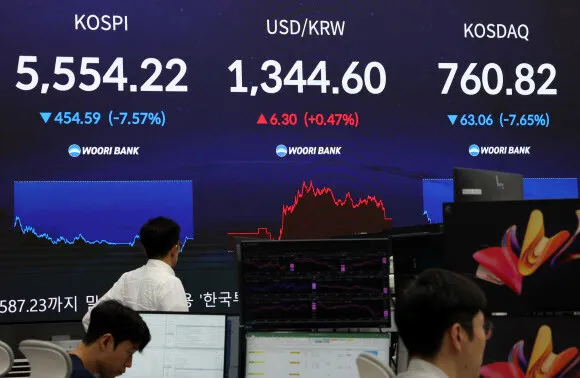
South Korea’s benchmark KOSPI index shed 7.57% on the 15th, closing at 5,554.22 — the steepest single-day decline since that brutal -10.84% drop on July 28. The KOSDAQ followed nearly in lockstep, dropping 7.65% to 760.82. This was not a sector rotation. It was a full-market stampede.
What makes this event worth watching goes well beyond Seoul. The KOSPI has now fallen for seven consecutive trading sessions, erasing 21% of its value in just over a week. That is the kind of velocity that does not stay contained within one exchange.
The contagion reached immediately. Taiwan’s TAIEX fell 4.2%, Hong Kong’s Hang Seng dropped 3.1%, and Japan’s Nikkei opened 2.8% lower before partially recovering. Portfolio managers in Singapore and Tokyo were already rebalancing allocations away from the region by mid-morning Seoul time. The speed of the geographic spread suggests algorithmic funds, not discretionary ones, were driving much of the initial selling.
Three Shocks, One Panic
The sell-off had a clear recipe, and it assembled in real time.
The first trigger came from the AI trade itself turning on its creators. Research firm Gartner issued a negative outlook on AI investment returns, rattling a market that had priced in near-guaranteed profits from the chip and software boom. Then Anthropic released third-quarter results that, while not a disaster in absolute terms, failed to meet the elevated expectations that had built up around the AI ecosystem. When the leaders stumble, the followers get sold first.
The psychological shift matters more than the fundamentals. For eighteen months, AI had operated as an unexamined assumption in equity pricing. Gartner’s report forced a reckoning — if the infrastructure build-out cannot justify its cost through revenue within the next two quarters, the entire valuation framework for semiconductor stocks unravels. That fear moved faster than any earnings report ever could.
The second came overnight from Washington. The US September consumer price index came in at 3.7% year-over-year, above the 3.6% consensus. Hotter inflation means the Federal Reserve’s path to rate cuts is getting bumpier. The Nasdaq closed down 1.88%, and semiconductor names — Nvidia, Broadcom, Micron — all sold off sharply. That matters for Korea because the KOSPI’s recent rally has been overwhelmingly concentrated in Samsung Electronics and SK Hynix. When American chip stocks cough, Korean chip stocks sneeze.
Samsung Electronics fell 9.91% to 209,000 won. SK Hynix dropped 11.49% to 1,255,000 won. Samsung Electro-Mechanics lost 16.16%. ES Square fell 11.03%. LG Energy Solution shed 6.04%. Hyundai Motor slid 7.02%. The selling was indiscriminate — large caps across every major sector participated.
The third factor was structural: the buyers who usually cushion Korean markets are running out of ammunition. The National Pension Service, which added significant support during the mid-year rally, has not adjusted its domestic equity allocation upward and now faces limited room to deploy fresh capital. Meanwhile, the two companies that anchor the market — Samsung and SK Hynix — are winding down their share buyback programs. When the biggest purchasers become the biggest sellers, the floor disappears.
Circuit Breakers and the Cost of Complacency
By early afternoon, the KOSPI had touched 5,450.81 — a loss of 9.29% on the day. Selling sidecars (which pause programmatic sell orders) activated in both the KOSPI and KOSDAQ markets. Circuit breakers then triggered a 20-minute trading halt in each exchange. It was the first time both mechanisms fired on the same day since July 29, a date that itself marked a major panic episode.
The dual circuit breaker activation is a data point that should alarm any portfolio with Asian exposure. It signals that the selling was not orderly — it was forced, programmatic, and self-reinforcing. What makes this particularly dangerous is the precedent it sets. If investors now expect circuit breakers to trigger on sharp declines, they will front-run those moves — selling ahead of the threshold rather than after. That dynamic accelerates downward pressure and compresses the space between “normal volatility” and “crisis.”
Historically, Korean markets have shown remarkable resilience after episodes like this. The July 28 crash was followed by a 12% rebound over the next three weeks. But that rebound depended on conditions that no longer exist: strong domestic buyback support, accommodative Fed expectations, and an AI narrative that had not yet faced a credibility test. All three have deteriorated.
What regulators are doing (and why it will not move the needle)
The Financial Services Commission convened an emergency meeting that afternoon. Chairman Lee Eui-taek urged financial institutions to curb indiscriminate credit extension and emphasized risk management. The message was appropriate and predictable. The problem is that warnings about leverage do not restore demand when the underlying drivers of selling — AI profitability doubts, US inflation, weakening commodity currencies — are still active.
Regulators in Seoul have historically relied on verbal interventions and moral suasion during market stress. This time, those tools feel insufficient. The FSC could coordinate with the Bank of Korea on liquidity support, but rate cuts are off the table with inflation elevated globally. They could encourage state-backed funds to increase equity purchases, but the NPS already signaled capacity constraints. The regulatory toolkit is not empty — it is simply aimed at problems that no longer dominate.
Second-Order Effects: The Won and the Supply Chain
Beyond the immediate market damage, Korea’s crash carries ripple effects that extend into currency markets and global supply chains. The Korean won weakened to approximately 1,385 per dollar in afternoon trading, approaching levels last seen during the May 2025 selloff. A weaker won makes imported inflation worse for a country that relies on energy and food imports, creating a secondary pressure on the Bank of Korea’s policy options.
The semiconductor sector, which accounts for roughly 20% of Korea’s exports, faces a new uncertainty. If AI capex slows even modestly, order books for memory chips — Samsung and SK Hynix’s primary revenue source — could compress faster than analysts currently model. Export data for the second half of the year may tell a story that diverges sharply from the bullish consensus that has priced into valuations.
Regional supply chain dynamics are also shifting. Taiwan’s TSMC, while not directly exposed to memory chip demand, moves in sympathy with Korean半导体 names. Any sustained pullback in Korean chip valuations creates a weight anchor on the broader Asian technology complex, potentially slowing the momentum that has carried these markets through much of 2025.
The broader read
Korea’s crash is a stress test for a simple thesis: that emerging Asian equities can decouple from US macro turbulence and ride the AI capex supercycle on their own merits. The answer so far is no.
The KOSPI rally this year was narrow and concentrated. It depended on a handful of mega-caps, supportive buybacks, and a benign global liquidity environment. All three supports have weakened simultaneously. The AI investment narrative is facing its first serious profitability audit. US inflation is proving stickier than markets assumed. And the domestic institutional buyers who provided the floor are tapped out.
For investors with exposure to Korean equities or the broader emerging Asia complex, the question is not whether this drawdown will continue — the seven-session losing streak suggests momentum is still downward — but how deep the reset goes. The 5,500 level on the KOSPI held today, barely. If it breaks, the next meaningful technical support sits considerably lower, and there are fewer structural buyers left to catch the falling knife.
For the region, the spillover risk is real but manageable if this remains an equity correction rather than a currency crisis. The won has absorbed pressure but has not broken. The more dangerous signal is psychological: when the world’s most outward-looking emerging market posts a day like this, capital tends to retreat broadly, not selectively.
The August 4 wave of emerging market selling shared this DNA. Today’s crash is smaller in magnitude but qualitatively similar — a realization that the tailwinds of the past twelve months may have been shorter-lived than the market assumed.
Where This Goes From Here
The next critical week will reveal whether this is a mean-reversion bounce or the opening act of a broader reassessment. Key variables to watch: the US PCE inflation print later this month, any signals from the Bank of Korea regarding policy flexibility, and whether Samsung and SK Hynix accelerate buyback programs to stabilize sentiment. If the won holds above 1,400 per dollar and the KOSPI finds support near 5,400, the case for a technical bounce strengthens. If both break, expect further deterioration across Asian equities.
The markets that survived July’s panic are facing a harder test now — one that demands not just liquidity but conviction. Conviction, it turns out, is the scarcest resource in a trend that has gone too far, too fast, for too long.