Korea's 4 Trillion Won Bet on US Nuclear
SK Group and Samsung C&B are leading a consortium to buy up to 10 percent of Westinghouse for as much as 4 trillion won, a move that reshapes how South Korea competes in American nuclear energy. The bet could redefine US-Korea clean-energy ties.
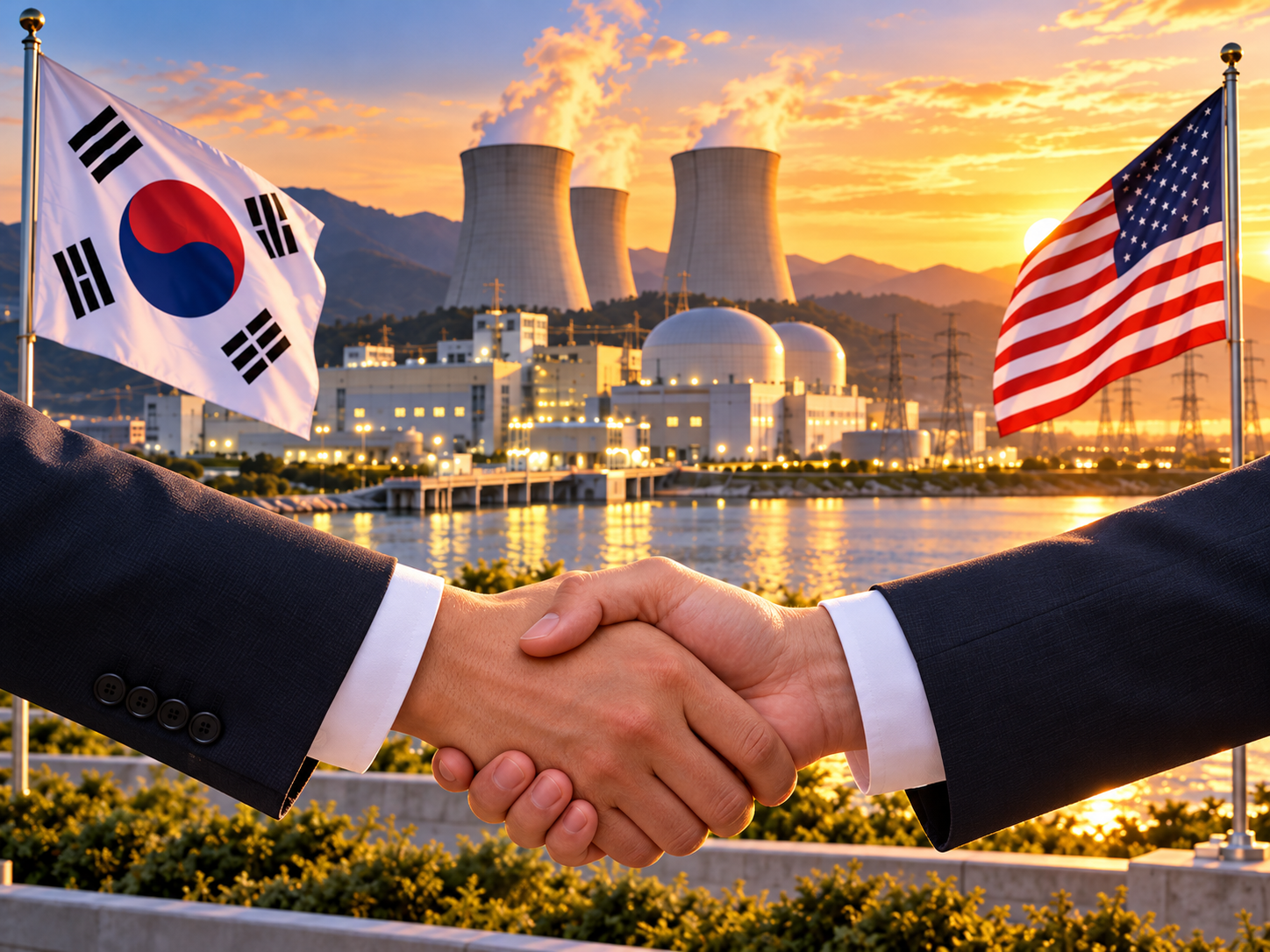
Korea’s largest private nuclear bet is a geopolitical play
SK Group and Samsung C&B are preparing to lead a consortium that could acquire up to 10 percent of Westinghouse Electric — the American nuclear giant behind the AP1000 reactor design — for as much as 4 trillion won, roughly $2.7 billion. This is not a passive financial investment. It is a deliberate entry strategy into the United States nuclear market, one of the last great industrial frontiers open to foreign contractors, and it signals a fundamental shift in how South Korea positions itself in the global clean-energy race.
The consortium being assembled under the guidance of the Ministry of Trade, Industry and Energy includes SK Group, Samsung C&B, Hyundai Engineering & Construction, GS Construction, and Doosan Enerbility. Korea Hydro & Nuclear Power and Korea Electric Power — the state-owned utilities that have built Korea’s domestic nuclear fleet — are expected to contribute only symbolic stakes, shielding their balance sheets from the strain of a multi-billion-dollar overseas acquisition.
At the center of the deal is a familiar Korean industrial playbook: combine public credibility with private execution capacity. But the target is different this time. Westinghouse is not a Korean supplier. It is an American company with deep design intellectual property, a US manufacturing base, and a set of safety certifications that no foreign firm can simply replicate. Owning a seat at its table changes what Korean construction and equipment firms can claim at the negotiating table.
Why Westinghouse, why now
The timing is sharp. The US nuclear market is expanding on policy alone. In May 2020, President Donald Trump issued an executive order targeting a quadrupling of US installed nuclear capacity from roughly 100 gigawatts to 400 GW by 2050. That net addition of 300 GW is equivalent to about 210 standard Korean pressurized water reactors. It is the single largest policy-driven nuclear expansion in modern history, and it is creating demand that cannot be met by US suppliers alone.
South Korea has spent the past decade proving it can build reactors on time and on budget — something the US has struggled with since the Three Mile Island era and the stalled Virgil C. Summer project. Korean firms now hold the construction credibility that American developers need. Westinghouse holds the reactor designs and the regulatory relationships. The consortium bet is about combining both.
The move also dovetails with a broader $120 billion US-Korea nuclear cooperation framework that Seoul and Washington have discussed, including plans to construct eight Korean-designed reactors on US soil. Equity in Westinghouse gives Korean firms a structural advantage in bidding for those projects — not just a commercial edge, but a seat at the table where contract allocation decisions are made.
SK’s nuclear strategy, expanded
SK Group is reportedly the consortium’s largest prospective contributor, according to financial-industry sources. That tracks with SK’s longer energy strategy. The company has already established a foothold in next-generation nuclear through a $250 million investment in TerraPower, the small modular reactor company co-founded by Bill Gates. SK and SK Innovation signed a key terms agreement in August with TerraPower to pursue global SMR business together.
If the Westinghouse stake materializes, SK’s nuclear portfolio spans the full size range: SMRs through TerraPower, conventional large reactors through Westinghouse. That is an unusual breadth for a conglomerate that is fundamentally a petrochemical and battery player. It also reflects a strategic recognition that reliable baseload power is becoming a competitive input for SK’s core businesses. AI data centers and advanced semiconductor fabs consume enormous electricity with zero tolerance for interruption. Energy security is now directly linked to technology security.
SK has been careful to say the investment is under active review, not finalized. But the direction is clear. Korea’s energy-intensive tech sector needs cheap, stable, carbon-free power. Nuclear is one of the few options that scales fast enough to matter.
Who wins, who loses
The winners in this arrangement are straightforward. Korean construction firms — Hyundai E&C, GS Construction, Samsung C&B — gain access to a market they have long wanted but never cracked with any real volume. Doosan Enerbility wins a pathway to supply reactors, steam generators, and other core equipment into US projects rather than remaining confined to domestic and Middle Eastern orders.
Westinghouse wins capital and a strategic partner in a country whose engineering discipline has repeatedly proven it can execute complex nuclear builds. The consortium structure spreads financial risk away from Korea’s debt-laden public utilities, which have spent years absorbing cost overruns on domestic projects.
The losers are less visible but real. US domestic suppliers who have lobbied for years to keep nuclear construction insulated from foreign competition now face a competitor with an unbeatable track record and deep government backing. The Iron Sharpens Iron argument that dominated the debate over Korea’s participation in the Vogtle project in Georgia is fading, replaced by a pragmatic acknowledgment that the US cannot build the reactors it wants without foreign contractors.
Chinese and Russian nuclear exporters, meanwhile, watch from the sidelines. Korea is securing a strategic alliance with the United States at a moment when Washington is actively trying to pull allies into its clean-energy orbit. This deal makes it harder for Beijing to offer nuclear financing as a diplomatic tool to US allies.
What still needs to happen
Several details remain unresolved. The exact stake percentage, the purchase price relative to any potential Westinghouse listing, and the final composition of the consortium are still being negotiated. Industry sources suggest Korean investors could acquire shares at roughly a 10 percent discount to a hypothetical IPO price, which would put a 10 percent stake in the $2.7 billion range against a theoretical maximum valuation of $30 billion for a now-private company.
More importantly, equity ownership does not automatically translate into construction contracts. Winning actual US nuclear project bids will depend on pricing, scheduling, and regulatory relationships that no shareholding can guarantee. The 210-reactor equivalent opportunity ahead is enormous, but so is the risk that Korean firms arrive at the negotiating table with leverage but without the final wins to show for it.
What is certain is that South Korea is no longer just a reactor exporter. It is becoming a nuclear investor, a technology partner, and a contractor in the United States simultaneously. That is a tier above what any Korean firm has attempted before, and it reframes the entire conversation about where Korean industrial strength is heading.