Why a Korean Broker’s Memory Shortage Warning Could Derail the AI Boom
KB Securities predicts an unprecedented memory chip shortage next year as AI infrastructure spending surges. If Samsung and SK Hynix can't scale fast enough, the bottleneck could throttle the entire AI capex cycle.
The Memory Bottleneck That Could Stifle AI
A Korean broker is sounding an alarm that could reshape how the world views the AI infrastructure buildout. KB Securities flagged what it calls an unprecedented memory semiconductor shortage next year—one that could throttle the very capex cycle powering the AI revolution.
The numbers are stark. Global hyperscalers are hiking AI infrastructure spending by 60 percent year-over-year to $1.3 trillion next year. But here’s what English-language markets often miss: memory chips will absorb a dramatically larger slice of that spend. KB projects memory’s share of AI infrastructure investment jumping from 14 percent in 2025 to 40 percent in 2026, then 57 percent in 2027. TrendForce, the data firm, sees that figure climbing even higher—to 68 percent by 2027.
That’s a fourfold expansion in two years. And it’s happening precisely because the AI revenue models are finally materializing. Cloud AI services, token-based pricing, agentic AI, and model hosting are no longer speculative. They’re generating real cash flow, and that cash flow is demanding real hardware.
The Wafer Constraint Nobody Is Discussing
The shortage isn’t just about demand outpacing supply in a normal sense. It’s structural. KB Securities’ Dong-won Kim pointed to a critical bottleneck: HBM4 production is devouring wafer capacity at a rate that general-purpose DRAM simply doesn’t.
HBM4—a next-generation high-bandwidth memory chip essential for AI accelerators—consumes three times the wafer production capacity per unit compared to standard DRAM. As Samsung and SK Hynix shift lines to HBM4, the total bit supply growth becomes constrained by physics, not just economics. The limited wafer fab capacity means the industry can’t simply produce more chips to meet demand. It’s a genuine capacity trap.
KB estimates DRAM and NAND bit demand will outstrip supply by more than 10 percentage points. Inventory at both Samsung and SK Hynix has already fallen below 10 days as of the third quarter. That’s not a cyclical dip. It’s the early signal of a supply desert.
The Undervaluation Paradox
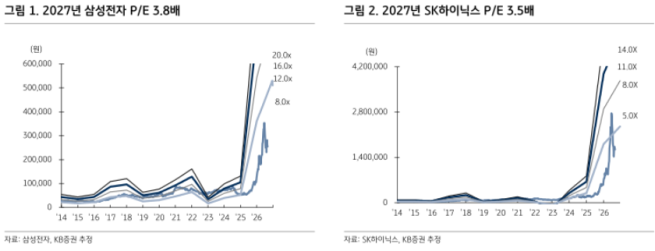
Here’s where the market narrative gets interesting—and potentially wrong. Over the past three months, Samsung and SK Hynix shares have dropped 38 percent from their highs. Their price-to-earnings ratios for 2027 earnings have compressed to roughly 3x. KB Securities calls this extreme undervaluation detached from fundamentals.
The broker expects both companies to post record earnings for three consecutive years, supported by sustained shareholder return programs. Kim sees a powerful re-rating ahead. Whether the market agrees is another question.
The disconnect reveals something important about how global investors view Korean semiconductors. Many still price these names as cyclical commodity plays rather than strategic infrastructure providers. If the memory shortage materializes as KB predicts, that mispricing could correct violently. But correction works both ways—if the shortage fails to materialize or supply chain adjustments absorb the gap, the current lows could prove to be the floor.
Who Wins, Who Loses
If KB’s forecast holds, the winners are clear: Samsung and SK Hynix, plus any company with existing memory inventories or long-term supply agreements. The losers are AI builders who can’t secure chip allocations and competitors without domestic memory production capabilities.
The implications extend beyond Korea. American AI companies like NVIDIA and AMD depend on HBM for their GPUs. Cloud providers—Amazon, Microsoft, Google—are locked into multi-year memory procurement deals. A shortage at the source ripples through every layer of the AI stack.
Even consumer technology could feel the pressure. Enterprise SSDs for inference workloads and CPU server DRAM are part of the same supply constraint. Companies building AI appliances or edge computing infrastructure may face allocation shortages alongside the data center builders.
What Happens Next
The timeline matters. KB’s forecast points to 2026 as the inflection year. That means the next six months will be decisive for supply negotiations, fab allocation decisions, and pricing settlements. Hyperscalers are likely already locking in contracts, but at what price?
Memory prices could spike—not just incrementally, but discontinuously. When physical supply hits a hard ceiling, pricing doesn’t adjust smoothly. It jumps. That’s the pattern in semiconductor shortages, and this one has the hallmarks of a structural rather than cyclical event.
Samsung and SK Hynix face a strategic decision: accelerate HBM4 production and accept the wafer capacity drag, or diversify output to general-purpose DRAM and risk losing ground in the highest-margin AI memory segment. The smart move is probably both—optimize HBM4 yield while gently expanding traditional DRAM capacity where possible. But optimization takes time, and time is a luxury neither the market nor the AI builders have.
The Bigger Picture
KB’s warning isn’t just about Korean equities. It’s a signal that the AI infrastructure buildout is hitting a physical constraint that financial engineering can’t solve. You can print money for data centers, but you can’t print wafers.
The memory shortage could force a reckoning in how the AI industry values hardware. Right now, much of the attention—and capital—flows to AI chips and software. Memory is treated as a commodity input. If the shortage becomes acute, that calculus shifts. Memory suppliers gain pricing power, strategic importance, and potentially a renegotiated share of the AI value chain.
For investors, the message is unambiguous: the market may be underpricing the memory bottleneck by treating Samsung and SK Hynix as passive cyclicals. For builders, the message is equally clear: secure supply now, or pay a premium later. For the industry, the lesson is that AI’s next phase depends on fundamentals—silicon, wafers, and physics—not just algorithms and capital.
The question isn’t whether memory will be scarce. It’s who will bear the cost when it is.