Why Korean Memory Makers Are Riding the Always-On AI Wave
OpenAI's GPT-6 Astra is pushing AI from chatbot to always-on agent, sending memory demand surging across every layer. Samsung and SK Hynix sit at the center of a supply crunch that analysts expect to last through mid-2028.
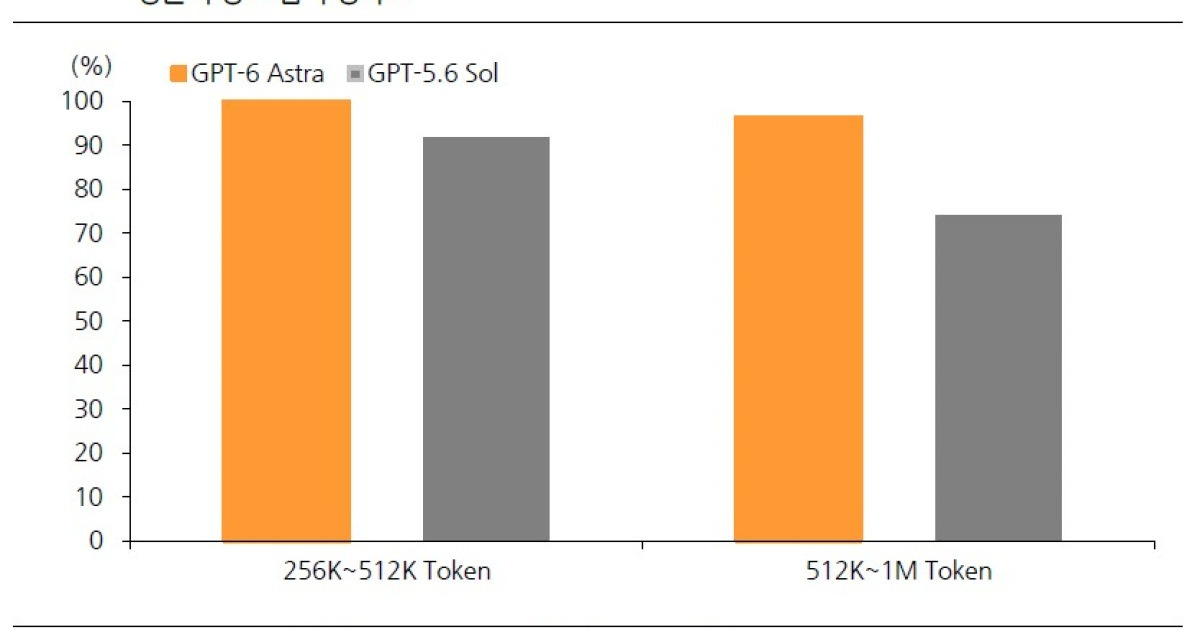
The GPT-6 pivot no one is overreacting to enough
OpenAI’s GPT-6 Astra isn’t just another model release. It represents a structural shift in how AI gets used — and that shift hits Korean memory makers harder than any earnings report could convey.
The key change: Astra pushes AI from question-and-answer chatbot into always-on autonomous agent territory. It handles asynchronous tool calls, manages context windows up to 1.05 million tokens, and runs multi-agent systems where different agents split roles across a workflow. According to Anthropic research cited by Korean brokerage Hanwha Investment & Securities, multi-agent setups consume 15 times more tokens per task than standard chat.
That 15x multiplier is the number that matters. More tokens flowing means more intermediate data being stored between inference steps. That data doesn’t vanish when the model isn’t actively computing. It sits. And sitting data needs memory.
The implications go deeper than raw token volume. When an AI agent runs continuously, it isn’t just processing longer prompts — it’s maintaining persistent state across hours or days of operation. Every decision made, every tool call executed, every reasoning step recorded creates a trail of KV cache entries that must be held in fast memory while the agent remains active. The difference between a chatbot that wakes for three seconds and an agent that stays awake for three hours is not three hundred times more computation — it’s orders of magnitude more memory residency, because the agent’s context window never clears.
What “always-on” does to the memory stack
Agent-mode AI changes the memory bill of materials in ways that go well beyond high-bandwidth memory — the HBM stacks that have dominated headlines.
Hanwha’s Park Jun-young maps it out clearly: the KV cache, the temporary data structures AI uses to hold active reasoning context, is expanding exponentially as agents run continuously rather than in short bursts. That cache lives in HBM alongside the computing model. But the standby data that agents hold between tasks goes into server DRAM. And the persistent records of agent activity accumulate on enterprise SSDs, or eSSD.
This isn’t a single-layer demand shock. It’s a cascade through every memory tier simultaneously.
To understand why this matters, consider the architecture of a typical agent deployment. A single production-grade agent cluster running continuous workflows might use four HBM3e stacks per GPU for model inference, but the same cluster will demand two to four times that amount in server DRAM for agent state management and KV cache offloading. Meanwhile, the audit logs, reasoning traces, and persistent context buffers being written to eSSD between sessions create a storage tier demand that wasn’t part of the original AI infrastructure blueprint.
The second-order effect is on board design. Server motherboards and OCP (Open Compute Project) reference designs are being reworked to accommodate larger DRAM footprints and additional eSSD slots specifically for agent workloads. That redesign cycle adds months to deployment timelines and concentrates purchasing power in the hands of a handful of board manufacturers — most notably Samsung Electronics’ PCB division and SK Hynix’s own server component partners.
The supply squeeze, now with longer legs
The most notable forecast coming out of Korean brokerages isn’t about peak demand. It’s about how long the shortage persists.
Current industry inventory sits at one to three weeks — essentially empty. Meanwhile, roughly 70 percent of global memory capacity is locked into long-term supply agreements. New fabrication capacity remains constrained, and the two major Korean expansions — SK Hynix’s Yongin cluster and Samsung’s Pyeongtaek P5 facility — are only reaching full operation in 2028, not this year.
DB Securities projects HBM demand will grow 59 percent in 2027 while supply expands 50 percent, leaving a gap that widens rather than narrows. HBM4 pricing is expected to jump 73 percent, driven largely by NVIDIA’s Rubin platform ramping into production. Server DRAM and eSSD are facing the same dynamic, just without the same price visibility.
The bottom line from DB’s Seo Seung-yeon: the DRAM supply deficit is unlikely to ease before mid-2028 at the earliest. That’s a longer supercycle than most participants in this market have priced in.
What makes this cycle structurally different from prior memory upcycles is the demand composition. Earlier shortages — say, the 2016–2018 DRAM bull run driven by crypto mining and data center expansion — were fueled by commodity-like demand that could be satisfied with more fabrication time. Today’s shortage is driven by technology-specific demand: HBM requires TSV (through-silicon via) bonding, 1y-node process geometry, and co-packaged optics readiness that only a handful of fabs worldwide can deliver. SK Hynix controls roughly 55 percent of global HBM capacity; Samsung holds about 35 percent. The remaining 10 percent is split between Micron and unproven Chinese suppliers. There is no fallback source.
Who wins, who loses, and what’s already priced
Samsung and SK Hynix are the clear winners here. Their 2027 profit estimates from DB Securities sit at 617 trillion won and 393 trillion won, respectively. Their forward P/E ratios, according to KB Securities, are 4.0x and 3.8x — deep value territory even by emerging-market standards. KB’s Kim Dong-won calls the current stock pullback a temporary supply-demand and valuation adjustment rather than a demand collapse.
NVIDIA wins too, obviously. More Rubin platforms means more HBM orders, which reinforces the pricing power that already exists. But the Korean players are the ones with the scarcest capacity and the strongest pricing leverage in the near term.
Everyone else faces a cost escalation that they can’t easily pass through. Cloud providers, AI startups, and enterprise customers buying into the agent era are competing for memory they can’t get and paying prices that didn’t exist twelve months ago. The pain is most acute for mid-tier cloud providers without the purchasing leverage of Amazon, Google, or Microsoft — companies that were banking on steady-state memory availability to build their agent infrastructure.
The competitive dynamic is also shifting within Korea itself. SK Hynix has historically led in HBM technology, while Samsung has emphasized volume and cost. But as agent workloads demand not just raw HBM bandwidth but also larger server DRAM configurations and integrated eSSD solutions, Samsung’s broader semiconductor portfolio — spanning memory, logic, and foundry — may give it an advantage in capturing end-to-end agent infrastructure contracts. That’s a thesis KB Securities is watching closely.
The valuation puzzle
The most striking thing about this setup is how cheap Samsung and SK Hynix trade relative to the demand trajectory. A 3.8 to 4.0 forward P/E implies the market sees cyclicality ahead, not structural growth. But the LTA lockup, the capacity bottleneck, and the multi-layer demand expansion suggest these companies are in a sustained upcycle, not a seasonal spike.
The market is pricing in the historical memory cycle — boom, bust, repeat — rather than the possibility that always-on AI agents create a permanent elevation in memory demand that doesn’t revert to prior norms. If that reversion doesn’t happen, current valuations represent a significant mispricing that could compress rapidly as earnings confirm the new baseline.
DB Securities raised its SK Hynix target to 2.3 million won and holds Samsung at 360,000 won, noting that the catalyst for re-rating will be confirmed earnings beats combined with aggressive shareholder return programs. That’s a specific timeline — results need to prove the numbers, and buybacks or dividends need to follow.
What happens next
The next several months will be defined by three events: NVIDIA’s Rubin platform shipment volume, Samsung and SK Hynix’s factory utilization rates, and the rollout cadence of next-generation models from Google (Gemini 4), OpenAI, and Anthropic.
If Rubin ships at scale and Korean fab utilization holds above 90 percent — as it appears to be — the memory shortage tightens further. If either model slows, the pipeline loosens slightly but likely not enough to break the cycle before 2028.
The broader implication for the global chip supply chain is that memory, not logic, is becoming the binding constraint on AI agent deployment. Every company building always-on AI infrastructure is now competing for HBM and server DRAM with Samsung and SK Hynix as the sole scaled suppliers capable of meeting the spec. That concentration is rare in this sector, and it’s likely to attract policy attention in both Seoul and Washington over the next year.
For Korean memory makers, the always-on AI wave isn’t a temporary tailwind — it’s a structural repricing of what memory is worth when AI stops being a tool you pick up and puts down, and starts being something that runs beside you, constantly, needing more space to think.