Korean Memory Stocks Are Becoming a Global Sentiment Barometer
Samsung and SK Hynix are swinging on U.S. rate expectations and NVIDIA momentum. Their volatility is no longer just a Korean story — it's becoming the canary for global AI-capex sentiment.
The Canary in the AI Coal Mine
Korea’s two memory-chip giants are about to face a week that could decide whether the AI infrastructure buildout has another gear or is already running out of steam.
SK Hynix on Monday approved a 40 trillion won share buyback and cancellation — the largest ever by a Korean-listed company — while Samsung Electronics is widely expected to unveil its own shareholder-return plan this month, with some reports putting the size near 100 trillion won. Next Wednesday, the Bank of Korea will set its benchmark rate. Thursday brings NVIDIA’s fiscal Q2 2027 earnings. And over the weekend, the Jackson Hole symposium will add its own ambiguity.
Four events. One outcome may matter most: whether memory stocks can sustain their recent rally or whether smart money is already exiting.
Why This Isn’t Just a Korean Story
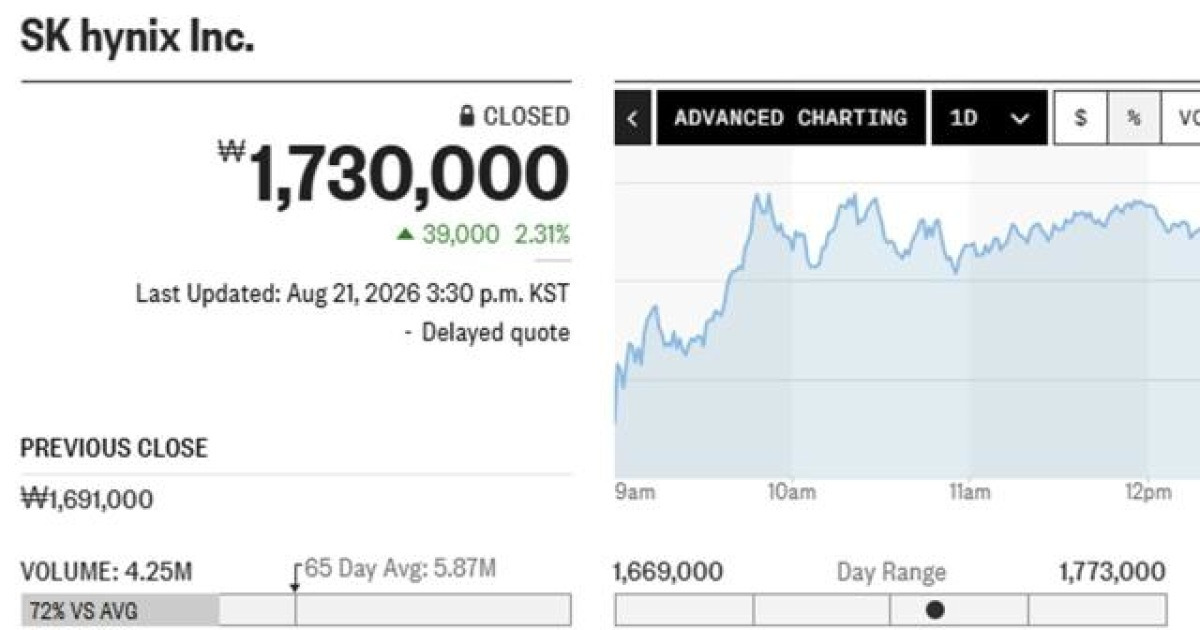
The conventional reading is straightforward. SK Hynix’s buyback reduces shares outstanding, lifts earnings per share, and rewards shareholders — a textbook positive. Samsung’s potential move amplifies the narrative. Together they create a self-reinforcing loop of optimism that has already pushed Samsung up nearly 4% and SK Hynix over 2% on the day of these announcements.
But the more interesting question isn’t whether these are good moves. It’s what the market’s reaction — and the scale of the payouts themselves — signals about the companies’ outlook for the next semiconductor cycle.
Memory-chip demand is cyclical by nature. The current upcycle has been driven by AI training workloads, where high-bandwidth memory (HBM) is the bottleneck product. SK Hynix dominates that segment; Samsung is playing catch-up. When a company commits 40 trillion won — roughly $30 billion at current exchange rates — to returning cash to shareholders, it is making an implicit statement: we expect earnings to stay elevated long enough that we don’t need every won reinvested into capacity expansion.
That statement matters globally because memory pricing is a leading indicator for the entire semiconductor complex. If DRAM and NAND prices hold, fab utilization stays high, and capex continues flowing toward next-generation nodes. If they soften, the rest of the supply chain feels it within two quarters.
The Rate Problem
Korea’s benchmark rate sits at 2.75%. The market is split on where it goes next. Some analysts see a hold. Others, citing household debt pressures and sticky core inflation, see a 25-basis-point hike. Either outcome creates headwinds for a sector that has surged on rate-cut expectations.
The dynamic is familiar from other markets: when central banks signal tighter-for-longer, growth-oriented and capital-intensive sectors compress first. Korean semiconductor stocks have been among the top performers this year, precisely because they have been the primary proxy for AI infrastructure demand. That makes them disproportionately exposed to any shift in the rate narrative — from Jackson Hole commentary, from NVIDIA’s guidance, or from the BOK’s own language.
NVIDIA as the Accelerator
NVIDIA’s earnings on August 26 are the single most important catalyst in this week’s schedule. The company’s data-center revenue guides the entire AI-capex conversation. Its forward-looking commentary on demand visibility, inventory cycles, and next-generation product roadmap sets the tone for everyone who builds on top of its chips — including Samsung and SK Hynix.
If NVIDIA beats expectations and offers confident guidance, memory stocks typically follow. The logic is tight: more GPU orders mean more HBM orders, which means higher realized ASPs for SK Hynix and Samsung.
If NVIDIA underwhelms — and here the risk is not just top-line misses but cautious outlook language — the reaction can be swift and indiscriminate. Memory stocks have been bid up on the assumption that AI demand is durable. A single data point suggesting otherwise can trigger a repricing that ignores fundamentals and moves purely on sentiment.
This is why the week’s outcome hinges on whether NVIDIA exceeds an already high bar, not whether it merely meets it.
What Smart Money Might Be Signaling
The buyback sizes themselves warrant a second look. SK Hynix’s 40 trillion won cancellation is remarkable, but so is the timing. The company has committed to returning more than half of free cash flow to shareholders across 2025 through 2027. That is an unusually long horizon for a sector that historically cycles between boom and bust.
Consider what that commitment implies. Management is betting that the current memory upcycle will be wider and deeper than previous ones — likely driven by the structural shift from training inference workloads, which require fundamentally different memory architectures than consumer or enterprise computing. If that bet is right, the cycle doesn’t just extend; it changes the underlying demand curve.
If it is wrong, the company is locked into a payout structure that becomes unsustainable the moment prices soften. In that scenario, the buyback announced today could look like the financial equivalent of a peak-cycle firm distributing excess cash rather than preparing for the downturn.
Samsung’s potential 100 trillion won return plan carries the same ambiguity at a larger scale. The market is pricing in both outcomes simultaneously, which is why the stocks have risen sharply but remain vulnerable to any negative surprise.
Who Wins, Who Loses
If NVIDIA delivers and the BOK holds or signals dovishness, the semiconductor rally extends. Memory stocks continue to act as the primary leveraged play on AI capex, pulling the broader KOSPI higher. Short sellers get squeezed. Index funds that have been underweight Korean tech face a rebalancing problem.
If NVIDIA disappoints or Jackson Hole raises rate-anxiety flags, the reversal could be steep. The very same buyback narratives that supported the rallies become harder to defend when forward earnings estimates drop. Traders who bought the news will sell the disappointment. Long-only funds that entered at elevated valuations may trim positions, creating a cascade of selling that hits smaller-cap memory suppliers first before moving to the giants.
The Bigger Picture
What makes this week significant beyond the individual events is a structural shift. Korean memory stocks are no longer just local industrial plays. They have become one of the few accessible proxies for global AI-infrastructure demand outside of U.S. exchanges. As international investors increasingly seek exposure to the AI buildout through non-U.S. vehicles, moves in Samsung and SK Hynix will carry implications for sentiment elsewhere — in Taiwan’s memory sector, in Japan’s equipment suppliers, and in the U.S. exchange-traded funds that hold them.
The volatility is not a bug. It is a feature of a market that has compressed a global narrative onto two companies in a small domestic exchange. That compression creates opportunity. It also creates fragility.
For investors watching from Seoul or San Francisco or London, the question is not whether next week’s headlines will be good or bad. It is whether the AI-capex cycle has enough momentum to justify the prices now embedded in memory stocks — or whether smart money is already pricing in the softening that follows every supercycle.