Korean Wallets Built Apple Pay's Road Then Made It Obsolete
Toss and Naver installed 500,000 payment terminals across Korea, clearing the infrastructure hurdle Apple needed. But their dominance may have also undercut the very reason card issuers would adopt Apple Pay — making Korea's Big Tech payment war a playbook for the rest of Asia.
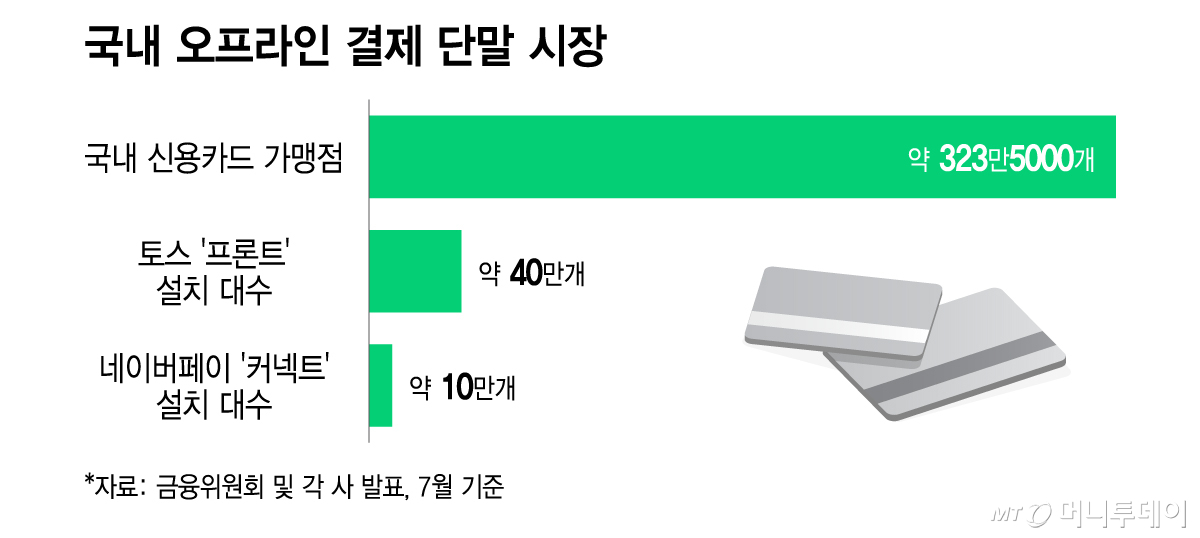
How Toss and Naver Cleared the Road for Apple — Then Blocked the Door
Toss and Naver built the road Apple Pay needed in Korea. They just didn’t realize they were also building a wall.
The two homegrown fintech giants have collectively installed roughly 500,000 offline payment terminals across the country — 400,000 under Toss’s “Front” brand and 100,000 under Naver Pay’s “Connect.” With Korea’s total credit card merchant base sitting at 3,235,000 locations, that means one in six merchants now runs hardware capable of accepting Apple Pay. For a card company weighing whether to invest in NFC-compatible terminals, that’s a massive reduction in risk.
Modern Card moved first when Apple Pay launched in Korea in 2022, spending 4.325 billion won on NFC terminal upgrades during a period when fewer than 10 percent of Korean terminals supported Apple Pay. Most other card issuers stayed on the sidelines, citing exactly that kind of upfront infrastructure cost as the reason they couldn’t justify adoption.
Toss’s own financials tell the story of what that investment looks like at scale. Toss Place, the subsidiary running the Front terminal business, posted a net loss of 74.592 billion won last fiscal year. Those machines are expensive to deploy, maintain, and upgrade — costs that the big tech players absorb so that card companies can later benefit from the network effect.
This is the first part of the paradox: Korean fintech firms subsidized the very infrastructure that would enable Apple Pay’s rollout, effectively doing the heavy lifting that Apple itself would have had to finance in a more fragmented market.
The Second Edge of the Sword
But here’s where the dynamic flips.
The same terminals that now accept Apple Pay also accept Toss Pay and Naver Pay — through NFC, QR codes, and facial recognition. A customer standing at a merchant terminal no longer faces a binary choice between Apple Pay and cash. They face a menu of options, most of which are controlled by the two companies that built the infrastructure.
Consumer sentiment already reflects this. Surveys and social media commentary from Korean iPhone users suggest that the widespread availability of Toss and Naver terminals has muted the frustration of not having Apple Pay at every register. As one common assessment put it: if your日常 payment circle already covers Toss and Naver terminals everywhere, the absence of Apple Pay doesn’t register as a meaningful inconvenience.
This creates a problem for card issuers that goes beyond cost calculations. Adoption isn’t just about whether you can accept Apple Pay — it’s about whether anyone will actually use it. If consumers have equally convenient alternatives right there on the same terminal, the value proposition of Apple Pay collapses from a card issuer’s perspective.
Modern Card’s Lucky Monopoly
The timing has produced an unusual outcome. Because no other major card issuer has launched Apple Pay in Korea since Modern Card’s 2022 entry, Modern Card enjoys what amounts to a temporary monopoly on Apple Pay transactions. Industry insiders acknowledge this isn’t necessarily good for the ecosystem, but they also note it’s not bad for Modern Card itself.
iPhone users who want Apple Pay still have to go through Modern Card. Demand exists — Apple has a loyal user base in Korea — and with no competing card offering the same experience, Modern Card captures that traffic entirely. The wider deployment of Toss and Naver terminals doesn’t erode this advantage; if anything, it expands the pool of merchants where Modern Card’s Apple Pay integration is the only premium option available.
What This Means for Asia
Korea’s payment story is instructive because it plays out a pattern seen across Asia: local Big Tech builds infrastructure first, then reaps disproportionate value from the network effects. Line Pay in Japan, GrabPay in Southeast Asia, Alipay and WeChat Pay in China — all followed similar trajectories of aggressive terminal deployment that lowered barriers for global entrants while simultaneously insulating themselves from disruption.
For Apple, the lesson is that entering regulated Asian payment markets requires navigating not just regulatory frameworks but entrenched local infrastructure. The cards and terminals are already in place — but they’re not neutral. They’re owned by companies that have every incentive to make Apple Pay feel redundant.
Card issuers across the region face the same calculation Korean banks are grappling with now: is the cost of joining Apple Pay worth it when homegrown wallets already cover the ground, and when consumers may not notice the difference?
The answer may determine whether Apple Pay becomes a standard feature of Asian payments or a niche option — available everywhere, used nowhere.
The Real Battleground
The terminal count numbers — 500,000 across two platforms, covering one-sixth of Korean merchants — sound impressive until you consider what happens next. Toss Place’s nearly 75 billion won loss signals that this expansion strategy is designed for long-term lock-in, not short-term profitability. The companies aren’t selling terminals. They’re selling the ecosystem around them.
Every new Front or Connect terminal is a node in a network that makes Toss and Naver indispensable to both merchants and consumers. Apple Pay can ride on that infrastructure, but it can’t own it. The card issuers who adopt Apple Pay do so through hardware they don’t control, reaching customers who may not prefer it, at terminals designed to serve a dozen competing payment apps.
That’s the double-edged sword Korean fintech created: they made Apple Pay viable in Korea, and in the process, they may have made it unnecessary.