Korean Webtoons Go Mainstream at New York Comic Con
Naver Webtoon's dual-booth strategy at NYCC reveals how Korean digital platforms are exporting both original IP and the tech behind American Marvel's new app — a quiet shift in who controls global comics distribution.
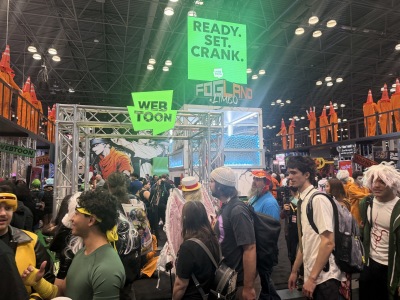
The Booth That Proved a Point
Stand in the right place at New York Comic Con and you will see it: a sea of visitors carrying tote bags bearing the Naver Webtoon logo. The company’s two solo booths — one for its Korean original title “Fogland,” the other for a brand-new Marvel Comics app developed entirely by its Korean engineering team — drew lines around them on a floor that holds over 500 exhibiting companies. Webtoon Entertainment ranked fifth in the show’s own most-remembered-booth survey last year. This year’s placement, with prime real estate and doubled footprint, was not an accident.
The implication is larger than any single headline. Korean webtoon platforms are no longer simply arriving at American pop-culture events to sell merchandise. They are exporting the technical infrastructure that powers Western IP distribution while simultaneously pushing their own serialized storytelling into English-speaking markets. Both tracks are running at once. That is the strategic escalation.
The Fogland Display Was No Accident
The Fogland booth was designed as a funnel. A six-meter-high structure — the maximum height allowed on the show floor — wrapped visitors in the series’ visual world from floor to ceiling. Cosplayers posed at a photo wall. Limited goods sold out. A giant gacha machine dispensed virtual items, but only after the participant downloaded the Webtoon app and read the first chapter. Every physical delight required a digital step.
The creator, known as POGO, said he had worked from his room until being summoned to New York. “To see Americans cosplaying my characters was incredibly fulfilling,” he told reporters. That moment is not symbolic. It is proof that a Korean prison-action webtoon, launched in Seoul in September 2024, has crossed a cultural threshold that previously belonged exclusively to American superheroes and Japanese anime.
Fogland follows an ordinary teacher dispatched to educate inmates at Fogland, the world’s worst prison — and then trapped there himself. The premise is simple enough to pitch, specific enough to sustain a serialized mystery, and visually bold enough to convert scrolling readers into committed subscribers. Its multilingual rollout began in January 2025 across English, Spanish, French, Thai, and Chinese, with German added in June. NYCC gave it an English-language homecoming in front of the audience it needs most.
The Marvel App Is the Real Signal
The second booth told an even quieter story. Webtoon Entertainment unveiled the Marvel Comics app, launching November 16, at a time when Marvel has spent years trying to fix its own fragmented digital reading experience. The app consolidates over 35,000 titles from Marvel, Star Wars, and 20th Century Studios under a single subscription. More importantly, it was built from scratch by Naver’s team, not outsourced to a Western developer.
The differentiation comes down to recommendation technology. At the booth, service lead Kim Yeo-min explained the shift in blunt terms: Western platforms have traditionally relied on human curators telling readers, “If you like Spider-Man, start here.” Webtoon’s approach replaced that intuition with a model trained on reading history. During early demos with Marvel, she said, the algorithmic recommendations generated the strongest positive reaction from both sides.
This matters because curation is increasingly the scarce resource in digital publishing. When content volume outpaces human attention, the winner is whoever best predicts what a reader will want next. Naver has spent a decade building recommendation engines on a platform where readers swipe upward through thousands of titles. Translating that engine to Western comic IP — including Marvel’s deepest back catalog and Star Wars’ sprawling shared universe — is a capability export, not a licensing deal.
The booth reinforced the message with concrete incentives. Pre-registering visitors received a first-year subscription discount. The first 2,000 sign-ups were given limited-edition printed ID cards. Visual weight at the booth tilted toward the Avengers and Doctor Doom films arriving in December, creating a feedback loop between the app and the cinematic release calendar. Webtoon is not just building an app; it is positioning itself as the digital spine of Marvel’s direct-to-consumer reading strategy.
Who Wins, Who Loses
Naver wins twice. The company acquires distribution muscle by powering Marvel’s English-language digital reading experience while proving that Korean originals can carry their own booths at the most competitive con in North America. Each Marvel reader introduced to the app’s interface is also exposed to the broader Webtoon ecosystem. The funnel works in reverse as well: Fogland fans discover Marvel content through the same platform architecture.
Traditional Western comic publishers lose ground on two fronts. First, they lose the opportunity to build their own recommendation technology because Naver already has it — and Marvel chose to install it. Second, they lose narrative ground: American superhero IPs are now appearing alongside Korean-made originals on the same digital shelf, normalizing the idea that serialized visual storytelling need not originate in New York or Los Angeles.
American readers arguably win, at least in the short term. A single app covering Marvel, Star Wars, and 20th Century Studios simplifies a fragmented market. Algorithmic recommendations reduce the friction of discovering back-catalog titles. The trade-off is that the engine driving those recommendations is Korean, not American.
What Happens Next
NYCC is now a recurring landing zone for Webtoon Entertainment, not a one-off experiment. The company’s solo booth in 2024 attracted an estimated 42,000 visitors and ranked inside the top five. This year’s placement followed directly from that result. The trajectory points toward a second phase: moving from booth presence to editorial influence. If Naver’s recommendation models shape which Marvel titles surface prominently, the company will effectively curate American comic canon without owning the IP.
Fogland’s next milestone will be an animated adaptation. The app’s November launch creates a waiting period during which reader habits can form. When the animation drops, the same funnel that moved readers from the gacha machine to the app will move them from the screen to the serialized episode schedule. That cycle — physical event, app download, serialized consumption, animated adaptation — is the model Webtoon Entertainment is now running in both directions: Korean IP heading west, Western IP routed through Korean technology.
The takeaway at NYCC was not that Korean webtoons had arrived. It was that they had redefined the arrival. The booth was the proof. The app is the infrastructure. Both will keep expanding.