North Korea's Missile Timing Is a Message to the World Stage
Pyongyang fired two ballistic missiles hours apart just days after a threat of retaliation, testing how far it can push deterrence messaging before the UN General Assembly opens. The pattern reveals a regime calibrating exactly how much provocation it can absorb at a critical diplomatic moment.
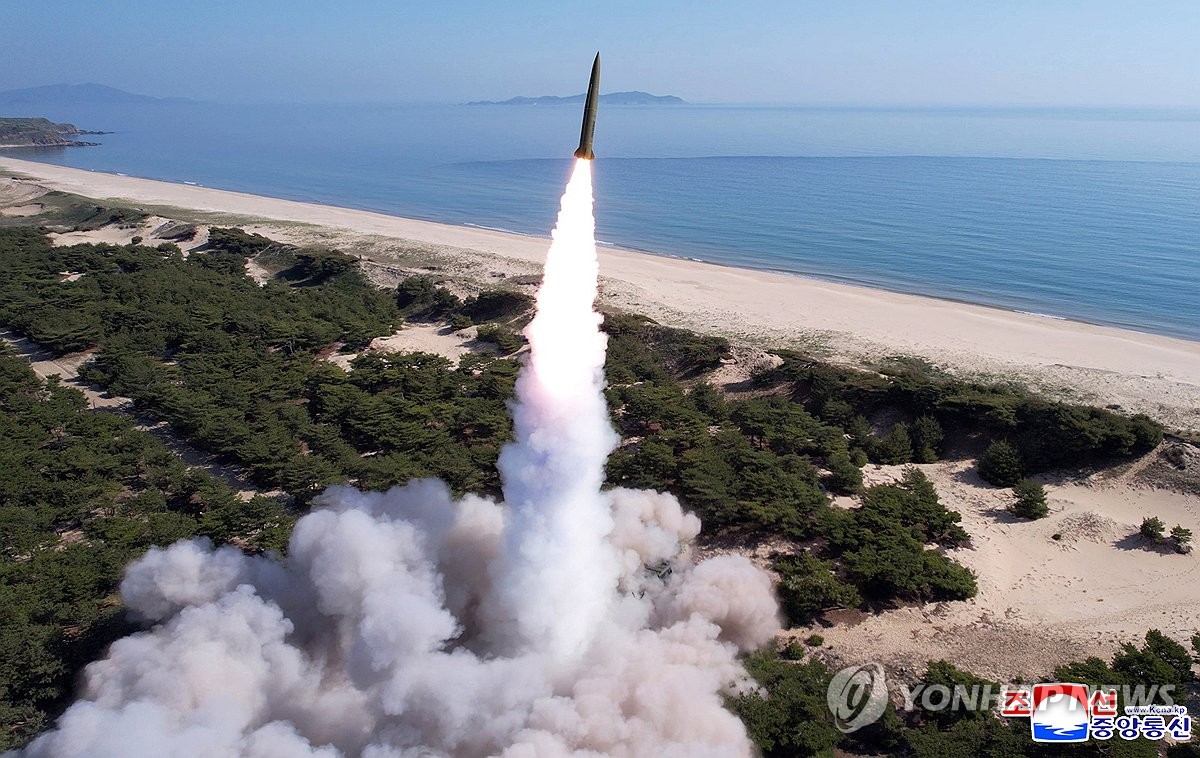
The three-hour gap between missiles is the point
North Korea launched two short-range ballistic missiles on September 20, roughly three hours apart, both from the Wonsan corridor into the East Sea. The first flew about 450 kilometers. The second went more than 600.
Joint Chiefs of Staff analysts believe both were Hwasong-11 series missiles — the variants North Korea calls KN-23 and KN-24. That makes this at least the 14th such launch this year and only eight days after the previous one.
The range difference is almost certainly deliberate. Firing the same class of missile at two different distances in a single day is not standard operational practice. It is a demonstration. Pyongyang is showing that within the same weapon family it can precisely control how far its projectiles travel, which implies granular control over targeting options against nearby regional bases and sea lanes without necessarily escalating to intermediate-range systems.
The timing is even more loaded. Launching two variations back-to-back sends a signal that goes beyond raw capability. It communicates procedural fluency — that the launch crews, the command chain, and the logistics pipeline can execute multiple missions in quick succession without degradation. For an adversary scanning satellite imagery or tracking launch signatures, that operational tempo matters as much as the distance any single missile travels.
Regional militaries have spent years building early-warning architectures around North Korean launch events. A single launch triggers a well-rehearsed response cycle. Two launches separated by three hours forces that cycle to compress, consuming radar channels, command attention, and decision space. It is a modest cost but a calculable one, and it is the kind of pressure Pyongyang understands its neighbors can feel even when they do not publicly acknowledge it.
Two days after a threat, the threat is executed
On September 18, Kim Yo-jong, the powerful deputy director of the Workers’ Party Central Committee, issued a statement warning that North Korea would respond with proportionate or greater offensive action to multilateral maritime drills led by the US Seventh Fleet, including Pacific Vanguard.
The September 20 missile launch is that response — or at least the opening gesture of it. Pyongyang framed the earlier February 12 launch and the subsequent coordinated-fire training that featured tactical ballistic missiles, attack drones, strategic cruise missiles, and long-range thermobaric rocket artillery as part of an integrated strike drill. But the sequencing tells a clearer story: a threat on the 18th, execution two days later.
Kim’s inspection tour of military factories from the 16th to the 18th — where she reviewed production of upgraded 600mm multi-tube rocket launchers, new 240mm rocket systems, and what appeared to be North Korean copies of Israeli Harop loitering munitions alongside newer drone models — preceded her public statement. The weapons review was not incidental. It established the material basis for the rhetorical threat that followed.
This is a pattern North Korea has refined over months, perhaps years. Kim Yo-jong has emerged as the regime’s primary voice for military signaling, a role that blends ideological authority with operational visibility. Her factory inspections function as both quality assurance and performance. When she appears at a production line, reviews a new system, and then issues a threat two days later, the connection is unmistakable to anyone watching. It ties rhetoric to实物, to hardware that can be counted, tracked, and verified by open-source analysts and intelligence services alike.
The February coordination exercise was notable not just for its scope but for its framing. North Korean state media presented the separate weapon tests — ballistic missiles, drones, cruise missiles, thermobaric artillery — as elements of a single plan. That narrative now carries forward. The September launches are being positioned not as isolated provocations but as continued implementation of an integrated strike doctrine that was already announced and demonstrated months ago.
The UNGA window is the real target
The launches arrive with the UN General Assembly opening on September 22 and the Trump-Xi meeting scheduled for the 24th. North Korean state media has consistently used major diplomatic gatherings as a stage for demonstrating that nuclear and missile development is non-negotiable, regardless of whether the United States offers engagement.
President Trump has signaled openness to talks — instructing the reduction of joint US-ROK military exercises in August and having a senior official reiterate on September 18 that he is ready to speak with Kim Jong-un by phone or in person. North Korea’s behavior since then has been to ignore the overtures and accelerate the hardware.
This is not a failure to read the signal. It is a choice to treat the signal as irrelevant to the strategic calculation.
The message is: no amount of diplomatic warmth changes what Pyongyang considers its core security requirement. The five-year defense modernization plan announced at the February party congress, which called for expanding operational-tactical missile systems aimed at South Korea, is being implemented on schedule. These launches are the visible proof.
There is a second-order effect worth tracking. When a regime demonstrates that it can proceed with weapons development regardless of diplomatic过暖, it reshapes the assumptions that allies and adversaries bring to the table. Seoul and Tokyo must factor in the possibility that US engagement gestures do not constrain Pyongyang’s launch calendar. Washington must reckon with the fact that its leverage may be more rhetorical than operational. And Beijing, watching the Trump-Xi meeting unfold against this backdrop, faces its own calculus about whether North Korea’s behavior strengthens or weakens the case for Chinese influence over its neighbor.
Who loses if this becomes routine
The Freedom Edge exercise concluded just before the September 12 launch, and the follow-up to Pacific Vanguard came days later. Each multilateral drill now appears to trigger a measured provocation within 48 to 72 hours. That pattern gives Pyongyang a reliable rhythm: identify an allied activity, issue a threat, execute within days, and reset.
For Seoul and Tokyo, the problem is not the missiles themselves — these are short-range systems that have been in the North’s inventory for years. The problem is the predictability of the escalation cycle, which normalizes provocation and makes it harder to respond with calibrated pressure rather than reflexive alarm.
For Washington, the harder question is what to do when diplomacy is offered and rejected without any change in behavior. Trump’s track record suggests he responds to provocation with unpredictability of his own, which raises the risk that the next cycle could move faster than the one before it. An escalatory response from Washington would validate Pyongyang’s underlying assumption: that the United States is reactive, that its commitments are conditional, and that pressure works best when applied sparingly rather than continuously.
The broader loss is to the norm against routine weapons testing. North Korea has spent nearly a decade normalizing the idea that a country under multiple UN sanctions resolutions can launch ballistic missiles with impunity. Each launch that goes unanswered without diplomatic consequence reinforces that normalization. Each launch that is met only with verbal condemnation strengthens the regime’s domestic narrative that it has outmaneuvered the international community.
What comes next
The next opportunity for a similar display will be the UNGA high-level week, when North Korea traditionally uses the platform to frame its weapons programs as defensive and unavoidable. Expect another launch — likely at an ICBM or new SLBM class if analysts are right that Pyongyang is accelerating those programs — as part of the same show of capability that accompanies diplomatic theater.
The three-hour gap between Tuesday’s missiles was not an accident. It was a calibrated statement: North Korea can fire two different-range projectiles from the same launch site on the same day, and it will keep doing so whether the world is listening at the UN or ignoring it elsewhere. The real message, however, is not in the hardware but in the cadence. Pyongyang is teaching its neighbors and its adversaries a new rhythm — one where threats are kept short, execution is kept swift, and the gap between the two is measured in hours, not weeks. That is the pattern to watch. Not because it signals imminent war, but because it signals something more durable: a regime that has found a sustainable way to project power without triggering the kind of response that would actually endanger it.