Nvidia Just Added $442B in a Day — What It Means for Korea's Chip Ambitions
Nvidia's $442 billion single-day market-cap increase — the second-largest in US stock history — signals that AI spending is far from cooling. For Korea's semiconductor industry, it's a double-edged signal: massive upside for HBM and advanced packaging, but deepening dependence on a single American chipmaker.
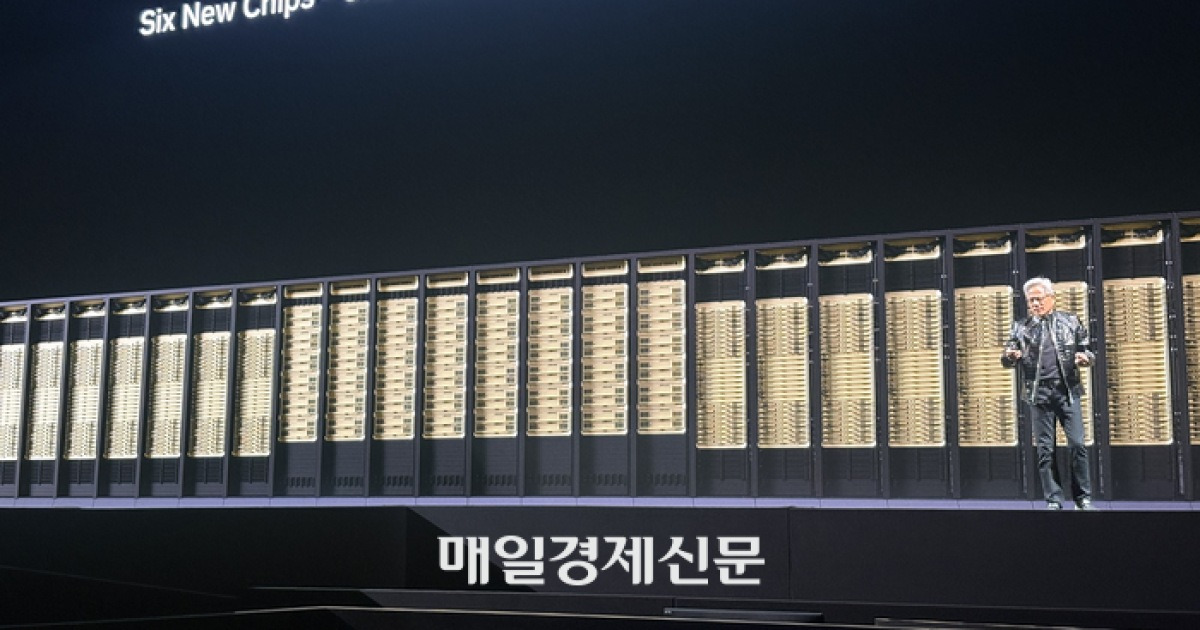
A $442 Billion Day
On August 27, Nvidia’s stock closed up 8.74% at $227.98, adding roughly $442 billion in market capitalization in a single trading session. That is the second-largest one-day gain in US equity history, trailing only Microsoft’s approximately $450 billion surge the previous month. The sheer scale of the move signaled something rarer than a strong earnings beat: a fundamental rewriting of how long the AI infrastructure cycle would last.
The catalyst was guidance, not just results. Nvidia projected next fiscal year’s revenue would grow about 70%, dwarfing Wall Street’s consensus estimate of 45%. Bloomberg Intelligence estimated the new forecast implied more than $1,000 billion in additional revenue versus prior expectations. JPMorgan noted the guidance was likely conservative precisely because it assumed supply constraints would persist — meaning actual demand could exceed even those elevated numbers.
This is not a company stumbling into demand. This is a company crouching against a wall of orders it cannot yet fulfill.
What the Guidance Actually Says
Let’s be precise about the number. A 70% growth rate on Nvidia’s current revenue trajectory means the company is projecting it will add well over $100 billion in annualized revenue compared to its previous full-year pace — not incremental quarterly bumps, but a structural step up. At that pace, Nvidia clears $160 billion in annual revenue within two years, a threshold no semiconductor company has ever reached.
The market was bracing for an AI spending slowdown. That thesis has just been demolished. The same investors questioning whether cloud providers would keep buying H100s and now Blackwell-class GPUs are now repricing their assumptions in real time. The psychological shift matters as much as the financial one: when Nvidia signals compounding demand, every other chip stock gets dragged higher by association.
Salesforce’s 18% jump the same day reinforced the pattern. Its AI agent platform, Agentforce, reached $1.5 billion in annualized recurring revenue — up 240% year over year. CFO Amy Weaver noted the so-called SaaS apocalypse driven by generative AI simply did not materialize. Instead, AI became a margin expansion engine inside existing enterprise software. Adobe, Oracle, and ServiceNow all reported similar inflection points.
This is the cycle: chip demand fuels platform revenue, platform revenue validates further chip demand, and the supply chain races to catch up. The feedback loop is self-reinforcing and currently unbroken.
Why Korea Is Watching Closely
For Korean investors and policymakers, Nvidia’s market-cap leap is not an abstract American equity event. It is a direct signal about the next round of capital allocation flowing into Korea’s semiconductor ecosystem.
SK Hynix is Nvidia’s primary supplier for high-bandwidth memory — the HBM stacks that every Blackwell and future architecture requires. Every dollar of additional GPU shipment means another layer of HBM pulled from SK Hynix’s lines in Icheon andritz. Samsung Electronics, which has been lagging in HBM qualification timelines, sits on the other side of a widening gap. Samsung’s HBM3E qualification for Nvidia’s Blackwell class remains incomplete, while SK Hynix has already shipped millions of units and is accelerating yield on its next-generation HBM4 stack.
The South Korean won-denominated headline of ₩610 trillion in added value translates into real currency exposure for Korean institutions holding US equities, real portfolio impact for pension funds with American allocations, and real sentiment pressure on the domestic KOSPI semiconductor sector. The KOSPI’s semiconductor sub-index rose 4.2% the same day, led by SK Hynix’s 5.8% gain and Samsung’s 3.1% climb — a clear correlation between Nvidia’s valuation and Korean chip performance.
More importantly, the guidance sets the pace for Korea’s own capital expenditure cycle. If Nvidia is ordering equipment to triple its advanced packaging capacity, the toolmakers on the Korean supply chain — companies producing substrates, interposers, and test equipment — get a clearer demand signal than they have had since 2023. LG Solutions, Doosan Robotics, and SEMES are all positioned to benefit from the next wave of fab and packaging expansion.
The Asymmetric Bet
The uncomfortable reality for Korea is that this boom is asymmetrically concentrated. Nvidia’s $5.5 trillion market capitalization now exceeds the GDP of most mid-sized economies. The company’s guidance assumes demand continues compounding at rates that most industries consider mythical.
For Korea, the opportunity is real but narrow. SK Hynix’s HBM business is a genuine competitive asset — it supplies the memory that makes Nvidia’s GPUs functional. But that same dependence creates vulnerability: any shift in Nvidia’s sourcing strategy, any qualification success for Samsung’s HBM, any design-win loss to AMD or custom silicon from the cloud providers themselves would compress that advantage quickly.
Consider the second-order risk. Google’s Trillium, Amazon’s Trainium, and Microsoft’s Maia are all custom AI accelerators designed to reduce reliance on Nvidia. None of them will replace Nvidia overnight, but each one chips away at the monopoly premium over time. If Nvidia’s dominance erodes even slightly, Korean HBM demand faces a ceiling that doesn’t exist under the current assumption of compounding GPU shipments.
Samsung’s struggle to qualify its HBM3E for Nvidia’s latest architectures is the clearest evidence of how fast the moat can shift. Samsung currently lags SK Hynix in the memory stack that powers the most demanded AI chips. Closing that gap is not optional — it is existential for Korea’s second-largest industrial conglomerate. A prolonged HBM deficit would force Samsung to divert resources from other growth bets, creating an opportunity cost that compounds over years, not quarters.
Supply Chain Friction and the Packaging Bottleneck
Beyond memory, there is a deeper structural tension. Nvidia’s guidance implicitly assumes that CoWoS advanced packaging capacity — almost entirely controlled by Taiwan Semiconductor — can expand fast enough to meet demand. TSMC has publicly committed to tripling CoWoS capacity by 2026, but the lead time for installation, calibration, and ramp-up runs 18 to 24 months. Every month of delay tightens the supply constraint and pushes Nvidia to raise prices, which in turn validates the revenue guidance and fuels further demand.
Korea sits adjacent to this bottleneck. Korean substrate suppliers — Semco, Hongik HiTech, and LG Innotek — feed TSMC’s packaging lines. If packaging capacity expands as planned, Korean substrate demand rises proportionally. If it doesn’t, the entire pipeline slows, and Korea’s exposure becomes purely speculative rather than operational.
What Comes Next
The next earnings cycle will tell whether this 70% growth projection holds or becomes the baseline that gets exceeded again. Historically, Nvidia has guided conservatively and delivered above those numbers by wide margins. If that pattern continues, the supply chain pressure in Korea intensifies rather than eases.
The tariff question also deserves attention. Nvidia’s previous $440 billion single-day gain came after President Donald Trump’s tariff pause announcement in April 2025. Trade policy remains a live variable for a company whose manufacturing is almost entirely outsourced to TSMC in Taiwan and whose memory comes from Korea. Any tariff restructuring that affects Taiwan Semiconductor or cross-strait chip flows would ripple directly through Nvidia’s cost assumptions and, by extension, its guidance. A 25% tariff on Taiwan-bound semiconductor equipment, for example, could add $8 to $12 billion annually to Nvidia’s cost structure and force margin compression that would reverberate through every supplier downstream.
For Korean institutional investors, the immediate play is straightforward: the semiconductor sector is re-rating upward alongside Nvidia. For Korean industrial policy, the longer game is ensuring that HBM leadership does not become the sole remaining competitive advantage as the rest of the chip value chain pulls further ahead toward American and Taiwanese firms. Korea needs a second engine — whether that means expanding into advanced packaging, accelerating domestic EUV capacity, or betting on next-generation memory architectures like HBM4 and HBM4e — before the current window closes.
Nvidia proved this week that the AI investment cycle has at least another gear. The question for Korea is whether it is building enough engines of its own to share the ride — or whether it will remain a critical component in someone else’s machine indefinitely.