NVIDIA's Groq 3 Moves to Mass Production, Reshaping AI Inference Supply Chains
NVIDIA's Groq 3 LPX AI inference accelerator has entered mass production via Samsung Foundry's 4nm process and Samsung Electro-Mechanics' FC-BGA substrates. The move marks a strategic pivot in AI chip manufacturing and a major inflection point for South Korea's semiconductor industry.
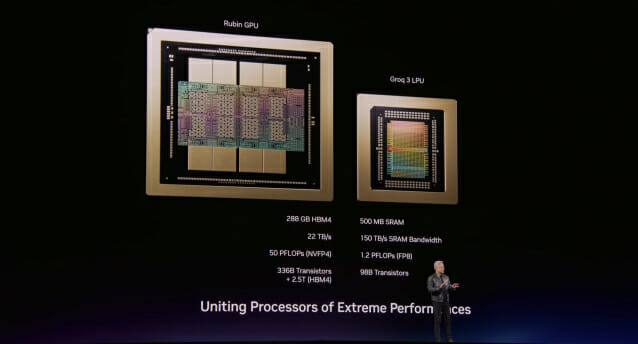
The Quiet Foundry Victory
NVIDIA announced on August 24 that its Groq 3 LPX inference accelerator has begun mass production — a milestone that looks small on paper but represents a significant crack in the TSMC-dominated foundation of AI chip manufacturing.
Groq was originally founded as an independent inference-specialist company and acquired by NVIDIA for roughly 29 trillion won ($20 billion) in a roundabout transaction late last year. The Groq 3 LPX is a rack-scale inference system packed with 256 Groq 3 language processing units (LPUs), designed specifically for high-throughput large language model inference rather than the training workloads that dominate headlines.
The manufacturing story here is where the real signal lies.
Samsung Foundry’s 4nm Gambit Pays Off
Samsung Foundry is producing the Groq 3 LPU on its 4-nanometer process (SF4X). Initial wafer input was estimated at around 10,000 wafers per month — modest by the standards of NVIDIA’s training GPU programs, which have historically flowed almost exclusively through TSMC’s most advanced nodes.
That baseline is expected to grow. An industry source familiar with the situation told ZDNet Korea that Samsung Foundry plans to increase Groq LPU wafer input to more than 15,000 per month next year. Another source said the company is already evaluating orders for a next-generation LPU, which would further lock in volume.
This matters because Samsung has spent years trying to prove it can compete at the cutting edge with TSMC, often stumbling on yield and capacity constraints. Groq’s inference-focused chip is simpler than a training GPU — less die area, fewer interconnects, tighter timing requirements rather than raw throughput — which may represent a smarter node entry point for Samsung than chasing NVIDIA’s latest H100-class training silicon.
Samsung Foundry’s broader trajectory supports this reading. The company’s 4nm node has been fully booked through next year, and the division is targeting a profitability turnaround in the second half of 2026, according to prior ZDNet reporting.
Samsung Electro-Mechanics Wins the Package
While Samsung Foundry makes the silicon, Samsung Electro-Mechanics (SEMCO) provides the substrate — the FC-BGA (flip-chip ball grid array) that connects each LPU to the board. SEMCO began mass production in the second quarter after securing “first vendor” status earlier this year, a designation that effectively guarantees it the largest share of substrate volume.
FC-BGA packages are increasingly critical for AI silicon. They offer superior electrical and thermal performance compared to traditional wire-bonded packages, and as inference chips push harder on latency and throughput, the substrate is no longer a passive component — it shapes performance directly.
For SEMCO, a company that has lived in the shadow of Samsung Foundry for decades, landing a first-vendor position on a product tied to NVIDIA’s brand is a rare upward shift. It also reinforces the argument that South Korean semiconductor competitiveness is increasingly portfolio-based — foundry plus packaging plus substrate — rather than dependent on any single manufacturer.
The First Customer: Neovi and the Enterprise Inference Market
The first commercial buyer of Groq 3 LPX is Neovi, a Netherlands-based cloud inference provider building what it calls the “Neovi Token Factory” — an enterprise-grade AI inference platform. This is a telling detail. The early adopters of inference-specialized hardware are not hyperscalers running their own models; they are boutique inference cloud providers competing on speed and cost against AWS Inferentia, Google TPU, and NVIDIA’s own H100-based offerings.
The inference cloud market is fragmented and fast-moving. Players like Together AI, Anyscale, and Replicate have carved out niches, and the economics of inference differ sharply from training: marginal cost is everything, and power consumption per token is a line item that makes or breaks margins. Groq’s approach — custom silicon for a specific workload rather than a general-purpose GPU — is a bet that specialization will win on cost-per-token as model sizes grow.
Neovi’s choice of Groq over alternatives signals that the inference hardware market is not yet settled, and that customers are willing to diversify their stack rather than committing to a single vendor.
Vera Rubin and the Bigger Play
NVIDIA did not present Groq 3 LPX as a standalone product. The company explicitly framed it as complementary to its Vera Rubin platform, which it began shipping in the second half of 2026. The messaging is clear: Groq handles the inference lane, Vera Rubin the training lane, and together they cover the full AI workload spectrum.
Benchmarking using the open-source Gemma 4 31B model showed Groq 3 LPX producing 3,400 tokens per second — NVIDIA’s best figure for that model. Whether that margin holds as models scale to larger parameter counts remains to be seen, but the headline number is designed to counter the persistent narrative that GPUs are the only viable path to fast inference.
What This Means for the Supply Chain
Three implications stand out.
First, Samsung’s dual role — foundry and substrate — demonstrates that the company can provide an integrated hardware stack to a customer that is not Samsung. This is exactly the playbook TSMC has followed with Intel and others, and Samsung is now executing it at the high end of AI silicon.
Second, the 10,000-to-15,000-wafer ramp for Groq LPU is a fraction of what NVIDIA trains GPUs consume, but it is meaningful for Samsung’s 4nm node precisely because it adds mix diversity. Training GPUs and inference LPUs have different design rules, testing requirements, and yield profiles. A foundry that only processes one type of AI chip is more vulnerable to demand swings than one that serves both.
Third, the Groq deal raises a quiet question about NVIDIA’s dependency structure. The company spent $20 billion to acquire a company whose hardware Samsung now manufactures. That is not a vulnerability today, but it is a precedent worth watching: as NVIDIA’s portfolio grows through acquisition, more of its silicon will flow through partners who have their own customer bases and strategic incentives.
The Korea Angle
For South Korea, the Groq 3 mass production announcement is a validation of a strategy that has been under pressure for years. Samsung Foundry’s recovery depends on landing clients outside its usual semiconductor customers. Samsung Electro-Mechanics needs high-value substrate orders to justify its capex cycle. Both now have a product tied to the world’s most visible AI brand, manufactured on Samsung’s own nodes and packages.
The numbers are still early — 10,000 wafers a month is a starting line, not a finish — but the direction is clear: inference is the next frontier for foundry competition, and Samsung is positioned to compete there.