Nvidia's Samsung Push Signals a New AI Chip War
Nvidia is now mass-producing its Groq3 LPX inference chips at Samsung Foundry, a move that breaks its reliance on TSMC and signals the hard launch of an inference-first AI arms race. Customers are already locked in, including Navius and SpaceXAI.
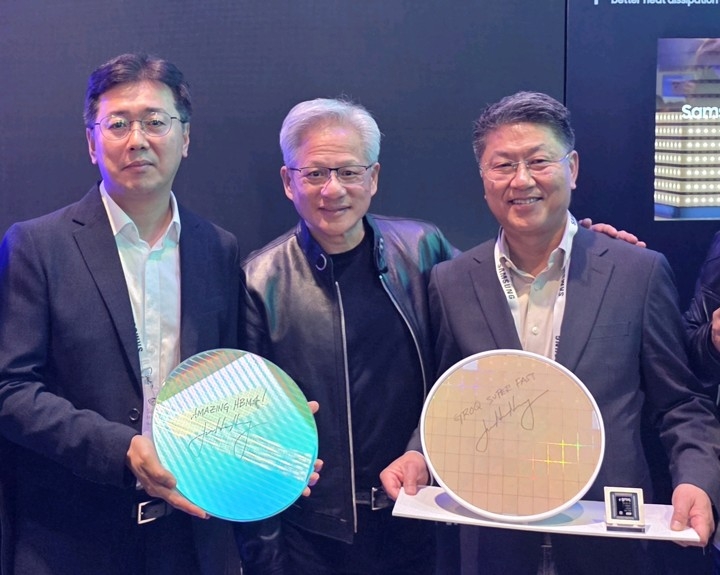
Nvidia just rewrote its own playbook.
Nvidia announced on Thursday that it has entered mass production of the Groq3 LPX inference accelerator, fabricated entirely at Samsung Foundry — not TSMC. The distinction is no longer a footnote. It is the main event.
The chip is built around technology Nvidia acquired through a workaround purchase of Groq late last year. Groq’s language processing units (LPUs) use SRAM instead of DRAM, dramatically reducing latency for inference workloads. Think coding agents, real-time reasoning, and the growing wave of AI agents that must respond in seconds, not minutes. A full Groq3 LPX system bundles 256 LPU chips into a single rack cabinet. Nvidia says agent-based tasks that previously took hours on standard GPU clusters can now finish in minutes.
Training still belongs to Nvidia’s GPUs. Inference is what the company wants you to believe will define the next phase of the business. Jensen Huang put it bluntly: inference is the growth engine of AI.
The technical architecture behind the move
What makes this announcement more consequential than a standard fab-diversification story is the architecture itself. The Groq3 LPX is not a GPU repurposed for inference — it is a fundamentally different silicon philosophy. By abandoning DRAM and relying on on-chip SRAM, the chip eliminates the memory wall that has constrained traditional GPU inference performance. Data never leaves the die. Communication between processing elements happens through a deterministic network-on-chip rather than through shared memory buses, which removes contention and produces predictable latency profiles.
For workloads like autonomous vehicle reasoning, real-time financial trading agents, or interactive multimodal systems, that predictability is the product. Randomness in inference latency is unacceptable when you are building systems that interface with the physical world or high-frequency decision loops.
Nvidia’s engineering teams have spent the past eighteen months adapting the Groq architecture for scale — something the original Groq chip was not designed for. The LPX represents a mid-generation refinement: wider processing tiles, improved routing efficiency, and integration with Nvidia’s CUDA inference runtime so that existing model deployments can migrate with minimal rewrites.
Who wins and who loses right now
Nvidia’s immediate competitor is AMD. The company has responded by launching the Helios rack system aimed directly at Nvidia’s Vera Rubin platform and partnering with low-latency chipmaker Ceribius. Both moves are designed to claim the inference share Nvidia is trying to lock down. Helios is AMD’s answer. It is not yet a decisive one.
Samsung Foundry wins by securing a high-profile customer that had previously been TSMC’s almost exclusive partner for Nvidia’s custom silicon. The move gives Samsung leverage in negotiations with other fabless AI-chip designers. It also signals that Samsung’s process technology is now considered viable for cutting-edge inference silicon, not just commodity logic.
TSMC does not lose today. Nvidia has not abandoned it. But the asymmetry is gone. The assumption that every advanced Nvidia accelerator would flow through TSMC’s most capable nodes is now broken. That changes how TSMC prices its services and how much negotiating power its customers hold going forward.
Navius, the AI cloud operator named as the first Groq3 LPX customer, gets early access to a chip that is purpose-built for low-latency inference. SpaceXAI’s commitment to the Vera CPU — Nvidia’s new agent-controller processor — is a far louder signal. The Vera CPU is said to handle agent orchestration 1.8 times faster than equivalent x86 designs from Intel and AMD, freeing GPUs to focus on model computation. SpaceXAI plans to extend that architecture into orbit, aboard a Starmind satellite equipped with a Vera Rubin system optimized for the space environment. That is not vaporware language. It is a deployment plan.
Second-order effects rippling through the industry
The implications extend well beyond the foundry floor. Every AI startup evaluating its hardware strategy now faces a recalibration. The assumption that TSMC was the only reliable path to leading-edge inference silicon has been undermined. Samsung Foundry has effectively been certified for this work, which means the next wave of custom chip designs — from venture-backed startups, from cloud providers, from defense contractors — will have a credible alternative ready to go.
This shifts pricing dynamics across the board. TSMC can no longer rely on scarcity premium for inference-class workloads. Customers who were accepting longer lead times and higher per-wafer costs to secure TSMC capacity now have an exit option. Even the threat of that option is enough to soften TSMC’s negotiating position.
On the geopolitical side, the move adds a layer of insulation. Any disruption to Taiwan — whether from natural disaster, supply chain friction, or escalation — no longer guarantees a single point of failure for Nvidia’s inference roadmap. Samsung’s fabs in Austin and Pyeongtaek provide geographic diversity that investors and enterprise buyers will find increasingly valuable as AI infrastructure scales into the multi-hundred-billion-dollar range.
There is also a talent dimension. Samsung Foundry has been aggressively recruiting process engineers from TSMC and Intel over the past two years. Landing Nvidia’s Groq3 LPX validates that recruitment strategy and will make it easier to attract the next cohort of engineers who want to work on cutting-edge AI silicon rather than consumer logic.
What this means for the supply chain
Nvidia’s decision to split fabrication between Samsung and TSMC is a response to a constraint that has been building for years: TSMC’s capacity is not infinite, and demand from Nvidia, Apple, and increasingly from custom-chip customers across the AI industry is compressing delivery windows. By bringing Samsung into the fold for inference-specific silicon, Nvidia creates a second supply thread for at least part of its roadmap. It also insulates itself from any single-fab disruption — geopolitical, natural, or operational.
The inference chip market is where the growth battle will be fought from 2025 onward. Training workloads plateau. Inference workloads expand with every deployed agent, every enterprise integration, every autonomous system. The companies that control low-latency inference silicon will control the layer that determines whether an AI system is useful in production or merely impressive in a demo.
Samsung Foundry now has a reference design it can show to other fabless AI companies. If it delivers at the performance and yield levels Nvidia claims, Samsung becomes the default alternative to TSMC for any company that needs inference silicon without the wait list.
The longer play
Nvidia is no longer selling just GPUs. It is selling a complete stack: GPUs for training, Vera CPUs for agent orchestration, Groq3 LPX for inference, and the software to tie them together. The company is building a closed loop that is harder for competitors to replicate because each layer is designed to talk to the others. AMD’s Helios is a rack-level response. Intel and Microsoft’s Maia, Google’s TPUs, and Amazon’s Trainium are custom chips aimed at specific verticals. None of them yet match the breadth of Nvidia’s integrated stack.
The Samsung partnership is a tactical move with strategic implications. It gives Nvidia manufacturing flexibility while strengthening a relationship with Samsung that could become critical if geopolitical tensions around Taiwan escalate. It also sends a message to every other AI company evaluating its fab options: the second source is now open.
What happens next depends on whether Nvidia can sustain volume at Samsung. The company declined to disclose deal sizes or delivery timelines. If the first wave of Groq3 LPX shipments meets its targets, Samsung’s foundry business gets a significant credibility boost. If yields lag or demand outstrips Samsung’s capacity, the arrangement will reveal its limits quickly.
The battle lines are drawn
The inference war has begun. Nvidia is no longer defending the training fortress. It is advancing on two fronts — and it has just opened a second factory gate. AMD will respond. Intel will respond. The custom-chip vendors that have been operating in relative obscurity will now face a competitor that has successfully married a new architectural approach with manufacturing diversification.
The companies that built their AI strategies on the assumption that one fab owned the future of inference silicon should expect their models to require revision. The door is open. The question is who walks through it first.