Oil Above $100, Yemens War Spills Into Every Container Ship
Brent crude just broke $100 as fighting erupts along the Bab el-Mandeb strait — a chokepoint that funnels energy through to Korea's refineries. The second-order shock is already underway.
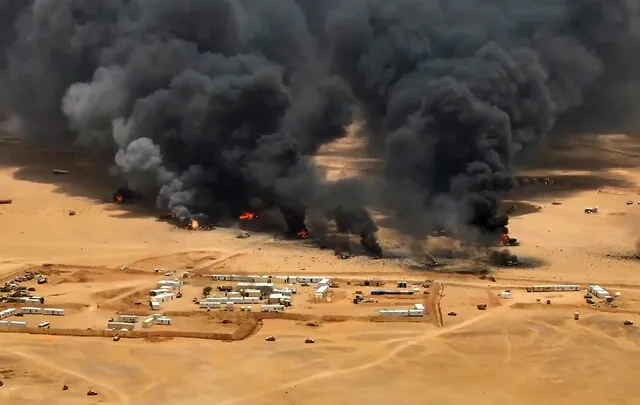
The $100 Threshold Has Been Crossed
Brent crude briefly topped $100.19 a barrel on Wednesday — a level that sends a jolt through import-dependent economies within hours, not months. South Korea, which relies on the Persian Gulf and the Red Sea for the bulk of its crude shipments, is now facing a compounding crisis: the Strait of Hormuz is under active threat from the US-Iran clash, and simultaneously, the Bab el-Mandeb strait — the southern mouth of the Red Sea — is becoming a new battlefield.
Two chokepoints. Two fires. One pricing signal.
The psychological barrier of $100 has held for decades as both a market milestone and a political trigger. When breached, it forces every downstream buyer — refiners, airlines, logistics operators, governments — to renegotiate assumptions about affordability. The last time Brent sustained above this level was mid-2022, during the Russia-Ukraine war’s opening shock. This time, the dynamics are qualitatively different: there is no single supply disruption to isolate. Two of the world’s most critical maritime corridors are simultaneously contested, and neither side in either conflict shows signs of de-escalation.
Yemen’s War Was Paused. Not Settled.
The fighting between Houthi forces and the Saudi-backed Yemeni government restarted in July when Sanaa International Airport was struck. What followed has been a seven-day escalation that has drawn in both sides with renewed conviction.
On September 9, Houthi broadcaster Al-Masira reported that Saudi coalition fighters carried out 32 airstrikes across Houthi-held territory in Marib, Al-Jauf, Taiz, and Hodeidah. The previous day, Houthis had hit what they described as Saudi-aligned oil installations and a military airbase with missiles and drones, wounding 73 civilians. Neither side is pulling back.
This is not a stalemate. Both sides see the regional chaos — the US-Iran confrontation, the wider Middle East instability — as an opening to settle the score while the world’s attention is elsewhere. The strategic calculus has shifted: both actors understand that the window of relative distraction is narrow, and they are moving aggressively to exploit it.
The Real Target Is the Strait
Al-Jazeera cited regional analyst Mohamed Al-Basha pointing out that the Houthis may be attempting something strategically familiar: imposing transit fees at Bab el-Mandeb the way Iran is pushing to do at the Strait of Hormuz. Control of the strait means control over who moves cargo through one of the world’s most critical maritime corridors. Roughly 12 million barrels of oil per day flow through Bab el-Mandeb — nearly a third of global seaborne oil trade — and another 15 million barrels pass through the neighboring Strait of Hormuz. Together, these two passages handle nearly half of the world’s container shipping volume and a dominant share of global LNG flows.
For Saudi Arabia, the stakes are immediate and logistical. If the Red Sea route is blocked, its oil exports cannot simply reverse course — they must be rerouted through Egypt or other distant ports, adding weeks and millions to every shipment. The East-West Pipeline, which runs from the Red Sea coast to the Arabian Gulf, was designed for exactly this contingency but has limited capacity and remains vulnerable to disruption itself.
The Yemeni government says its objective is the recapture of Sanaa and what it calls the liberation of Yemen from Houthi control. But the military movements around Al-Jauf and the forward positions near the strait suggest the broader goal is denial: making sure the Houthis cannot turn the Red Sea into a blockade that strangles Saudi trade and Ethiopian port access alike.
Iran’s Wider Game Changes Everything
The US Central Command reported on September 8 that it had destroyed five Iranian tankers. Iran’s Revolutionary Guards responded the next day, claiming strikes on two US warships and eight tankers, and warning of attacks on tankers in Kuwait and Bahrain ports. Twenty missiles were launched at a US base in Jordan; eighteen were intercepted. No casualties were reported.
This is no longer a shadow war. It is open naval confrontation in the Gulf, and the consequences for global supply chains are no longer theoretical. Iran’s doctrine has always treated the Strait of Hormuz as a lever — one it has threatened to close repeatedly since 2011 but never fully tested. The current escalation suggests Tehran may now be willing to cross that threshold, either directly or through proxies operating in adjacent waterways.
The second-order effect is already visible in insurance markets. War-risk premiums for the Gulf of Oman and the Arabian Sea have doubled in the past week, according to sources familiar with London Marine insurance renewals. P&I clubs — the protect-and-indemnity insurers that cover commercial vessel liability — are increasingly refusing to underwrite transit through restricted zones without explicit government guarantees. That means even if a tanker can physically pass through, it may not be able to secure the insurance required to do so legally.
Korea’s Refiners Already Feel It
South Korea’s three major refiners — S-Oil, GS Caltex, and Hanjin Shipping-linked operators — source the majority of their crude from the Middle East. The Hormuz strait alone handles roughly 20 million barrels per day in global throughput, and Korea’s refineries depend on a significant share of that flow.
When Brent moves above $100, the margin compression hits immediately. Refiners buy crude at spot prices that already embed a war premium, but they sell refined products into markets where demand is elastic and competition is global. The spread narrows. Some runs become unprofitable overnight.
Shipping rates through the Red Sea have already climbed as insurers reassess risk. Vessels that normally transit Suez are being rerouted — or held off. Either way, delivery timelines stretch and freight costs rise. A VLCC (very large crude carrier) that once completed the Ras Tanura-to-Incheon run in approximately 28 days now faces schedules extending to 35 days or more, depending on routing and stopover requirements.
The ripple effects extend well beyond energy. Korea’s petrochemical industry — a sector contributing roughly 8 percent of total manufacturing output — runs on naphtha and other refinery byproducts sourced from the same Middle Eastern supply chain. Feedstock cost increases of even 10 to 15 percent per barrel translate into broader industrial inflation, touching plastics, textiles, and synthetic materials that feed into consumer goods globally.
Who Wins, Who Loses
Saudi Arabia gains leverage it has not had since the 2022 UN-brokered truce held — the international community is less sympathetic to the Houthis when civilian infrastructure and energy facilities come under fire. The alliance is recalibrating.
The Houthis gain strategic depth. Even if they do not hold territory indefinitely, controlling threats to the strait gives them a bargaining chip they never had during the quiet years of the truce. Their ability to disrupt shipping — even symbolically — elevates them from a insurgent group to a gatekeeper of global trade, a status that reshapes negotiations with regional powers and international mediators alike.
Korea loses on both sides of the curve. Input costs rise. Export competitiveness erodes. The won-denominated cost of every barrel that passes through Hormuz or skirts the Red Sea comes home in fuel prices, in chemical feedstock, in the price of everything that moves.
Japan and China face the same structural exposure, but Korea’s refineries are disproportionately concentrated — three major complexes handling the vast majority of processing — meaning disruption hits harder and faster than in more diversified economies. There is no alternate crude sourcing corridor that can absorb the shock within any meaningful timeframe.
Second-Order Effects Already Emerge
Beyond the obvious energy and shipping channels, the crisis is producing less visible but equally consequential effects. Container freight rates on Asia-Middle East lanes have already ticked upward, and those increases will propagate into European and American retail prices within weeks. Agriculture is particularly vulnerable: fertilizer imports from the Gulf, grain shipments transiting Suez, and cold-chain logistics all depend on predictable shipping schedules that no longer exist.
Currency markets are pricing in the risk. The won has weakened against the dollar by approximately 2.3 percent since the escalation began, reflecting Korea’s structural trade deficit and its dependence on imported energy. The Bank of Korea faces a difficult policy constraint: raising rates to defend the currency would crush domestic demand already softening from earlier rate hikes; keeping rates low invites further depreciation and imported inflation.
Defense spending is another pressure point. Regional allies — including Korea, Japan, and the Philippines — are reassessing maritime security commitments in the Gulf, potentially diverting resources from Indo-Pacific deterrence to Middle East presence. This realignment is small in absolute terms but symbolically significant in a region where naval posture communicates strategic priority.
What Happens Next
The immediate risk is not a full regional war — though the trajectory makes that less unthinkable each day. The more probable scenario is sustained disruption: periodic strikes on shipping, intermittent closures of the Bab el-Mandeb, and Hormuz remaining in a state of contested navigation.
That means oil stays elevated. It means Korean buyers will lock in forward contracts at higher floors. It means inventory draws down faster than planned. And it means the next shock does not need a headline — it just needs a tanker to disappear through the strait.
The $100 mark was always going to be tested. What makes this moment different is that two chokepoints are under pressure at once, and no major consumer economy has a realistic hedge against both. Korea’s energy security architecture was built for a world with one controllable disruption at a time. That world no longer exists.
The question now is not whether the second-order effects will arrive — they already are — but whether Seoul and its partners can build a response before the next escalation forces a choice between economic pain and strategic irrelevance.