OpenAI's GPT-6 Astra Just Broke the AI Hardware Economics
Jensen Huang revealed GPT-6 Astra was trained on 100,000 GPUs at ZFLOPS-scale compute. Here's what that means for who can build AGI and who gets left behind.
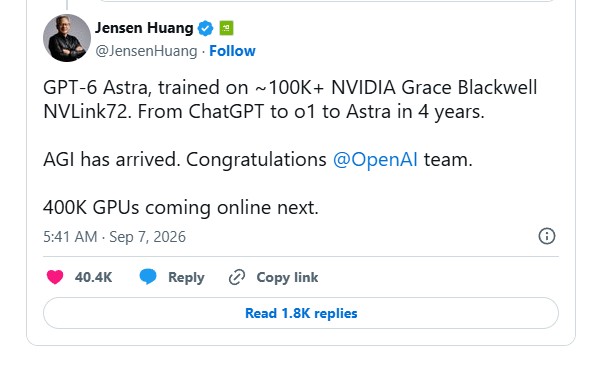
The Number That Changes Everything
Jensen Huang didn’t just congratulate OpenAI on X. He dropped a number that should make every AI researcher, investor, and policy maker pause: 100,000 GPUs.
Not 10,000. Not even 50,000. One hundred thousand NVIDIA Grace Blackwell chips, linked together in NVLink72 configurations, training the model that OpenAI calls GPT-6 Astra. And Huang says the next jump is 400,000.
This isn’t incremental scaling. This is a qualitative break in the economics of artificial intelligence. The barrier to building frontier models just moved from “well-funded startup” to “requires nation-state-level capital expenditure.”
What GPT-6 Astra Actually Did
Let’s start with what this model accomplished, because the benchmark numbers are staggering even for people who follow this space.
GPT-6 Astra scored 99.9 percent on ARC-AGI-3, the Abstraction and Reasoning Corpus benchmark designed specifically to measure how close AI is to human-like general intelligence. That test rewards systems that can solve novel problems through abstract reasoning rather than pattern matching or memorization. A 99.9 percent score on that benchmark is not a rounding error. It is a signal that the model has crossed something fundamental.
Separately, videos circulating on X show GPT-6 Astra autonomously operating professional painting software, navigating complex 3D modeling interfaces, and designing complete 3D game environments without human intervention. These are tasks that require not just language understanding but tool use, spatial reasoning, and sustained goal-directed behavior across multiple software contexts.
Huang called it the achievement of AGI. He also noted it took only four years from ChatGPT’s launch to reach this point. That timeline is itself a data point worth examining.
The Hardware Math Behind the Claim
Here is where the economics get concrete, and where the numbers become almost difficult to parse.
Each NVIDIA GB200 Grace Blackwell Superchip contains one CPU and two GPUs, delivering 80 teraflops of FP64 performance. Multiply that by 100,000 GPUs — which means roughly 50,000 of these superchip units — and you are looking at approximately 4 exaflops of theoretical peak performance for the entire training cluster.
For context, the current TOP500 supercomputer ranking lists the world’s most powerful machine, a Chinese system, at 2.19 exaflops. GPT-6 Astra’s training cluster, by raw FP64 spec, already exceeds that. In practice, modern LLM training leverages mixed precision formats like FP4 and FP8, which squeeze far more throughput out of the same silicon. That pushes the effective computational scale into the zettaflops range — one thousand exaflops, or one trillion floating-point operations per second.
The energy requirements alone are worth considering. A cluster of this size consuming power at data-center scales for weeks or months of training is a line item that dwarfs nearly every other technology investment in history.
Who Can Afford This?
Let me be direct about what this means for competition.
Four years ago, OpenAI launched with what was considered a very large GPU cluster by industry standards. Today, the frontier has moved to a scale that is roughly ten times larger in physical hardware, and orders of magnitude larger in effective compute when you account for the precision optimizations and training efficiency improvements. The trajectory suggests that by the time GPT-7 arrives, the hardware requirement could approach a million GPUs.
This creates a funnel. On one side, you have a handful of organizations — OpenAI, Anthropic, Google DeepMind, possibly Microsoft, and well-funded Chinese labs — that can absorb the capital costs. On the other side, everyone else: startups, universities, open-source communities, and companies in countries without access to cutting-edge semiconductor supply chains.
Huang’s comment about 400,000 GPUs coming online next is not speculation. It is a roadmap disclosure. NVIDIA is building the supply chain, the networking, the power delivery, and the software stack to support this scale. OpenAI and its peers are the customers. The bottleneck is shifting from algorithmic breakthroughs to hardware procurement and energy infrastructure.
The Chinese Supercomputer Context
It is worth noting that the world’s fastest supercomputers are Chinese. The TOP500 leader referenced above is a system built in China. This creates a geopolitical dimension that extends beyond AI model development. Nations are investing billions in exascale computing infrastructure, and private AI companies are now competing against those same national capabilities.
China has been explicit about treating AI as a strategic priority. The convergence of government-backed supercomputing with private-sector AI development creates a dynamic where the boundary between state capacity and corporate capability is blurring. The 100,000-GPU training cluster is not just an OpenAI asset. It is a piece of infrastructure that sits at the intersection of commercial ambition and national technological competition.
What 400,000 GPUs Signals
Huang did not stop at describing what exists. He disclosed what is coming. Four hundred thousand GPUs. That is a fourfold increase over the GPT-6 Astra cluster. If the scaling relationship holds — and there is every reason to believe it will, given the empirical track record — the next frontier model will require compute resources that are difficult to model in conventional financial terms.
The question is no longer whether AGI is possible. The question, as Huang framed it, is how much computational resource the path to AGI demands, and how intelligent the resulting systems will become. Those are questions that exceed the framing of most technology analysis. They require thinking in terms that feel almost abstract: trillion-dollar economies of scale, energy grids redesigned for data-center loads, geopolitical realignments around semiconductor access.
The Real Cost Is Not Just Money
The headline number is the hardware cost. But the deeper cost is the organizational and temporal concentration of capability. Four years from ChatGPT to a model that scores 99.9 percent on an AGI benchmark. That pace of development means that the window for any organization to enter the frontier is closing faster than most people realize.
Open source cannot simply replicate this. The dataset sizes, the compute clusters, the refined training pipelines — these are locked behind capital requirements and institutional knowledge that do not transfer easily. The companies that built this trajectory have spent four years accumulating both. New entrants face a compounding disadvantage that is not merely financial but structural.
Where This Goes Next
The arc is clear enough to trace, even if the destination is not. More GPUs. More compute. More capability. The question that should occupy policymakers, investors, and anyone tracking the technology is what happens when the gap between frontier and non-frontier becomes unbridgeable for all but a handful of actors.
Huang’s congratulatory message was brief. The numbers embedded in it are not. One hundred thousand GPUs. ZFLOPS-scale training. Four hundred thousand coming next. The economics of artificial intelligence just entered a new phase, and the people who can afford the hardware are the ones who will define what comes after.