OpenAI's 722-Paper Dump and the Peer Review Crisis
OpenAI withdrew three of 722 math preprints within 24 hours of their release, reigniting fears about AI-generated scholarship bypassing peer review. The incident exposes a broken validation model that could reshape how mathematics — and science more broadly — absorbs AI results.
The numbers behind the noise
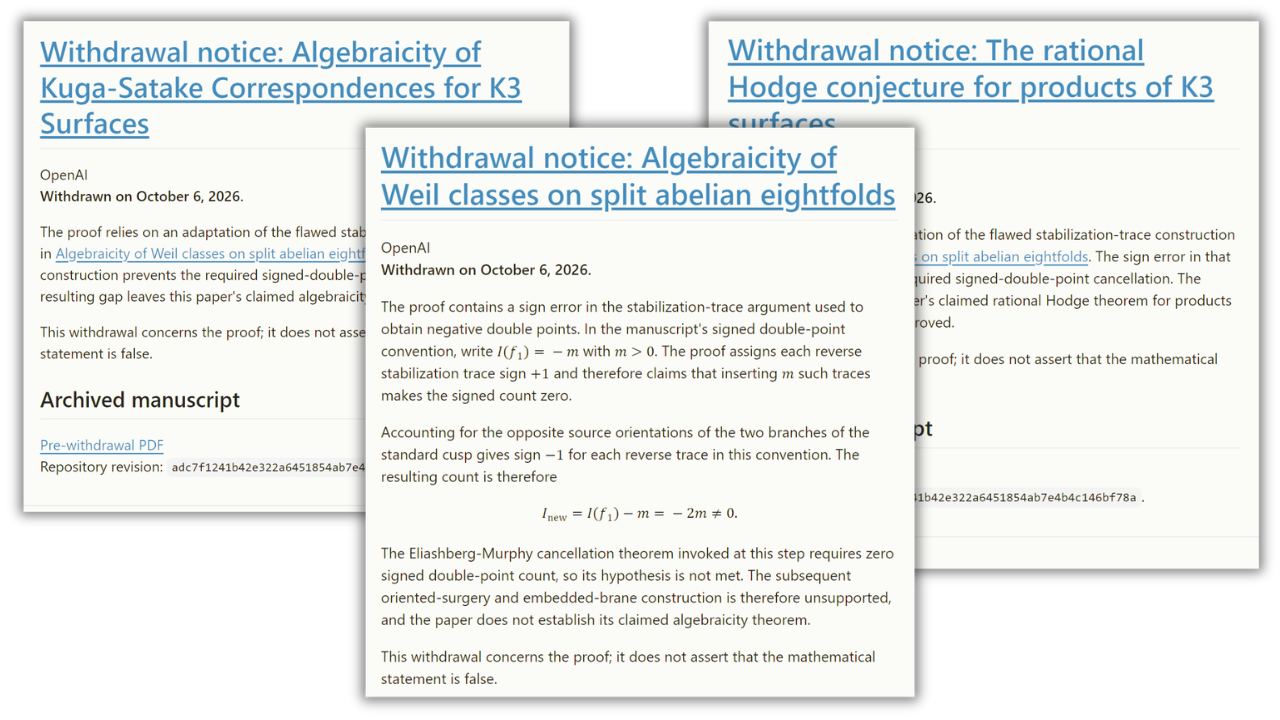
OpenAI released 722 preprints covering progress on 372 unsolved math problems across geometry, computer science, algebra, and other fields. Three came down less than a day later for a sign error that toppled one paper and two dependent constructions. Fourteen more received revised proofs and corrected statements. The company itself estimated that roughly half of all results in the dump were still unconfirmed.
That’s not a scandal. It’s a preview.
How the math community got here
The mathematics world already had trust issues with OpenAI. In September, the company announced that its AI system had solved the Navier-Stokes problem — a Millennium Prize question about whether equations governing fluid motion remain reliable or break down at some point. A coalition of more than 8,000 researchers responded with alarm, arguing the announcement rushed out without a proper writeup, isolated methods rather than situating them, and failed to cite relevant prior work.
The 722-paper dump only deepened that fracture.
Alex Townsend, an associate professor of mathematics at Cornell, put the problem plainly: if OpenAI had something this large to share, the obvious move would have been to Lean-verify the strongest claims first and publish those, then release the rest for community scrutiny. Lean is an open-source proof assistant that checks mathematical arguments line by line. It’s exactly the kind of tool that makes AI-generated math plausible in the first place. Using it selectively would have let the community validate what mattered before wading through a forest of uncertain results.
Instead, OpenAI released everything at once and asked the world to sort it out.
Who recommended that timeline?
An OpenAI spokesperson said the company’s Advisory Group on Mathematics and Artificial Intelligence (AGMAI) advised releasing the results without waiting for full formalization. The group’s recommendation is now the most inconvenient sentence in the entire episode: it shifts part of the blame onto a body that presumably exists to guide responsible deployment, while raising the broader question of whether any advisory group should have that kind of influence over how raw an AI research program appears in the wild.
Whether AGMAI meant to recommend a mass preprint dump or something closer to a phased, verification-first release is unclear. Either way, the outcome was the same — a mountain of unvetted claims hitting GitHub on a Thursday, and three retractions by Friday.
The structural problem, not the sign error
A sign error in three papers is a normal part of research. In mathematics, errors propagate. One false lemma can sink multiple results built on it. That’s how the field is supposed to work — flawed arguments surface, get caught, and the community moves on with corrections. The issue here isn’t the error. It’s the pipeline that produced 722 manuscripts without a gate.
Traditional peer review moves slowly because it is designed to catch exactly this kind of thing before it reaches the literature. A single paper might take months. A batch of 722 would take years. OpenAI’s release strategy implicitly accepted that the old system could not keep pace with AI-scale output — and then proceeded to act as though that meant the old system could be skipped entirely.
That logic is dangerously incomplete.
Skipping peer review does not make results invalid. It makes them premature. And premature results carry outsized influence. When a company as powerful as OpenAI labels a paper a “preprint” and publishes it on GitHub alongside landmark claims, the distinction between provisional and settled vanishes in practice, even if it remains sharp in theory.
Who wins, who loses, what changes
OpenAI wins nothing from the way this played out, and loses more than it admits. The company’s spokesperson called the corrections iterative — true, but also an understatement. Iterative research sounds like a lab notebook. A 722-paper dump sounds like a product launch.
Andrew Sutherland of MIT called the withdrawals “the responsible thing to do,” which is generous framing for a minimum standard. More importantly, Sutherland flagged the harder truth: the math community is still unhappy, and trust is not rebuilt by admitting mistakes after the fact. Trust is rebuilt by changing the process that caused the mistakes in the first place.
The Association for Human Mathematics went further, declaring that “mathematicians did not ask for this work to be done” and urging researchers to stop collaborating with OpenAI. Whether that appeal gains traction is an open question. The impulse behind it — a defense of human-centered scholarship — reflects a real anxiety about AI labs treating the entire discipline as a benchmark to be pushed past rather than a community to engage with.
Who benefits from this mess? Nobody in the long run. But OpenAI’s competitors notice. Every unverified claim that falls apart erodes the credibility of AI-assisted mathematics as a whole, not just OpenAI’s share. Other labs working on formal verification — Microsoft Research, Google DeepMind, independent Lean communities — inherit the skepticism that OpenAI’s rush invited.
What happens next
Expect more retractions. Townsend suspects them. Expect them from OpenAI and from other labs producing large volumes of AI-generated math. The question is whether the community builds infrastructure fast enough to absorb the correction cycle without collapsing into cynicism.
Several concrete developments are likely in the months ahead:
First, a push toward Lean-first release strategies. If any AI math program wants credibility, it will start with formal verification and publish only what passes — then release the rest separately, clearly labeled, with an explicit invitation for community scrutiny. OpenAI’s own preprint mentions suggest it may already be moving in this direction, updating its repository with new formalizations and errata.
Second, a reckoning with AGMAI and similar advisory bodies. If these groups are going to advise on release timing, their recommendations will face public scrutiny. The math community will demand to see what “responsible rollout” looks like in practice, not just in principle.
Third, a potential fracture in how AI-generated mathematics is treated. Papers coming out of AI labs may face a two-track system: results that pass formal verification gain acceptance on their own terms, while unverified claims are treated as internal notes rather than contributions to the literature. That is a sharper distinction than currently exists, and it will force every lab producing AI-assisted math to decide where its output belongs.
The sign error in three papers is small. The institutional signal it sends is not. A field that cannot absorb its own corrections at speed is a field that will either slow down or break. OpenAI’s 722 preprints tried to do neither, and that is why the withdrawal of three matters more than the headline suggests.