Pennsylvania's measles crisis is a warning for the world
America's largest measles outbreak is unfolding in Lancaster County's Mennonite and Amish communities, where vaccination rates have plummeted and vaccine hesitancy is deeply rooted. The crisis reveals how religious exemptions, pandemic-era distrust, and falling immunization rates combine to create the perfect conditions for a global public health reversal.
A fire burning at the wrong time of year
Measles is supposed to be a winter disease. It surges in cold months when people huddle indoors and transmission takes hold. What is happening in Lancaster County, Pennsylvania, is not supposed to be happening in September.
The state is now wrestling with 577 confirmed cases — the largest measles outbreak in the United States — and more than 246 of those cases are concentrated in a single county home to the country’s largest Mennonite community. Two people have died. The virus is spreading through schools, churches, and summer camps where children who should be protected are instead incubating an outbreak that public health officials fear will worsen before it improves.
This is not just a Pennsylvania story. It is a preview of what happens when vaccine confidence erodes inside communities that have long opted out of mainstream medical systems — and it mirrors a global pattern playing out in nations from India to Brazil to France.
The numbers behind the outbreak
The data from Lancaster County tells a story of steady, deliberate decline.
At Weavertown Elementary, where four children from the Smucker family attend school, only one in four kindergarteners is immunized against measles. That is the lowest reported rate in all of Pennsylvania. At Ephrata Mennonite School, where at least two children fell ill in the earliest weeks, vaccination coverage sits at roughly one in three. At Gehmans Mennonite School, it is below one in two.
These are not accidental numbers. They are the product of years of rising exemption requests. At Ephrata, religious and philosophical waivers jumped from about one in ten kindergarteners in 2019 to 44 percent last year. In Mennonite schools across the county where data is available, roughly one in three kindergarten students carries an exemption — compared to about seven percent in public schools.
Mark Roberts, a physician who formerly led the University of Pittsburgh’s Public Health Dynamics Lab, studied the preceding outbreak in Texas and saw the same trajectory there. Immunization rates in Mennonite classrooms had been falling at an alarming pace for years before measles arrived. The 2019 study he contributed to warned that many classrooms were already below the threshold needed to prevent large outbreaks.
Herd immunity for measles requires vaccination coverage of roughly 93 to 95 percent, given the virus’s extraordinary contagiousness — a single infected person can transmit it to 12 to 18 others in a susceptible population. The Mennonite schools in Lancaster are far below that line.
How the virus moves through close-knit communities
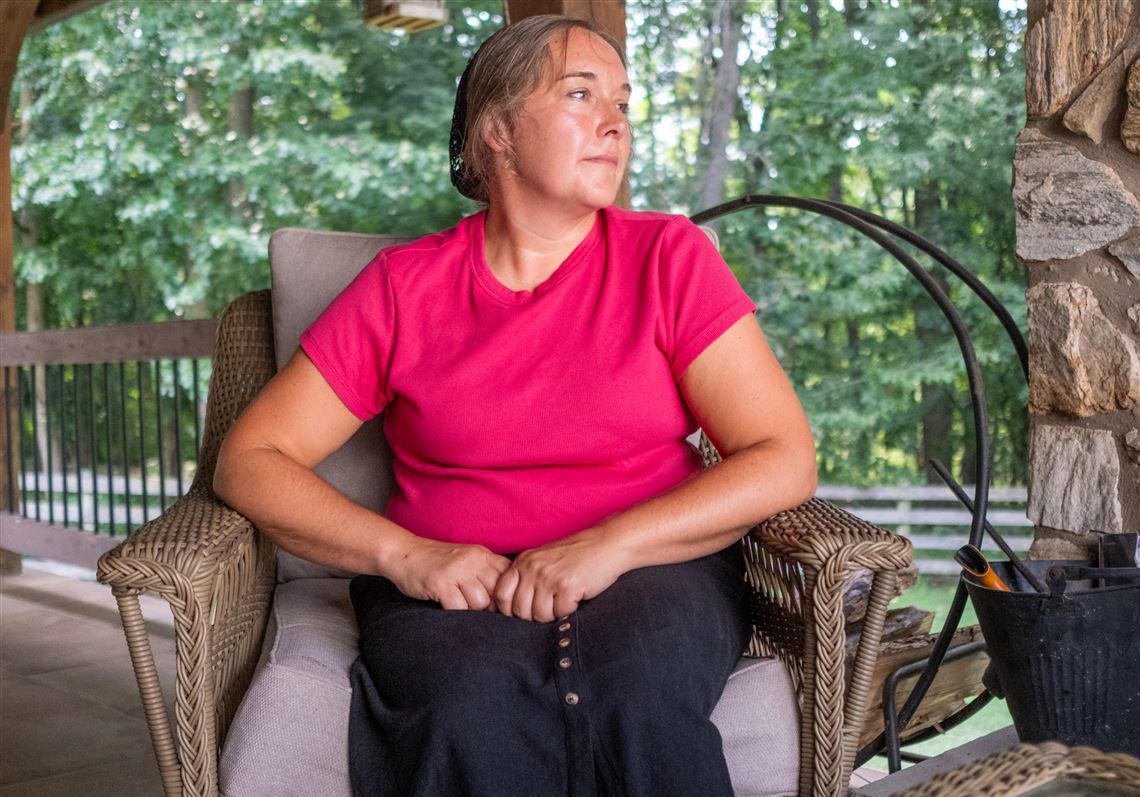
For Hilda Smucker, a 44-year-old mother raised in a Mennonite family, the signs appeared after her daughter Danielle returned from summer camp. Red spots on the cheeks. A fever spiking to 104. A cough. The rash spreading downward. Within days, Danielle’s younger siblings, ages five and seven, began showing symptoms too.
Smucker did not call a doctor. She did not report the case to the state. She posted photographs of the rash in a congregation chat and was added to a group message with more than two dozen parents whose children were already sick. The advice circulated: take vitamin A, drink chamomile tea, stay hydrated.
This response is not unique to Lancaster. It reflects a deep-seated instinct in Mennonite and Amish communities to manage health internally, away from government institutions. The culture of self-reliance stretches back generations — homes where families grow their own food, sew their own clothes, and homeschool their children.
But the instinct also has a specific pharmacological history. In 1982, a widely watched NBC documentary claimed that the whooping cough vaccine could cause neurological injury. Subsequent studies found no link to brain damage, though the vaccine did cause some children to experience seizures and was eventually replaced with a safer variant. The documentary, however, left a mark. When Smucker became a mother, she vaccinated her first two children despite warnings from family and friends. Years later, her views shifted along with the broader community.
A second factor took root around the development of the rubella vaccine, which uses cell lines derived from tissue from terminated pregnancies. For many in the Mennonite community, that detail became a moral objection that extended skepticism to other vaccines as well. The COVID-19 pandemic and the mask mandates, business closures, and public health orders that followed amplified existing distrust.
“COVID really woke some people up,” Smucker said.
The human cost
Public health researchers estimate up to two deaths and 200 hospitalizations per 1,000 measles cases. In Pennsylvania so far, two people have died — both in Lancaster County.
The state initially described the fatalities as measles-associated. The county coroner later ruled that one of the deaths — a newborn — was caused by a ruptured spleen, not the virus itself. That finding drew criticism from leading infectious disease experts, including Paul Offit, who noted that measles can cause spleens to enlarge and rupture. The coroner’s office is also investigating a second death, a six-week-old infant with a genetic disorder, and determined the cause to be measles. It remains unclear whether that case is among the two fatalities the state announced.
An Atlantic reporter tracked down an Amish couple on a Lancaster farm believed to be the parents of the deceased infant. The mother, unvaccinated, contracted measles before giving birth at a midwife-run facility.
The deaths have drawn national attention, but they have not shifted community attitudes. Smucker, despite her daughter’s severe illness, has not changed her position on vaccines. She believes immunity will come through natural infection rather than shots. Roberts acknowledged that before the measles vaccine was introduced in 1963, that is precisely how populations acquired immunity. The trade-off, he said plainly, was that children died.
What this means beyond Pennsylvania
The Lancaster outbreak does not exist in isolation. It shares a pattern with outbreaks in other tight-knit communities across the United States — the Texas surge the previous year, which left two children dead and nearly 100 hospitalized, followed the same trajectory through Mennonite communities. It also mirrors dynamics playing out in countries where vaccine hesitancy is fueled by religious belief, government distrust, or misinformation.
Globally, the World Health Organization reported a 79 percent increase in measles deaths between 2023 and 2024, with more than 10 million cases worldwide. The disease, once declared eliminated in the United States in 2000, is returning through the same fissures: falling vaccination rates, concentrated pockets of unvaccinated children, and communities that resist external public health intervention.
The implication for global health policy is uncomfortable. Vaccine access is no longer the primary barrier in many wealthy nations. The barrier is now belief — and belief is harder to treat than a virus. Public health campaigns that rely on trust in government institutions are largely ineffective in communities that do not trust those institutions. Pop-up vaccine clinics, like the one offered at Ephrata Mennonite School, draw only a handful of participants when the underlying conviction is that vaccines are not in the community’s best interest.
What happens next
Roberts sees two possible paths to ending the outbreak: either enough people contract the disease and develop natural immunity, or vaccination rates rise sharply. The first option carries an unavoidable cost — children will be harmed and some will die. The second is theoretically possible but faces steep cultural and structural barriers.
The timing of the outbreak makes the outlook darker. A summer surge in a community with vaccination rates far below herd immunity thresholds suggests the virus has significant room to grow. “You’ll see more and more,” Roberts said.
State health officials continue to work with local partners to establish vaccine clinics and trace contacts. But the fundamental challenge remains: how do you intervene in a community that has built its identity around self-sufficiency and suspicion of outside authority, especially when that authority is asking people to accept something as simple and proven as a vaccine?
The answer may not come from Lancaster alone. It will require public health strategies that work within the value systems of resistant communities rather than against them — strategies that global health officials are still learning to build.