Riyadh Hit for the First Time — and the Alliance Testing It
Houthi missiles struck the Saudi capital for the first time, shattering the illusion that the kingdom's defenses were impenetrable. Turkey and Pakistan are now saying their defense pact is real — and the US is bracing for a faster explosion.
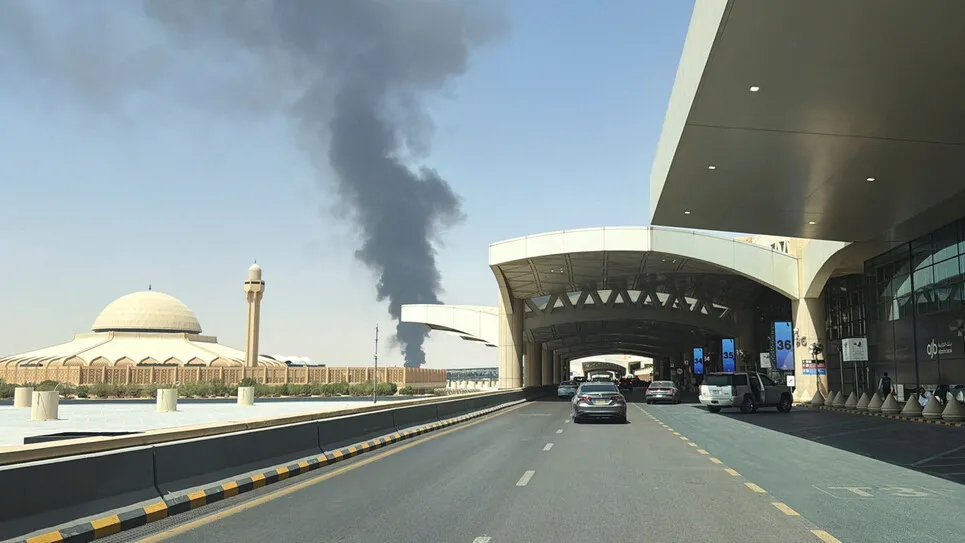
Riyadh burned on March 19.
Black smoke rose above fuel storage sites near King Khalid International Airport. Residents received warnings of an active aerial threat. FlightRadar24 recorded the airport’s disruption index at its maximum — a rare 5.0. The Saudi coalition claimed it intercepted ballistic missiles over the capital. The Houthis claimed they hit “sensitive facilities” inside Riyadh and an Aramco site in the Red Sea port city of Yanbu. Both sides withheld specifics on damage.
What matters is the direction the strike is pointing. This was the first Houthi attack on the Saudi capital since open fighting erupted in July. The boundary between “proxy war off the coast” and “war on Saudi territory” has just disappeared.
How we got here
The Houthis declared a maritime blockade of Saudi waters in July. They have since turned the Red Sea into a contested corridor, targeting Saudi ships, coastal cities, and energy infrastructure. They captured the port of Mokha and later seized Perim Island, which sits at the northern mouth of the Bab el-Mandeb strait — one of the world’s most critical chokepoints for global shipping.
Saudi Arabia responded with repeated airstrikes against Houthi-held territory. The cycle escalated but stayed roughly contained within Yemen’s borders and the sea lanes around it.
That containment ended on March 19.
The alliance that could not stay in the basement
A month ago, Riyadh signed a mutual defense pact with Ankara and Islamabad — the so-called Mecca Agreement. The formal terms were straightforward: an attack on any signatory is considered an attack on all three. Until now, the pact existed on paper.
On March 18, Pakistan’s military spokesperson Lt. Gen. Asif Ghafoor told Arab News that Pakistan would “not hesitate to take any action” to defend its ally. The next day, Turkish Foreign Minister Hakan Fidan told state-affiliated NTV that Turkey would honor the Mecca Agreement’s commitments in response to the Riyadh strike.
Neither leader specified what “action” or “commitments” would look like. But the signal is unmistakable: the alliance is moving from deterrence rhetoric to operational posture.
Who gains, who loses
Saudi Arabia’s Crown Prince Mohammed bin Salman built his security strategy on two assumptions: that external threats could be managed through expensive missile defenses and strategic partnerships, and that the Houthis could be degraded without direct invasion. The Riyadh strike punctures both.
Turkey gains something it has chased for years — a tangible military role in the Gulf. Ankara has long wanted recognition as a key security player beyond its own borders. The Mecca Agreement gives it a formal entry ticket. Whether President Recep Tayyip Erdoğan can deliver boots or just air support is an open question, but the political capital is already being banked.
Pakistan faces the sharpest dilemma. Islamabad has historically avoided entanglement in Middle Eastern wars. Committing to a Saudi defense pact pushes it toward a theater where domestic politics, financial fragility, and a fragile economy make deep military involvement extremely costly. The military establishment’s bravado “we will not hesitate” is easier to say than to execute. If Pakistan does send forces, it risks angering Iran and destabilizing an already precarious balance.
The Houthis gain strategic relevance. Striking Riyadh proves they can threaten the Saudi heartland, not just its coastline. That shifts bargaining power inside Yemen and strengthens their position vis-à-vis both the Saudi-led coalition and their Iranian backers.
The United States loses leverage. Washington has signaled caution about deeper military involvement in the region, repeatedly declining Saudi requests for direct intervention. The State Department’s March 19 warning — advising Americans in nine Middle Eastern countries to prepare for “rapid escalation” — was followed by President Donald Trump cutting short a Camp David stay and returning to the White House. The implication: Washington sees a widening crisis and is already pivoting to damage control rather than crisis management.
What happens next
The immediate risk is a three-front exchange. If Saudi Arabia responds to the Riyadh strike with a broader campaign against Houthi positions — including deeper strikes on Iranian-backed networks — the Houthis could escalate against Saudi oil infrastructure, Red Sea shipping, or civilian targets. Turkey and Pakistan’s involvement turns a bilateral conflict into a multilateral one.
The second risk is Iranian calculation. Tehran has long used the Houthis as a low-cost pressure instrument against Saudi Arabia. A direct strike on Riyadh raises the stakes for Iran as well. If Washington interprets the attack as Iranian-directed, the possibility of a broader US-Iran confrontation moves from speculative to plausible.
The third risk is economic. The Red Sea is already a damaged trade route. An attack on Aramco’s Yanbu facility — Saudi Arabia’s second-largest oil export hub — introduces the threat of supply disruption at the source, not just on the sea lanes. Energy markets react quickly to anything that touches Saudi capacity.
The bigger picture
The Mecca Agreement was always a geopolitical experiment. It attempted to stitch together three powers with different threat perceptions — a Sunni monarchy, a NATO member with regional ambitions, and a nuclear-armed South Asian state with an anxious economy — into a single defensive framework. Security pacts are easy to sign. They are harder to activate without triggering unintended consequences.
The Riyadh strike proves the pact is no longer theoretical. Whether it holds, fractures, or escalates further is the question that will define Middle Eastern security in the months ahead.
The conflict is no longer contained to Yemen. And containment was always the fragile part.