Russia Strikes Kyiv During Merz Visit Signals New Escalation
Russia's deliberate decision to pound Kyiv during Chancellor Friedrich Merz's visit marks a break from Kremlin tradition and a warning to Europe. What happens when Germany's military aid pledge collides with Moscow's shadow war strategy?
The Kremlim Broke Its Own Unwritten Rule
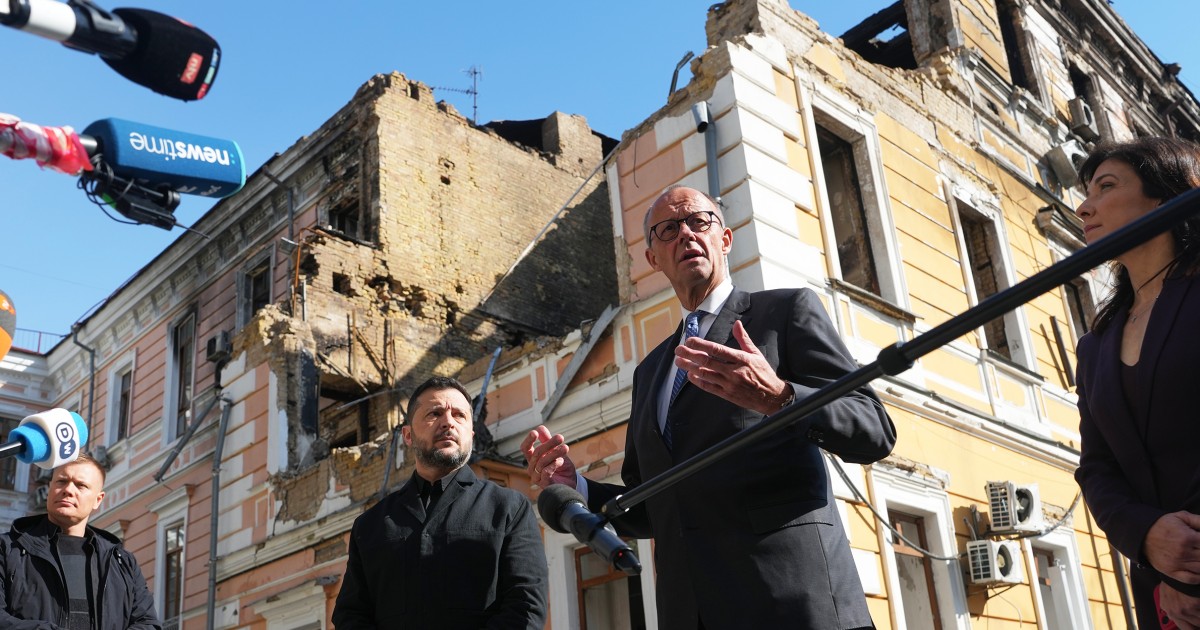
For years, the pattern was predictable: when a dignitary of high rank arrived in Kyiv, Russian strikes would fall silent. The Kremlin understood the optics — a world leader standing beside Ukrainian President Volodymyr Zelenskyy amid air raid sirens was a story it preferred not to tell. On Sunday, October 5, Chancellor Friedrich Merz’s train pulled into Kyiv and the bombs fell anyway.
This was not a coincidence or a intelligence failure. It was a message. Moscow chose the day of a German chancellor’s visit to intensify attacks on Kyiv’s critical infrastructure — including bridges in broad daylight during rush hour, a new tactic aimed at severing the two halves of the city separated by the Dnipro River. The Russian Defense Ministry openly acknowledged the strikes were retaliatory, triggered by Ukraine’s successful campaign against Russian oil refineries that has disabled more than half of Moscow’s refining capacity since summer.
The timing is the escalation. Russia has long understood that symbolic targeting of Western visitors carries a specific kind of political cost. Breaking that convention signals that the Kremlin no longer feels constrained by diplomatic delicacy — and that it is recalibrating how far it can push hybrid warfare on European territory before triggering a broader response.
Germany’s Dollar Comes With a Warning
Merz did not cancel his visit. He reaffirmed Germany’s commitment, announcing an additional $1.1 billion in military aid over the weekend. The framing was unusually sharp. This was not routine support diplomacy — it was a public declaration that Germany would not be intimidated out of supporting Ukraine, explicitly linking Ukrainian defense to Europe’s own security.
That linkage matters because it exposes the central tension at the heart of European defense policy heading into winter. Germany has been one of Ukraine’s most ardent supporters since the early days of the full-scale invasion, but it has also been quietly preparing for a scenario where the conflict’s spillover risks become unavoidable.
On Monday, Germany’s foreign intelligence chief warned that the country was at risk of being drawn into a “violent conflict with Russia,” citing Moscow’s escalating “shadow war” against European democracies. The warning came as Russia issued a second diplomatic evacuation advisory for Kyiv — mirroring a similar threat in May that most European missions ignored. The EU’s ambassador to Ukraine, Katarina Mathernova, delivered the response that has become the European posture: “We are staying.”
But staying and surviving are different things. The four-day bombardment of Kyiv that included Merz’s visit has severely disrupted the capital’s life. Million remain without reliable access to the city’s left bank. Businesses are paralyzed. Transport networks are grounded during alerts. The destruction of bridges — key arteries that connect the growing economic and military logistics of Ukraine’s largest city — represents a qualitative shift in Russian targeting strategy.
The Oil War Is Changing Everything
The context most Western capitals are still underestimating is the oil war. Ukraine’s strikes on Russian refining capacity have created a domestic fuel crisis that the Kremlin cannot easily absorb. The Russian Defense Ministry’s justification for the Kyiv campaign was blunt: it was punishment for those refinery strikes. But the logic cuts both ways.
Moscow is now striking Ukrainian civilian infrastructure in direct retaliation for Ukrainian strikes on Russian energy infrastructure. This is not a proxy war anymore — it is a mutual war of attrition against national economies, and both sides are demonstrating they can hurt each other’s critical systems. The question is who blinks first.
Germany’s aid package reflects that reality. The $1.1 billion is not just support for Ukraine — it is an investment in preventing a scenario where Russian success in degrading Ukrainian logistics forces a negotiated settlement on Moscow’s terms. For Berlin, the stakes extend beyond Kyiv. If Russia can demonstrate that it can strike a European capital with impunity while Western leaders are present, the psychological calculus changes across the continent.
What Winter Will Test
Winter approaches, and with it the three challenges that will define European defense posture: energy resilience, refugee pressure, and military readiness. Germany has taken in over a million Ukrainian refugees already, and any deterioration in Kyiv’s livability will trigger new displacement flows. Russia’s bridge strikes make evacuation and supply lines more dangerous — exactly when cold weather makes them essential.
The intelligence chief’s warning about a “violent conflict with Russia” should not be read as alarmism. It is an assessment that the shadow war — cyberattacks, disinformation, infrastructure sabotage, targeted intimidation — is transitioning toward something more kinetic. The bombing of Kyiv during a German chancellor’s visit is one data point in that trend. The evacuation advisories, the refinery war, the hybrid campaigns across Europe are all connected threads.
European allies have refused to heed Russia’s calls to leave Kyiv, and that cohesion is real. But cohesion without capability is just posture. The question heading into winter is whether Germany and its partners match their political declarations with the defensive infrastructure — air defense, energy hardening, emergency protocols — that the Kremlin’s latest escalation demands.
Merz went to Kyiv knowing the sirens would sound. That alone shows the conflict has moved past the point where symbolism matters. What comes next is whether Europe is willing to treat the new escalation as the beginning of something longer, and more dangerous, than anyone expected.