Russia Is Weaponizing Ballot Boxes to Cement Its Stolen Land
Moscow's first wartime parliamentary election in occupied Ukraine isn't about democracy. It's an escalation strategy to launder annexed territory through the charade of voting — and it changes the calculus for Western deterrence.
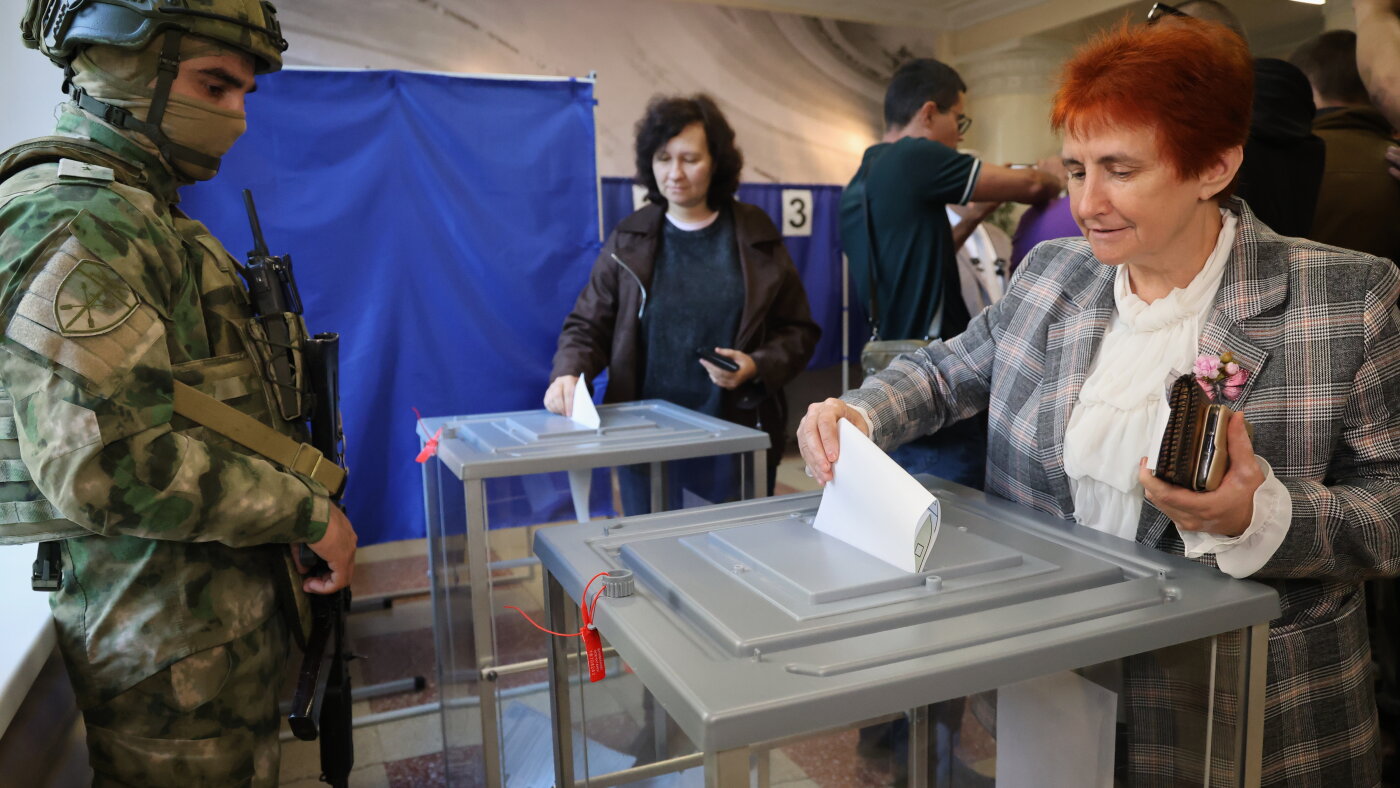
Moscow’s ballot box campaign
The images are almost casual in their choreography. An armed Russian soldier stands guard at a polling station in the Donetsk region. Voters drop paper ballots into a box. The AP camera captures it all with its usual flat detachment.
But this moment represents something far more consequential than a routine election day in a conflict zone. For the first time since the full-scale invasion began over four and a half years ago, residents of territories Russia illegally annexed in September 2022 are being rolled into a Russian parliamentary vote. More than 3.5 million people — or the survivors among them — are being asked to cast ballots for the State Duma.
This is not an election. It is an act of administrative warfare.
The mechanics of laundering territory
Russia’s leadership has spent the better part of three years building the bureaucratic scaffolding around its annexations. In 2023, it issued Russian passports en masse. It integrated local pension systems. It replaced Ukrainian schools with Russian curricula. It installed Moscow-loyal governors and mayors.
Each of these steps was designed to make the occupation look mundane. The election pushes the project forward into its next phase: political incorporation.
Putin’s Wednesday speech laid out the logic plainly. He told voters in the so-called new regions that they were casting ballots “for the first time since their reunification with Russia.” The word choice was deliberate. “Reunification” is Moscow’s official narrative — the claim that these lands always belonged to Russia and are simply being restored to their homeland. The election is meant to give that fiction the thin veneer of democratic consent.
The timing matters, too. The vote runs from Friday through Sunday across most of Russia, but it began in the occupied Ukrainian territories at the end of last month. Russian officials cite security reasons for the staggered schedule. In practice, it lets Moscow accumulate images and data from the front lines before the domestic portion of the election, creating a narrative of normalcy where there should only be destruction.
Coercion as policy
What makes this particularly brazen is how openly the Kremlin is deploying coercion. Violeta Artemchuk of Donbas SOS described election commission members going house to house, escorted by Russian troops, to ensure participation. Public sector workers face dismissal for staying home. Pensions and social payments are being held hostage — withheld from those deemed “disloyal” for opting out.
This is not subtle. The European Commission called it a “blatant violation of international law.” A coalition of nine Ukrainian human rights groups urged residents to stay away, warning that organizing the vote could carry criminal liability under Ukrainian law.
The coercion tells you something important about the Kremlin’s confidence — and its insecurity. Moscow does not expect genuine turnout. It expects manufactured turnout. The difference matters because it reveals the hollow center of the entire enterprise.
What this means for deterrence
The broader implication here is not just about Ukraine. It is about what happens when an aggressor state successfully uses electoral theater to consolidate territorial conquest, and the international community responds with condemnation but no structural countermeasure.
Kyiv has appealed to foreign governments and international organizations not to recognize the vote. The EU has already stated it will never recognize the results. But statements are not strategies.
For decades, the West’s deterrent against territorial aggression rested on a simple premise: captured land would not be合法ized through any process the aggressor controlled. The Dayton accords, the Minsk agreements, even the post-2014 stance on Crimea — all rested on the principle that borders cannot be redrawn by force and then sanitized through manipulated political processes.
Russia’s election in occupied Ukraine tests that principle directly. If the international community accepts the ballot boxes as legitimate — or, more dangerously, simply shrugs — it establishes a new template. An authoritarian state can invade, occupy, coerce the population into voting, and then present the results as proof of sovereignty.
That template would apply far beyond Eastern Europe. It would signal to Beijing that Taiwan’s future could be decided under similar conditions. It would embolden other revisionist powers to treat elections as another instrument of conquest.
The domestic calculation
Inside Russia, the election serves a different but related purpose. The State Duma is being used to showcase public support for the war. Putin explicitly framed the vote as a demonstration that “millions of people stand behind our fighters.” Soldiers deployed in the occupied territories are voting as well, ensuring that the military itself becomes part of the legitimation machinery.
This is the Kremlin’s attempt to close the domestic political loop: the war in Ukraine is portrayed as a defensive necessity, and now the people — including those in newly annexed lands — are giving their stamp of approval. It reinforces the narrative of a united nation standing together against external threats.
But the fact that the vote must be held under conditions of shelling and bombing, with soldiers guarding polling stations, should tell anyone watching that the unity being performed is coercive, not organic. As political analyst Volodymyr Fesenko put it, elections held at gunpoint are a farce. Any electoral procedure conducted by Russian occupation authorities has nothing to do with democracy.
Who wins, who loses
Moscow wins the propaganda value of having conducted an election in territory it claims to govern. It gains another round of imagery for domestic consumption. It adds seats — however marginal — to its Duma majority.
Ukraine loses because every ballot cast under Russian authority is used to reinforce the fiction of permanence. The longer the occupation continues, the more the world accustoms itself to the idea that these territories are simply Russian now. The election accelerates that normalization.
The international community loses because its response remains largely rhetorical. Sanctions, statements, diplomatic isolation — none of it addresses the specific mechanism of electoral legitimation. Until there is a concrete cost to using votes as instruments of conquest, the template will only spread.
What happens next
The vote is expected to produce a comfortable supermajority for United Russia. The real question is whether any Western capital treats the results with more than dismissive contempt, or whether the election becomes yet another item on a long list of Russian provocations that the international community observes without acting.
Ukraine has made clear it will not negotiate over territory acquired through coercion. But the passage of time is working against Kyiv. Each month of occupation, each institutional layer added by Moscow, each manipulated election hardens the reality on the ground. The ballot boxes in Donetsk are one more brick in that wall.
The world’s response to this election will be measured not in words but in whether it changes anything about how Moscow calculates the cost of its aggression. So far, the answer has been no. That may be the most telling result of all.