Samsung's 67 Trillion Won Chungnam Bet Is a Quiet War Move
Samsung Display's massive investment in South Chungcheong reshapes Korea's display supply chain, but the real story is what it signals about the company's strategy against Chinese competitors and what it means for regional development inside Korea.
The scale of the bet
Sixty-seven trillion won. That is roughly $45 billion at current exchange rates, though the exact figure will fluctuate with the KRW/USD rate and how Samsung structures phased disbursements over multiple years. What matters more than the headline number is what Samsung Display has decided to do with it: build a new production base in Asan, South Chungcheong Province, dedicated to OLED and next-generation display manufacturing, with the first phase coming online by June 2028.
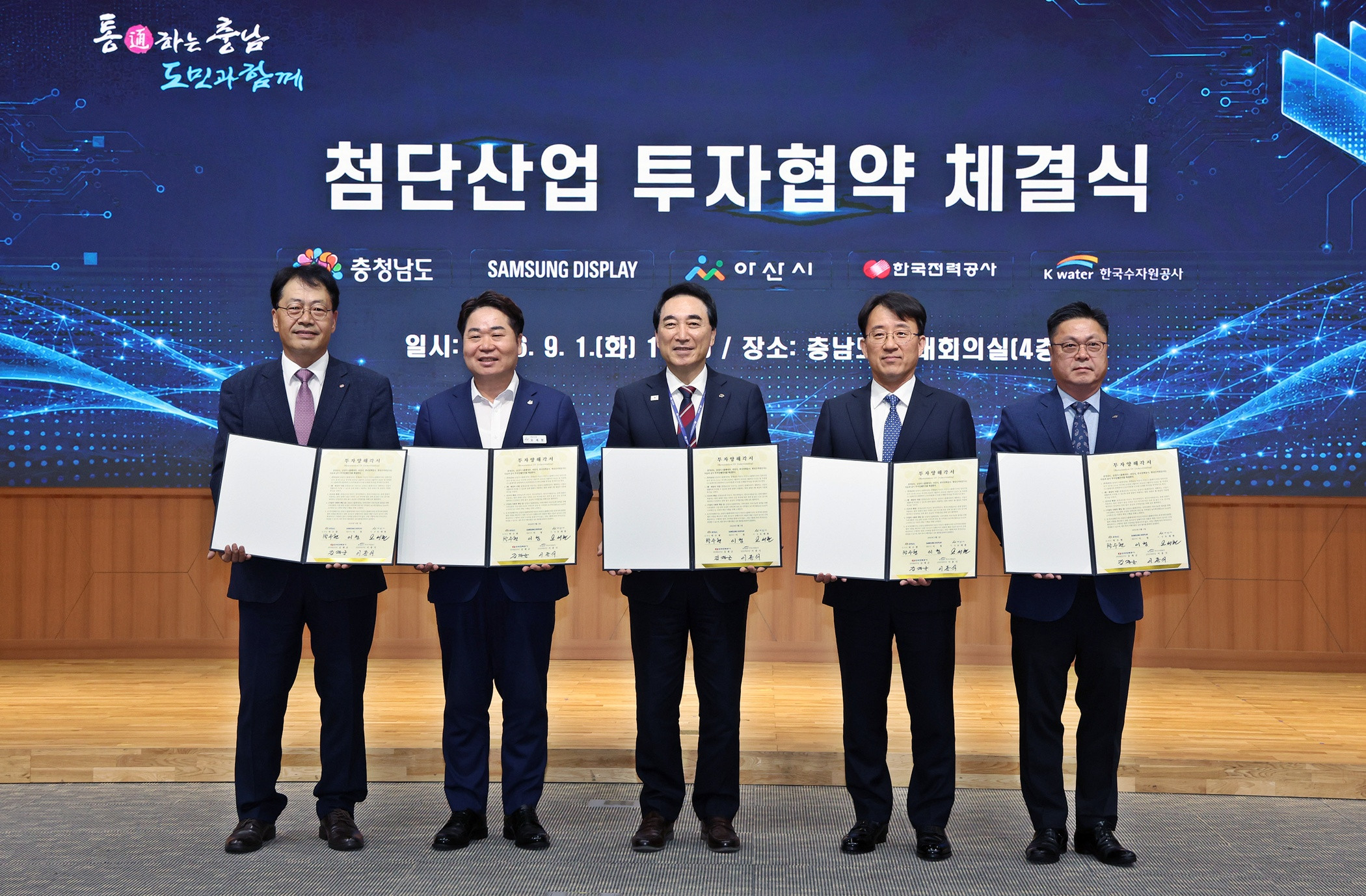
The announcement came through a multilateral MOU signed Tuesday morning at the Chungnam provincial office, bringing together Samsung Display, the provincial government, Asan city, Korea Electric Power Corporation (KEPCO), and Korea Water Resources Corporation. This is not a typical investor-government handshake. The inclusion of KEPCO and K-water as signatories signals something unusual: Samsung is treating power and water access not as background utilities but as strategic inputs worth locking in at the highest institutional level.
Why Chungnam, and why now
Samsung Display has long anchored its operations in Pyeongtaek, south of Seoul. The Asan site represents a deliberate geographic shift — not the kind of move companies make lightly when they already have established facilities nearby. There are three reasons this matters.
First, Chungnam has been positioning itself as a regional alternative to the capital area, and Samsung’s arrival legitimizes that play. The provincial government has already created a dedicated task force under Vice Governor leadership, complete with hotlines to Samsung, assigned civil servants, and expedited permitting. Governor Park Su-hyun called the investment a “signal flare” for Chungnam’s advanced industry ambitions. That framing is not accidental — it is designed to attract follow-on investment from material suppliers, equipment makers, and component manufacturers who would otherwise cluster around Pyeongtaek or Seoul.
Second, the July government announcement of a 202 trillion won advanced industry investment plan for the Chungnam region makes Samsung’s 67 trillion won commitment the anchor around which the rest will orbit. Samsung Electronics, Samsung SDI, and SK are all reportedly planning additional investments in the region. Samsung Display’s move is the first concrete execution of that broader policy, and the sequencing tells you something: Samsung is betting that Chungnam can deliver the infrastructure — especially stable, high-capacity power and water — that its OLED fabs require.
Third, and perhaps most important, the timing aligns with intensifying competitive pressure from Chinese manufacturers. BOE, CSOT, and TCL’s华星光电 have been aggressively expanding OLED capacity, particularly for smartphone and mid-size displays. China’s state-backed financing model allows these companies to price below cost for extended periods and absorb losses that Samsung would struggle to justify on pure commercial grounds. Samsung’s Chungnam bet is, in effect, a capacity consolidation move — doubling down on areas where it still holds a technology edge while building a modernized, more efficient base that can compete on cost without sacrificing yield.
The infrastructure angle nobody is talking about
The MOU’s inclusion of KEPCO and K-water deserves more attention than it is getting. OLED manufacturing is extremely power-intensive. The deposition processes, annealing ovens, and clean room requirements mean that a single Gen-8.5 OLED line can consume as much electricity as a small city. For Samsung’s investment to work, it needs reliable, high-volume power — not the kind of service you get from a standard industrial zone contract.
KEPCO’s participation as a signatory means Samsung has effectively secured a priority relationship with the utility. That is valuable. Korea’s industrial power demand has been tightening in recent years, and there have been localized concerns about grid capacity for new fabs. K-water’s involvement addresses the water side — OLED production requires ultra-pure water at scale, and Chungnam’s proximity to the Geum River basin gives K-water a logistical advantage over competing regions.
This is the unglamorous backbone of the investment story. The press releases focus on the trillion won figures and the LED terminology. The real lock-in happened in the signing of those two utility agreements.
Who wins and who loses
Inside Korea, the winner is Chungnam. The region has long struggled with economic dependence on heavy industry and face a brain drain toward Seoul. Samsung’s arrival changes the calculus for skilled workers, suppliers, and municipal governments. The provincial government is explicitly planning to use this investment to attract upstream material and equipment companies, creating a cluster effect that could outlast Samsung’s own operational timeline.
Samsung Display itself is the second winner, at least in strategic terms. The new Asan facility will likely incorporate more automation and newer process technologies than its existing Pyeongtaek lines, which have been operating for years. Consolidating capacity in a purpose-built environment gives Samsung an efficiency advantage that older facilities cannot easily match.
Chinese OLED manufacturers are the implicit losers, or at least the competitive threat that makes this investment necessary. If Samsung can bring per-unit costs down through scale and efficiency in Chungnam, the pricing pressure on BOE and CSOT increases — particularly in the smartphone OLED segment where margins are already thin.
Regional competitors within Korea are the other potential losers. Gumi, Jeongeup, and other industrial cities that were courting Samsung or competing for the same supply chain companies will now face a taller order. Chungnam has locked in the flagship investor and the utility relationships that come with it.
What happens next
The first phase — 99,141 square meters at Display City 2 in Asan — breaks ground with a 2028 deadline. That is an aggressive timeline for a facility of this type. Delays are possible, particularly if KEPCO’s grid expansion commitments face regulatory or construction bottlenecks. But the MOU structure, with multiple institutions binding themselves to the project, suggests Samsung is serious about enforcing timelines.
The more interesting question is what follows the first phase. Samsung has committed to phased investment across the Chungnam base. If the 2028 line performs well, the second and third phases will likely target higher-generation OLED platforms — possibly flexible displays, foldable panel lines, or even micro-LED production that Samsung has been developing in parallel. The provincial government’s language about “next-generation display industry” and “superior competitiveness” implies they are already thinking past smartphone OLEDs.
What is less clear is whether the supply chain spillover will match Samsung’s ambitions. Chungnam’s existing industrial base is weaker than Pyeongtaek’s in terms of material supplier density. Pulling equipment and component manufacturers into the region will require sustained government incentives and enough margin improvement on Samsung’s part to justify the relocation costs for suppliers.
The 202 trillion won regional investment plan announced in July is a policy framework, not a guarantee. Samsung’s 67 trillion won commitment is the largest single piece, but the rest depends on Samsung Electronics, Samsung SDI, and SK following through — and on conditions that may shift if OLED market dynamics change faster than expected.
The underlying signal
Samsung’s Chungnam bet is not just about displays. It is about demonstrating that Korea can still win large-scale advanced manufacturing investments against Chinese state-backed competition, that regional development outside Seoul is viable, and that utility relationships — power, water, grid access — are as strategic as IP and fab design. The MOU structure with KEPCO and K-water is the most underreported part of this story, and it may ultimately be the most consequential.
If the Asan facility comes online on time and at expected yield levels, Samsung buys itself a cost and efficiency advantage that Chinese competitors will struggle to close in the near term. If it stumbles — and large fab projects always carry execution risk — the investment becomes a cautionary tale about overcommitment in a maturing market.
Either way, the 67 trillion won number is only the beginning of what this story will become.