Samsung's DRAM Dominance Is Fueling a Global Chip Inflation Crisis
Samsung just widened its lead over SK Hynix in the DRAM market by nearly 4 percentage points in a single quarter, capturing the full force of a 57% market surge. The shift is creating 'chipflation' pressures that will ripple through every electronics supply chain for years.
Samsung Just Won a Quiet War — and Chip Prices Prove It
The global DRAM market grew 57% in the second quarter of 2026, a surge driven by AI server demand and a sharp rebound in general-purpose memory pricing. But the headline number conceals a deeper story: Samsung Electronics absorbed virtually all of that growth intact, while its nearest Korean rival, SK Hynix, ceded ground to American and Chinese competitors it can no longer afford to ignore.
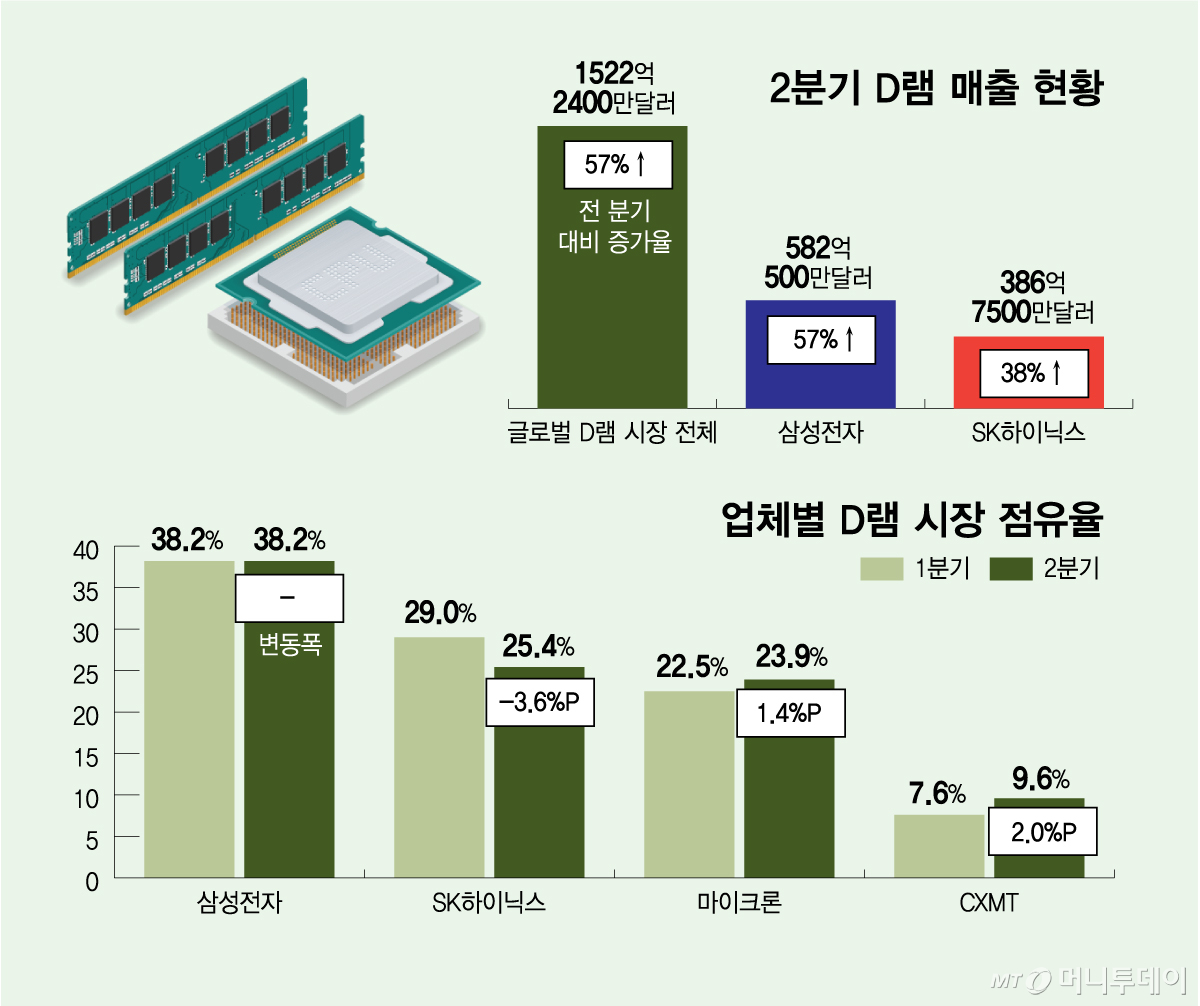
According to Counterpoint Research, global DRAM market revenue reached $152.24 billion in Q2, up from roughly $95 billion in the previous quarter. Samsung’s DRAM segment alone brought in $58.05 billion, a 57% increase that maintained its market share at 38.2%. That consistency is the real accomplishment. When a market expands by more than half in a single quarter, staying flat in share means you grew faster than the market. Samsung did exactly that.
SK Hynix, by contrast, posted $38.68 billion in DRAM revenue — up 38%, well below the market’s pace. Its share slipped from 29% to 25.4%, a 3.6 percentage-point loss in one quarter. The gap between the two Korean giants widened from 9.2 percentage points in Q1 to 12.8 percentage points in Q2, a dramatic reversal from a year earlier when SK Hynix led Samsung by 6.2 points.
The HBM Trap
The mechanics of this shift are specific and revealing. SK Hynix’s trouble did not come from a lack of demand — it came from the structure of its revenue mix and the timing of its contracts.
SK Hynix had long bet its DRAM growth on HBM, the high-bandwidth memory that powers AI training and inference chips. HBM commands premium pricing, and SK Hynix was the first to ship HBM3E in volume. But two forces are working against it right now. First, HBM3E prices are softening as supply catches up with demand. Second, the rollout of HBM4 has been delayed, removing a near-term pricing catalyst that analysts had counted on.
General-purpose DRAM, meanwhile, has seen prices surge because AI servers require far more conventional memory per unit than prior architectures. A single AI server CPU loadout today may specify 12 to 16 channels of DDR5, pulling demand well beyond historical norms. Samsung, with its broader base in standard DRAM and its ability to scale output quickly, captured this price surge directly. SK Hynix did not.
Compounding the problem, SK Hynix had signed long-term agreements (LTAs) with customers at prices set before the current surge. Those contracts locked in revenue at rates well below spot market prices, meaning the company could not pass the price increase through to its bottom line. Samsung, which structured a larger portion of its supply without such constraints, reflected the full price movement in its quarterly numbers.
Who Gained SK Hynix’s Share?
The market did not simply reward Samsung. Two other players expanded at SK Hynix’s expense.
Micron’s share rose from 22.5% to 23.9%, a gain of 1.4 percentage points. The American memory maker has been investing heavily in process upgrades at its Idaho and New York fabs, and its capacity expansion strategy is finally yielding results in a market where every percentage point of supply matters. SK Hynix lost 3.6 points; Micron took 1.4. The math is undeniable.
The more surprising winner is Changxin Memory Technologies (CXMT), China’s leading domestic DRAM producer. CXMT’s share climbed from 7.6% to 9.6%, a gain of 2 percentage points. In a market dominated by Korean and American firms, a Chinese player gaining 2 points of global share in a single quarter is unusual. It signals that CXMT has moved beyond trial production into meaningful volume, and that customers are willing to qualify Chinese memory for non-critical applications even amid geopolitical friction.
Together, Micron and CXMT accounted for nearly all of SK Hynix’s 3.6-point decline. The remainder belongs to Samsung’s incremental gains and residual market consolidation.
The Chipflation Cycle Has Just Begun
The implications extend far beyond Samsung and SK Hynix. What economists sometimes call “chipflation” — the pass-through of semiconductor price increases into end-product costs — is accelerating, and it will affect consumers across multiple categories through at least 2027.
General-purpose DRAM prices have already risen sharply. The trend is not self-correcting. AI server deployments are scaling globally, and each new data center adds to baseline memory demand. Consumer electronics manufacturers — smartphone makers, PC assemblers, automotive electronics suppliers — are bidding against each other for a finite supply of standard DRAM. The result is upward pressure on device costs that will show up in retail prices within two to three quarters.
Smartphone margins, already thin in many segments, face renewed compression. PC manufacturers are watching memory costs with particular alarm; the average PC contains significantly more DRAM than it did five years ago, and that density trend is accelerating with the adoption of LPDDR5X in flagship devices. Automotive electronics, which typically lock in memory supply through multi-year contracts, are now renegotiating at higher rates — a signal that even the most insulated sectors are feeling the squeeze.
Samsung’s dominance in general-purpose DRAM gives it pricing power that will likely persist through at least the next two quarters. Industry sources told Money Today they expect another round of general DRAM price increases in Q3, which would further widen Samsung’s revenue advantage. Whether that advantage translates into sustained margin expansion depends on Samsung’s own capital spending discipline, but the revenue gap with SK Hynix appears structurally entrenched for now.
SK Hynix’s Path Back
SK Hynix is not without options. Its LTA portfolio will roll off contract prices over the coming quarters, and renewed agreements at higher spot rates could restore some of the revenue growth it lost in Q2. HBM4, once it ships, may reassert SK Hynix’s premium positioning — though competitors are already working to close the performance gap. And the company continues to invest in process technology that could shift the cost curve in its favor.
But the window is narrow. Samsung’s capacity advantage in general DRAM is real and currently unreinforced by a comparable counter-strategy from SK Hynix. The Korean memory sector’s dual-lead model, which has historically kept both companies competitive, is showing strain. If Samsung extends its share lead beyond 40% — a threshold not far from its current 38.2% — the competitive dynamics shift in ways that favor larger players and penalize niche strategies.
For the global electronics industry, the takeaway is straightforward: chip prices are not coming down. The architecture of AI computing demands more memory per node, and the suppliers best positioned to deliver it are consolidating their advantage. Consumers may not notice the difference in a single product, but the compounding effect across every device — from phones to cars to cloud infrastructure — will be felt in wallets and balance sheets alike.
The DRAM market grew 57% in a quarter. Samsung grew with it. The rest of the world is still adjusting to the bill.