Samsung, SK Hynix Return 90 Trillion Won to Shareholders—What It Really Signals
Samsung and SK Hynix are committing to nearly 200 trillion won in shareholder returns over three years while betting heavily on AI memory chips. The scale is staggering—but so is the ambiguity about what comes next for Korea's chip giants.
The Number That Changes Everything
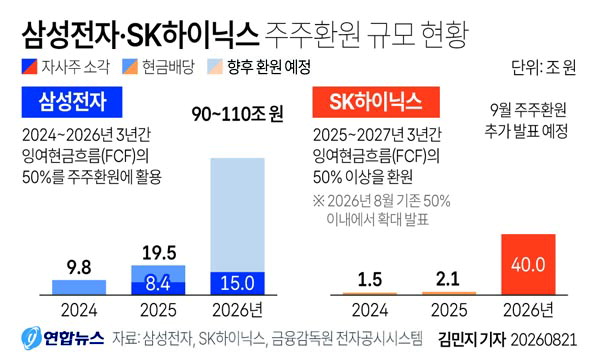
Samsung Electronics approved a shareholder return plan of 90 trillion to 110 trillion won for 2026. On its own, that’s enormous—roughly five times the company’s previous record of 20.3 trillion won in 2020. But placed alongside SK Hynix’s parallel commitments, it tells a story that goes well beyond Korean corporate governance trends.
This is not ordinary capital return. It is a statement about what these two companies think is coming.
Three Years, 120 Trillion Won
Samsung has already returned 19.6 trillion won through regular dividends across 2024 and 2025—9.8 trillion each year. In 2025, it added a 1.3 trillion won special dividend and 8.4 trillion won in share buybacks and cancellations. The 2026 plan, still subject to an October board approval, pushes the three-year total to an estimated 120 trillion to 140 trillion won.
The mechanism is specific: Samsung pledged to allocate 50 percent of free cash flow to shareholder returns from 2024 through 2026. That is not a vague promise. It is a contractual ceiling built into the company’s capital allocation framework. Roughly 30 trillion won of this comes through cash dividends in the third quarter alone, with the remainder decided in January 2027 based on that year’s operating results.
SK Hynix has not published identical figures in the available reporting, but its board has approved a comparable shareholder return program, signaling that the two Korean memory giants are moving in lockstep. The synchronicity matters. When two competitors move together on capital allocation, it suggests shared expectations about the industry’s trajectory—whether those expectations prove correct or not.
The Real Question: Why Now?
Here is where the narrative fractures. A massive shareholder return plan can mean one of two things.
First, it signals extreme confidence: the company expects AI-driven memory chip profits to remain elevated for years, and it wants to reward investors while still funding aggressive capital expenditure on next-generation HBM production. Samsung and SK Hynix are both racing to qualify their latest high-bandwidth memory processes for Nvidia’s Rubins and AMD’s MI400, which were showcased at Hot Chips 2026 this week. Meta, Microsoft, Google, and OpenAI also unveiled custom chip roadmaps at the same event. The demand side is real and growing.
Second, it signals caution: the company expects the current memory supercycle to peak soon, and it wants to return cash to shareholders before earnings compress. Memory chips are famously cyclical. The last time HBM demand approached these levels, the industry surprised on the upside—but it also surprised on the downside when server demand softened in prior cycles. The danger is that shareholder returns committed today become impossible to honor tomorrow if margins collapse.
Samsung’s leadership has not publicly chosen between these two interpretations. That silence is itself meaningful. It leaves room for the market to project its own assumptions onto the commitment.
Second-Order Effects Nobody Is Discussing
The implications of these return plans extend well beyond Samsung and SK Hynix’s balance sheets. Consider what happens if the memory cycle turns down faster than expected. A company that has contractually committed to returning 50 percent of free cash flow faces a terrible choice: default on its promise and crater investor confidence, or cut capital expenditure and fall behind in the HBM race. Either outcome weakens the company’s competitive position.
There is also a capital allocation distortion at play. Samsung’s total capex for 2025 is expected to exceed 100 trillion won—another record. The company is simultaneously spending aggressively on capacity expansion and committing aggressively to shareholder returns. This dual posture only works if margins hold. If they don’t, the company finds itself trying to do both things with less money, and both will suffer.
SK Hynix faces a similar tension but with an added complication. The company has been more transparent about its HBM technology roadmap than Samsung, and that transparency creates an expectation gap. If Samsung’s returns signal confidence while SK Hynix’s technology execution lags, the market will punish the gap. Conversely, if SK Hynix outperforms on HBM qualification while Samsung stumbles, Samsung’s return commitments could look foolishly optimistic.
What the Market Is Pricing In
The KOSPI has been tugged between geopolitical friction—the stalled US-Iran truce extension and rising long-term yields across major economies—and the gravitational pull of Korean semiconductors. Recent sessions showed the index absorbing the macro shocks but recovering ground on shareholder return optimism. It is a fragile equilibrium.
NH Investment & Securities analyst Na Jeong-hwan noted that the primary headwinds constraining the KOSPI—long-term Treasury yield volatility and uncertain corporate capital returns—have largely dissipated. The remaining catalysts are Nvidia’s earnings later this week and Fed Chair Jerome Powell’s speech at Jackson Hole on August 28–29. If Nvidia validates the AI cycle and Jackson Hole calms bond market anxiety, Na expects valuation normalization to accelerate.
But normalization for whom? The KOSPI as a whole benefits only if Samsung and SK Hynix can sustain their earnings trajectory. If memory prices soften in 2027—as they did after the 2021–2022 cycle peak—the shareholder return commitments could become a liability rather than a lifeline. The index has effectively become a leveraged bet on memory chip pricing, and that concentration risk is underpriced by most participants.
The Global Supply Chain Angle
English-language coverage often treats Samsung and SK Hynix as Korean stories. They are not. These two companies control the vast majority of the world’s HBM supply, and HBM is the bottleneck constraint on every major AI accelerator being shipped today. Nvidia cannot scale Rubin without HBM. AMD cannot scale MI400 without it. Even Google’s and Meta’s custom silicon depends on it.
A 90-to-110-trillion-won return commitment from Samsung is a signal about how much excess cash the company expects to generate from this bottleneck position. If the company believed HBM margins would erode quickly, it would conserve cash for capex flexibility or debt reduction. Instead, it is committing to distribute it.
That commitment has implications beyond Seoul. Global AI infrastructure builders—whoever relies on HBM supply from Korea—should read this as management signaling confidence in sustained demand through at least 2026. But confidence is not a supply contract. If those same builders find alternative memory sources or if Samsung and SK Hynix fail to meet qualification timelines, the demand confidence could evaporate faster than the cash commitments can be reversed.
What Happens Next
Three things to watch in the coming weeks.
Nvidia’s earnings on August 26 will be the first real test. If the company guides for continued HBM demand growth, Samsung and SK Hynix shareholders will see validation. If guidance softens, the shareholder return story loses its foundation. The market will immediately start repricing the sustainability of those commitments.
The October board meeting will fix Samsung’s 2026 return details—cash dividend size, buyback amount, and cancellation schedule. That is when the abstract commitment becomes concrete. Investors who have been pricing in confidence should pay close attention to whether the final numbers match the range or land at the lower bound.
Jackson Hole will set the macro backdrop. Lower Treasury yields would lift KOSPI valuations broadly. Higher yields would penalize even strong corporate performers. The interplay between micro confidence (shareholder returns) and macro uncertainty (yields, geopolitics) will determine whether this story ends as a validation of Korea’s semiconductor dominance or as a cautionary tale about cyclical overreach.
The shareholder return numbers are now locked in policy. The earnings that justify them are still unwritten. Whatever writes them will define whether these commitments look like prescience or desperation.