Seoul's 2.3 Trillion Won Bet to Race China in Humanoid Robots
South Korea is becoming its own first customer for domestic humanoid robots, committing 2.3 trillion won by 2030 to buy over 1,000 machines and force local supply chains. The move is as much about cutting dependency on Chinese hardware as it is about winning the next industrial cycle.
South Korea is buying robots so it stops needing anyone else to build them
For years, some of South Korea’s top universities have been doing their robotics research on Chinese-built humanoid machines. That dependence was not lost on officials in Seoul. It is exactly why the government has decided to become the first buyer of homegrown humanoid robots, committing 2.3 trillion won ($1.7 billion) through 2030 to create a domestic ecosystem from scratch.
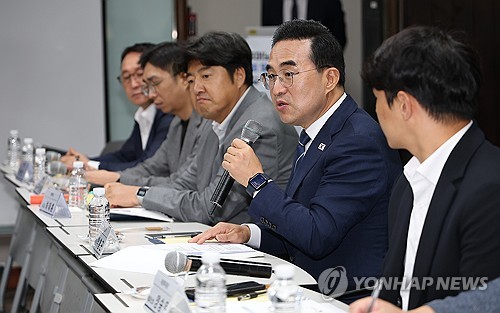
The plan, announced by the Ministry of Economy and Finance on August 27 during its second fiscal operations strategy council, reads like a textbook industrial-policy play. But what makes it notable is the speed and the specificity. Park Hong-geun, the ministry’s minister, framed the government as the initial demand anchor — a role typically reserved for defense contracts or healthcare systems, not for unproven humanoid platforms.
Next year, the government will purchase 250 units. By 2030, that figure rises to 1,080 domestic humanoid robots, all mandated to use locally produced parts and software. Universities and national research institutions will receive them. If quadruped and other non-humanoid robots are included, total government procurement climbs to roughly 1,700 machines by 2027 and about 5,000 by decade’s end.
The localization angle: why 80 percent matters
The most consequential number in the plan is not the spending figure but the localization target. South Korea currently sources only about 45 percent of the core components used in humanoid robots. The government wants to push that to 80 percent by 2030.
That shift matters for reasons that go beyond national pride. Humanoid robots require high-density actuators, precision reducers, torque sensors, and advanced battery systems — components that overlap significantly with the supply chains powering South Korea’s dominant semiconductor and display industries. Forcing localization means those industries get a new, high-value outlet for their output. It also means reducing exposure to geopolitical supply disruptions, particularly from China, which already supplies affordable humanoid robot platforms to Korean labs at scale.
The 35-percentage-point gap between current and target localization is enormous. It signals that the government knows the supply chain does not yet exist and is using guaranteed government demand to force its creation.
A staged rollout that mirrors market reality
The deployment schedule reveals how seriously Seoul is treating the problem of practical readiness. Development begins in 2028 with humanoid robots designed for controlled manufacturing and logistics environments — the lowest-hanging fruit. By 2030, the scope expands to outdoor and unstructured settings. Only by 2035 does the plan target household chores and eldercare, the applications that will ultimately drive mass-market demand.
This sequencing is deliberate. It acknowledges that building a robot that can navigate a factory floor is orders of magnitude easier than one that can fold laundry or care for an elderly person. Other countries, particularly Japan and China, are simultaneously racing toward the same consumer applications. South Korea’s strategy is to secure industrial use cases first, build a supply chain, and only then compete for the more lucrative consumer market.
Physical AI and the data moat
Perhaps the less visible but potentially more important part of the plan is the mandate to consolidate fragmented government data on manufacturing and physical AI into a single national library. Currently, ministries operate in silos, each collecting different datasets with limited interoperability. A unified repository could accelerate training for the physical AI models that will run these robots.
The government also aims to train approximately 20,000 workers in manufacturing AI transformation and physical AI skills by 2030, with demonstration projects planned across eight sectors — autonomous manufacturing, small and medium manufacturing, agriculture, construction, logistics, ports, eldercare, and defense. More than 500 on-site demonstrations are expected next year alone.
This is a data strategy as much as a robotics strategy. The companies that control high-quality physical-world datasets will have a decisive edge in training the next generation of embodied AI systems. Korea’s move to centralize data could either accelerate domestic development or entrench existing chaebol dominance, depending on how access is governed.
What this means for the global race
China currently leads in affordable humanoid robot production, and its companies have a cost advantage that no government subsidy easily erases. The U.S. is investing heavily in general-purpose humanoid platforms through private capital — figures like Tesla’s Optimus and figures from Figure, Apptronik, and others — betting on software abundance rather than hardware localization. South Korea is taking a third path: using state procurement to build a domestic hardware supply chain while leveraging its strengths in semiconductors, batteries, and precision manufacturing.
The bet is that by anchoring demand through government purchases, Korea can create enough volume to justify the supply-chain investment, reach cost parity, and eventually export. If successful, it could redirect a meaningful portion of the global humanoid robot supply chain toward Korean components. If it fails, the country will have spent 2.3 trillion won on machines it could have imported cheaper.
The timing is also critical. With the global humanoid robot market still in its early stages and no dominant standard yet established, a coordinated national push like this could shape not just Korea’s position but the architecture of the industry itself. The question is whether 1,080 robots is enough to move the needle — or whether it is simply a signal that Seoul is serious about not being left behind.
The 2.3 trillion won commitment suggests the latter. What remains to be seen is whether the supply chain can actually deliver.