Serbia's Student Ouster of Vucic Reshapes the Balkans
Aleksandar Vucic's concession to a youth-led movement marks the end of 14 years of authoritarian rule in Serbia and signals a decisive regional pivot toward Europe. Here's what the shift means for the Western Balkans and beyond.
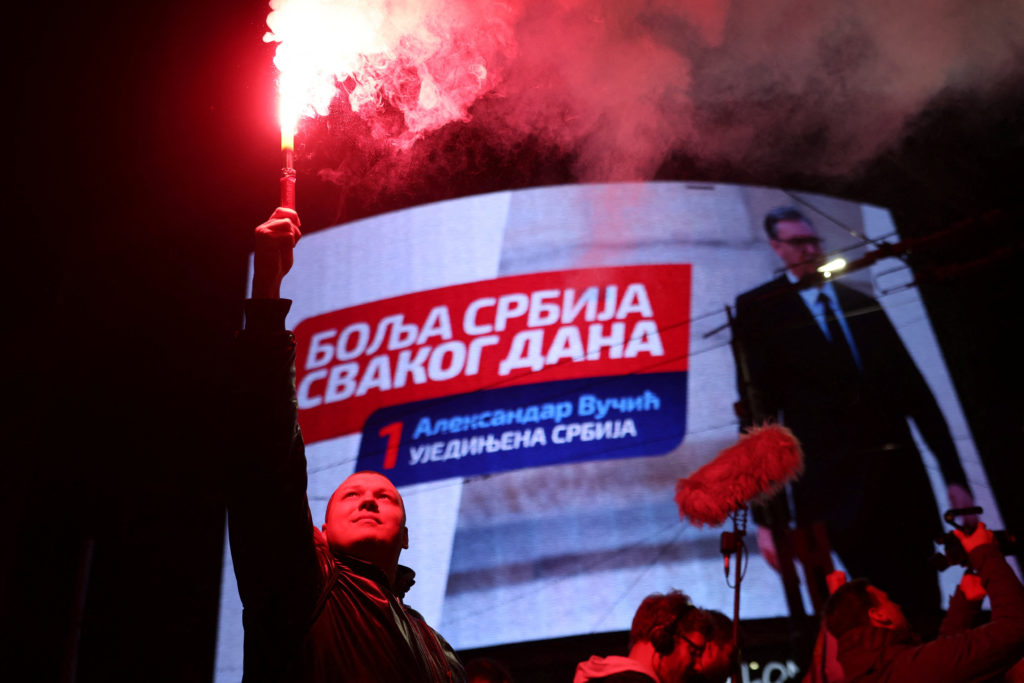
A movement of students just ended 14 years of Serbian strongman rule. Here’s why that matters far beyond Belgrade.
Aleksandar Vucic conceded defeat Sunday, ending more than a decade of near-absolute power in Serbia. The man Putin once endorsed as a reliable Balkan partner lost to a coalition of university students who spent two years marching through his streets and rural heartlands.
The result is more than a domestic political upset. It is the most consequential realignment in the Western Balkans in decades — one that pulls Serbia away from Moscow and accelerates its trajectory toward Brussels.
How a train station collapse became a revolution
Vucic’s decline did not begin with ideology. It began with concrete.
In 2024, a canopy collapsed at a train station in Novi Sad, killing 16 people. The tragedy exposed decades of cutting corners, crony contracts, and graft in public works. What followed was a wave of youth-led protests that refused to dissipate.
Dijana Hrka, mother of one of the victims, stood in Belgrade’s celebration crowds Sunday. “I have been waiting for this moment for two years,” she told N1 television. “Now I expect that they will all be held accountable.”
The protests transformed into something Vucic could not easily dismiss: a political movement. The Students’ List formed, not as a traditional party but as a coalition of unknown experts, athletes, farmers, and artists. Not a single university student appeared on its electoral list — a deliberate choice to signal that this was bigger than campus politics.
They cycled and walked through Vucic’s traditional rural strongholds, bypassing state-controlled media to reach voters directly. The strategy worked.
The numbers tell the story
Vucic’s Serbian Progressive Party (SNS) won approximately 1.7 million votes, according to his own concession remarks. The Students’ List took around 2.2 million — a clear parliamentary majority.
Turnout reached roughly 70 percent, the highest in Serbia since 2000. Long queues formed at polling stations across the country and in Serbian diaspora communities worldwide. Some diaspora voters reported being forced to cast ballots in the middle of the night after authorities tied voting hours to local Serbian time rather than host-country clocks.
Independent monitors documented dozens of irregularities — ballot photography suggesting voter intimidation, attempted vote buying, and a campaign marked by detentions, surveillance, and cyberattacks against activists. The European Union, watching closely as a candidate nation, has yet to certify the results.
But the direction is unambiguous. Vucic announced the concession just 90 minutes after polls closed.
What Vucic blamed — and what it reveals
In his concession speech, Vucic did not credit his opponents. He pointed to independent media and alleged interference by unnamed European countries and what he called an “American deep state.”
The rhetoric is familiar territory for a leader who spent 14 years weaving a narrative of external threats. It is also a blueprint for what comes next: even in defeat, Vucic retains significant institutional support and a loyal voter base that viewed him as a stabilizing force amid global uncertainty.
SNS projects it will hold around 105 of the 250 parliamentary seats. That is enough to make noise, file lawsuits, and complicate any transition. The Students’ List needs between 135 and 140 seats for a governing majority — and those numbers are still projections.
Why this echoes across Europe
Serbia’s outcome mirrors Hungary, where youth participation helped unseat Viktor Orbán after 16 years and install a pro-European government. The pattern is spreading: frustrated young voters in authoritarian-adjacent states are organizing outside traditional party structures and winning.
But Serbia is strategically different from Hungary. It is not yet in the EU. It is a candidate country navigating the delicate balance between Russian influence and European integration. For 14 years, Vucic played both sides — accepting Russian goodwill while pursuing EU accession talks that stalled repeatedly.
That dual alignment is now ending. A student-led government will face immediate pressure to accelerate reforms, clean up the corruption that triggered the original protests, and commit credibly to Brussels.
Who wins, who loses
The winners: Young voters who turned grief into political action. Serbia’s diaspora, many of whom felt silenced by time-zone manipulation. EU institutions looking for a democratic foothold in a restless region. Ukraine and other Eastern European nations watching Russian influence recede mile by mile.
The losers: Vucic’s network of cronies who built fortunes on public contracts. Russian diplomats who counted on a friendly Balkan partner. Serbians who benefitted from the stability-authority bargain, however uneasy.
The uncertain: Kosovo, whose status dispute with Serbia will now face a government with no clear position inherited from Vucic. Bosnia and Herzegovina, where Serbian political representatives may face pressure to moderate. Montenegro and North Macedonia, watching a neighbor transform overnight.
What happens next
The immediate question is whether the Students’ List can form a stable government. Coalition politics in Serbia are fractured. The movement’s strength came from protest energy, not legislative experience. Governing requires building alliances with parties that may not share its reform agenda.
There is also the legal dimension. Vucic’s team has already signaled it will challenge results. Serbian courts will decide whether irregularities are sufficient to overturn the outcome — or whether the margin is too large to ignore.
On the international stage, the EU will move quickly. Candidate nations that deliver free elections get rewarded; those that do not get stalled. Brussels has every incentive to recognize the result and fast-track accession negotiations.
Russia will react carefully. Open hostility toward a newly elected Serbian government would isolate Moscow further in the region. Quiet outreach through economic levers — energy, investment, media — is more likely.
The deeper significance
Serbia’s student movement did not win because of foreign funding or elite plotting, as Vucic claimed. It won because a generation refused to accept that corruption was permanent, that authoritarianism was inevitable, and that their voices did not matter.
The fences and tents Vucic’s loyalists maintained in central Belgrade for over a year — a physical manifestation of his grip on public space — were dismantled Sunday. One was set on fire.
It was a symbol. The strongman is gone. What replaces him is still unwritten.